Science Units as Jewelry: Who Is This Wave of 'Nerdy Romance' Meant to Move?

Turning standard units like 10 grams and a half-second pendulum into wearable charms that sell science and belonging.
This article introduces a set of "standard scientific unit charms" that turn abstract measures—a 10-gram mass, 10-kilocalorie sucrose, a half-second pendulum, a square centimeter—into wearable, touchable objects. Rather than utility, the product sells ritual built on humanity's fragile consensus. The area charm is the most educational; the half-second pendulum puts a time standard on your wrist via the pendulum period formula. A Black Friday "legacy box" gift hooks subscribers. The article argues such knowledge merch really sells identity and belonging, grounded in embodied cognition—an undervalued path for science communication and education products.
When Measurement Units Become Wearable Objects
"Is your Bible stuffed with tape measures? Do you own three unabridged editions of Webster's? Are you sick of all those weird units?"
This opening comes from a creative product promo video on YouTube, pitching a line of standard scientific unit charms. The selling point is straightforward: turn abstract weights and measures into tangible objects you can carry with you and touch.
For instance, if people keep asking you "how much is a gram, really," you can flash your随身 10-gram reference mass. If you feel your sense of time slipping away, a half-second pendulum charm can "anchor you back to consensus"—two periods equal one second, one second, two seconds, three seconds, and the rhythm sits right on your wrist.
The core logic of this product isn't utility—it's turning the fragile consensus of human collaborative knowledge into a wearable sense of ritual. The original line "Why touch grass when you can touch the fragile agreements that make cooperative knowledge possible?" is practically the value manifesto of the whole video.
Which "Units" Can You Actually Wear
Mass and Calories: 10 Grams and 10 Kilocalories
The two most direct pieces are a 10-gram reference mass and a 10-kilocalorie sucrose reference object. The former solves the "how heavy is a gram" bodily-feedback problem; the latter turns "calories" from a concept in your head into a small physical object worn close to your heart. The original calls it "right next to your heart," turning a nutrition unit into an emotional object.
"Kilocalorie" (kcal, also called the large calorie) is the most commonly used energy unit in nutrition; 1 kcal equals the heat needed to raise 1 kilogram of water by 1 degree Celsius. 10 kcal is roughly the energy released by fully oxidizing 2.5 grams of sucrose, and since 1 gram of sucrose contains about 4 kcal, the "10-kilocalorie sucrose reference object" corresponds to a physical mass of about 2.5 grams. Notably, the "calories" on food packaging are actually all kilocalories. Turning 10 kcal into a worn object is essentially using a small piece of sugar's mass to build a touchable reference for "energy," a physical quantity that's hard to intuitively grasp.
Time: The Half-Second Pendulum
The half-second pendulum charm is the cleverest piece in the set. The period formula of a simple pendulum makes it a natural time standard: two periods equal exactly one second. By swinging it, the wearer can recalibrate their perception of "one second" through bodily rhythm.
The period formula for a simple pendulum is ( T = 2\pi\sqrt{L/g} ), where ( L ) is the pendulum length and ( g ) is gravitational acceleration. For the period to be exactly half a second, the pendulum length needs to be about 6.2 centimeters (under Earth-surface conditions ( g \approx 9.8,\text{m/s}^2 )). That is, two full swings (one round trip) take exactly one second—the physical basis for the "two periods equal one second" claim. Historically, pendulum clocks used exactly this principle to measure time: Huygens designed the first pendulum clock on this basis in the 17th century. The half-second pendulum charm turns this formula into a touchable object—its length isn't arbitrary but locked in by physical law.
Area: Square Centimeters Nested in Square Inches
Area units become touchable thin plates: the outer frame is one square inch, and the punched hole inset within is one square centimeter. You can feel the size difference between the two with your fingers at any time.
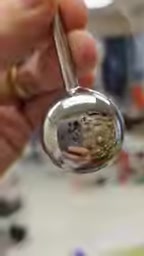
This is actually the most "teaching-oriented" piece in the whole set—it turns unit conversion from a formula on paper into a tactile comparison.
Temperature: Silhouettes of Cold-Blooded and Warm-Blooded Animals
There's also a piece of clothing with animal silhouettes, using dark and light projections on the skin to express the concept of temperature, so that when you lie in the sun you can feel the difference of "warm-blooded and cold-blooded critters lying on you." The original puts it bluntly: "It's called touch, and I'm no stranger."

The Promo Mechanism and the "Legacy Box"
The video wraps up with a Black Friday promotion: choose the annual subscription plan and get a free legacy box containing six of their favorite historical inventions, including two dual-scale solar system stickers.

The legacy box also includes a non-standard unit ruler—but the original hastens to add "rest assured, it also has inches and centimeters," a concession to pragmatists.
This detail actually exposes the product's positioning tension: on one hand it jokes that "we had to cage the thrill, dissect it into shared units, and proudly wear its innards," while on the other it has to admit that standard units are the very premise that makes it possible.
Why This Kind of Product Is Worth Noticing
From a science-communication perspective, this set of charms hits a real pain point: units are abstract, and people lack bodily feedback for abstract numbers. 10 grams, 1 square centimeter, 1 second—these values appear repeatedly in textbooks but rarely get directly perceived by the body. Turning reference objects into accessories is essentially an attempt at "embodied cognition."
From a product-design perspective, it's a typical piece of knowledge merch: it doesn't solve practical problems; it sells identity and a sense of participation. The original lands on "show that you're part of humanity's collective intellectual journey," plus that slightly wistful closing line—"Love, money, and memories mean nothing if we're alone."
This reminds us that what science-communication products really sell is often not knowledge itself but belonging. When someone wears a 10-gram reference mass, they're not buying mass—they're buying the signal that "I stand with a group of people who care about precision."
For people making science content or educational products, the lesson of this case is: restoring weights and measures from symbols to sensory experience is a validated but far-from-fully-exploited path. Whether it ultimately becomes a refined scientific toy or just another form of consumerist packaging depends on how the user themselves views that half-second pendulum hanging from their keychain.
"Embodied cognition" is a theoretical orientation in cognitive science holding that human thinking and concept formation are not purely abstract symbolic computation but deeply depend on the body's sensations, movements, and spatial experience. Research has found that people's understanding of concepts like "heavy," "long," and "hot" is often built on their own bodily memories. Turning reference objects like the 10-gram mass and the half-second pendulum into wearable accessories is exactly an attempt to bring abstract measures back to the level of bodily experience—through repeated touching and swinging, the wearer converts values that once existed only in books into muscle memory and tactile impressions.
One-line Summary
Turning standard units like 10 grams and a half-second pendulum into wearable charms, selling science communication and belonging through bodily sensation.
Paragraph Summary
This article introduces a set of "standard scientific unit charms" that turn abstract measures—a 10-gram reference mass, 10-kilocalorie sucrose, a half-second pendulum, a square centimeter—into wearable, touchable objects. The product doesn't pursue utility but converts the fragile consensus formed by human collaboration into a sense of ritual. Among them, the area charm, with a square-inch frame enclosing a square centimeter, is the most educational; the half-second pendulum uses the simple pendulum period formula to wear a time standard on your wrist. The Black Friday promotion hooks customers with a "legacy box" gift for annual subscriptions. The article points out that what this kind of knowledge merch really sells is identity and belonging, underpinned by the idea of embodied cognition, offering an undervalued path for science communication and educational products.
Related articles
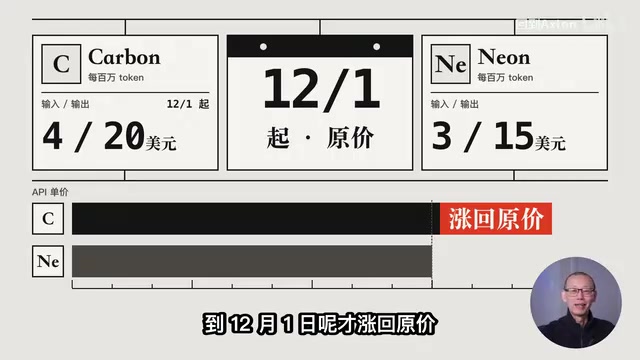
Deep Dive: Uncovering the Capabilities of the Entire Gemini 4 Model Family — Why Does the Default Tier Rank Last?
Double-blind testing of Gemini 4's four models — Argon, Carbon, Hydrogen, Neon — reveals why the default Neon High ranks last, how X High overtakes Carbon, and how Orchestrator sweeps 3-0, plus cost breakdown and four selection tips.

One Week with the Gemini 4 Family: Four Models Each Take a Crown on the Private Leaderboard, Carbon's Speed Polarizes
Bilibili creator tests the Gemini 4 family for a week: Neo, Argon, Carbon, and Hydrogen each top a private leaderboard, frontend aesthetics are weak, Carbon is strongest but slow.
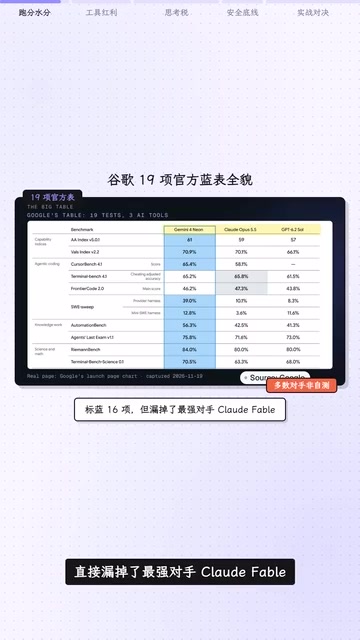
Is Gemini 4 Neon Really Better Than GPT-6.2 Sol? Breaking Down the Benchmarks
Google's Gemini 4 Neon won 16 of 19 official benchmarks, but independent testing and real-world bills reveal tool differences, thinking costs, and response speed that make GPT-6.2 Sol the better value.