Deep Dive: Uncovering the Capabilities of the Entire Gemini 4 Model Family — Why Does the Default Tier Rank Last?
Double-blind testing of Gemini 4: default tier fails; highest thinking tier and multi-model orchestration are the answer.
Based on a Bilibili creator's double-blind testing of the Gemini 4 series (Argon, Carbon, Hydrogen, Neon), the article maps their one-way lineage: Argon as the native sparse MoE base, Carbon forking for deep reasoning, and Hydrogen/Neon forking from Carbon. Three hard 3D tasks showed the default Neon High repeatedly ranking last, while X High took multiple firsts; Orchestrator swept the default tier 3-0. Carbon cost more than default Neon despite its promotion. Four selection tips conclude.
Google released four Gemini 4 series models in just over a month — Argon, Carbon, Hydrogen, and Neon — with naming so confusing it makes your head spin. To thoroughly understand the real capability boundaries of these four models, Bilibili creator "Axton" spent over ten hours running all six tiers through the same batch of high-difficulty tasks in a double-blind test. The results were highly counterintuitive: the default Neon pinned at the top of the official menu actually ranked last on several 3D generation tasks, yet with a single setting change it immediately overtook the top-tier Carbon and took first place.
This article is based on that testing material, covering the model relationships within the Gemini 4 family, capability performance, multi-model orchestration in practice, and the cost breakdown, concluding with four selection recommendations.
The Gemini 4 Family Tree: A Clear Line of Descent
Many people assume these four models were trained from different base models, and there's even a rumor that Neon is a lightweight variant of Hydrogen. But looking at DeepMind's four official technical cards, the truth is a single one-way lineage.
- Argon is the native sparse mixture-of-experts large base model launched on October 13 — the origin point of the entire family, not a fine-tune of an older model.
- Carbon builds on Argon for deep reasoning, released on November 10.
- Hydrogen and Neon both fork and adapt from the top-tier Carbon, launching on November 12 and November 18 respectively.
One detail worth noting: the official blog's family table on November 18 had already removed Argon, keeping only Carbon, Neon, and Hydrogen. Google's Gemini App menu was also replaced by Neon, and the dropdown menu in the AI coding tool AntiGravity lists the default Neon High at the very top, followed by the four single models and the multi-model Orchestrator.

Sparse Mixture of Experts (Sparse MoE) is a Transformer architecture variant: the model internally consists of multiple "expert" feed-forward sub-networks, and during each forward pass a gating network activates only a few of these experts rather than all parameters. This allows the total parameter count to be extremely large while keeping the compute cost per inference comparable to only the activated portion, balancing capacity and efficiency. Argon being called a "native sparse mixture-of-experts large base model" means it was designed with the MoE structure from the very first step of pre-training, rather than training a dense model first and retrofitting it. As a result, routing and expert specialization are more fully developed, providing the capacity foundation for subsequent forked models like Carbon and Neon.
Model forking refers to continued pre-training or targeted fine-tuning on existing base model weights to produce derivative models aimed at different scenarios. It differs from training from scratch: forked models inherit the parent model's language and reasoning capabilities and only need incremental optimization on target capabilities (such as deep reasoning or lightweighting), which is why release dates can be so tightly clustered. This also explains why Hydrogen and Neon could launch within days of Carbon's release while sharing substantial underlying capabilities.
Test Failures: Why Does Default Neon Rank Last?
3D Physics Task: Off-Road Vehicle Crossing a Speed Bump
The first task was an offline 3D physics challenge: write pure code to build an off-road vehicle driving over a speed bump, with focus on tire contact with the ground, suspension compression and rebound, and body dynamics. All six tiers produced suspension compression, but the quality differences were immediately apparent.
Ranked first was Neon X High with the highest thinking tier enabled, taking 24.7 minutes — over ten minutes faster than top-tier Carbon. It was the only one in the entire field to render the matte olive-green body's curved surfaces, wheel arches, and gold shock absorbers with a real-car feel, with no clipping or overexposure when played back in slow motion over the bump. Second place went to Carbon High at 36.3 minutes, with solid suspension mechanics but a rigid default camera angle and overexposed highlights on the rear.
The real contrast came at 3rd and 4th place: the default Neon High pinned at the top of the menu took 23.1 minutes and only ranked 4th, while the multi-model Orchestrator took the field's shortest time of 19.6 minutes to claim 3rd. The older base model Argon ranked 5th, and the lightest Hydrogen came in last, missing contact shadows under the vehicle and failing to model the brake discs, calipers, and axles inside the wheel arches.
Thinking budget (reasoning effort) is a common adjustable parameter for reasoning models: it determines how many "thinking tokens" the model may consume for internal reasoning, self-checking, and solution iteration before producing a final answer. Higher tiers make it more likely the model will catch and fix deep issues like geometric clipping, missing components, and animation logic errors, but time and cost rise accordingly. In this article, Neon performs like two completely different models under the default tier versus X High — precisely because the default tier compresses the thinking budget to control latency, leaving insufficient time for multi-round verification on complex 3D tasks, while X High spends much longer repeatedly working through physics and spatial relationships. This mechanism means that "capability" under the same model name is not a fixed value; when selecting a model, the thinking tier must be considered together with task complexity.
Fine Mechanical Structure: Interactive 3D Mechanical Butterfly
The second task was to build an interactive 3D mechanical butterfly with hollow metal and crystal textures, real interlocking internal gears, and a four-layer exploded view that could be checked after rotating the view to see whether any parts flew outside the frame.
Overall first place went to Carbon High, taking 30.7 minutes — silver-white titanium paired with champagne gold and crystal on four wings, with genuinely interlocking gears embedded inside, and all four layers of the exploded view staying firmly within the frame, at the cost of waiting half an hour for this single task. Neon X High ranked second in just 16.2 minutes — half the time of Carbon — with a stunning dark-clockwork-style body and dense gear detail, but when switched to the 100% exploded state, the wings extended beyond the left and right edges of the frame.
Ranking last at 6th was again the default Neon High, taking 13.7 minutes, with wings reduced to rigid giant squares that looked like two solar panels, dead-white glass surfaces, and a large gear at the tooth root cutting straight into the shell causing clipping. The same Neon with X High on versus off is like two entirely different models.
Complex Engineering Animation: Table Assembly Instructions
The third task was to turn a PDF assembly manual for a midnight table into a 3D distributed assembly animation. When Carbon was tested previously, this task timed out entirely; this time all six tiers completed it.
First place again went to Neon X High, finishing in 29.4 minutes — the only one in the field to simultaneously get right the second-step asymmetrical staggered table head, one hundred pieces of hardware, multi-layer wood grain on the sides, and the animation of wooden dowels aligning with and inserting into their holes. Carbon took 49.8 minutes for second place but rendered the second step as three fully symmetrical X-shaped boards. The default Neon High took only 21.1 minutes for fifth place, not only miscounting 92 wooden dowels as 58, but also leaving two animation segments frozen on static exploded views the entire time, completely omitting the distributed movement assembly animation.
This task thoroughly confirms the conclusion: when facing heavy complex engineering work, never stop at the default tier.
Static Image Viewing: Quick Q&A Shows No Gap
In five static image quick Q&A tasks — reading Roman numerals, counting eggs, identifying Lisbon, spotting seven differences, and reading Lincoln's handwritten letter — all five single-model tiers scored perfect marks. The cheapest Hydrogen took only 1.6 minutes at $0.19 equivalent to get everything right, while Carbon took 12.1 minutes and $0.67.
Static image viewing shows no gap; what really separates the models is thinking depth and multi-model orchestration.
Multi-Model Orchestration: Orchestrator Wins 3-0 Against the Default Tier
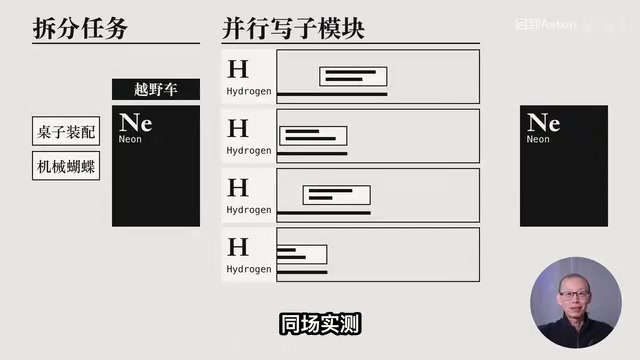
When selecting Orchestrator mode in the AntiGravity menu, there's no need to manually adjust thinking tiers — the server automatically has Neon handle task decomposition and final review, while dispatching multiple lightweight, cheap Hydrogens in parallel to write specific sub-modules.
Putting Orchestrator into the same three heavy 3D tasks for live comparison, it scored a 3-0 sweep against the default single-run Neon High on output quality:
- Off-road vehicle over the bump: 3rd place, beating the default tier's 4th, with 19.6 minutes setting the field's fastest record — the only one in the entire lineup to render the tire sidewall model as a three-dimensional relief, and with the most transparent yellow coil springs in the wheel arches.
- Mechanical butterfly: 4th place in just 12.4 minutes, faster than the 13.7-minute last-place default Neon High, and beating it by two positions in quality.
- Table assembly instructions: 3rd place in 33.7 minutes, beating the 5th-place default Neon High and 4th-place Argon, and fully producing the distributed assembly animation that the default single-run missed.
But on demanding spatial details, it still narrowly loses to the single-run Neon X High and Carbon High. The off-road vehicle had slight clipping at the instant it crested the bump, the mechanical butterfly's wings lacked embedded gears inside, and the wings flew outside the left and right frame in the exploded view. In the table instructions, although the orchestration mode restored the distributed assembly animation, the wooden dowels dropped vertically from directly above and got stuck on the top edge of the board instead of entering the target holes.
In other words, having Neon plan and coordinate while leading Hydrogen to work in parallel can indeed reliably raise the floor of the default tier, but when it comes to fine component alignment and frame control, the ceiling still falls short of the single-run Neon X High and Carbon High.
Multi-model orchestration refers to a "scheduler model" decomposing a complex task into several sub-tasks, dispatching them to multiple lighter, cheaper models for parallel execution, and finally having the scheduler model aggregate, verify, and integrate the results. It essentially replaces "one all-capable large model fighting alone" with a pipeline of "one planner plus a group of executors." The advantages are parallel execution shortening total time and pushing simple sub-tasks to low-cost models to reduce expenses; the cost is that cross-model handoffs lose contextual detail, making it prone to deviations in areas requiring global consistency such as fine alignment and frame control. In this article, Orchestrator having Neon coordinate while multiple Hydrogens write sub-modules in parallel is a typical form of this pattern.
Cost Breakdown: Cheap Unit Price Doesn't Mean Lower Total Cost
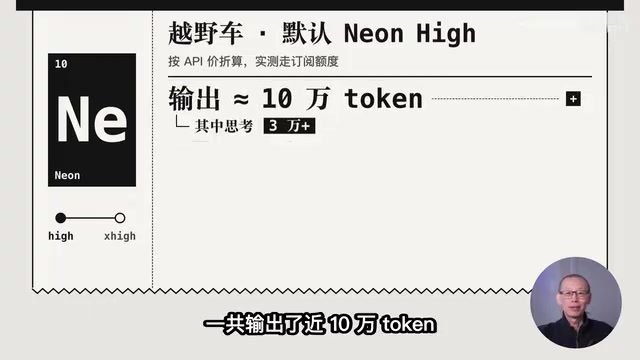
The testing ran on subscription quota, with single-model costs uniformly converted at official API list prices, including thinking tokens. Taking the off-road vehicle task on default Neon High as an example, it output nearly 100,000 tokens in total, including over 30,000 thinking tokens, plus input and cache reads, equivalent to $2.81.
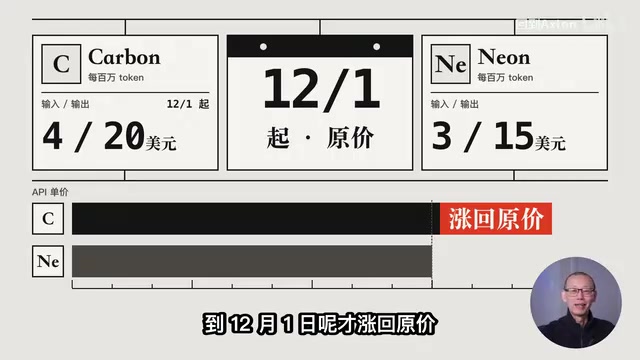
There's a price inversion here: when implicit cache hits occur, read costs are only 5% of regular input, and top-tier Carbon was still in its promotional period until November 30, with API unit price at roughly two-thirds of the new flagship Neon, only returning to full price on December 1.
The result is highly counterintuitive: even with Carbon still in its half-price promotional period, across the five tasks it spent about $1.22 more on multi-turn input and cache reads, completely canceling out its unit price advantage. Carbon ultimately ran 138 minutes at $10.25 equivalent, actually $0.54 more than the default Neon High's $9.71. The default Neon High used only 66 minutes for the five tasks — about half of Carbon's time.
Once Carbon returns to full price, its total cost for the five tasks will jump to $20.50, and the default Neon High will cost only about 47% of that. Even better value is Neon X High, which took two first places and one second: total time of 86 minutes across five tasks at $14.89 equivalent, 38% faster than Carbon, and after December its total cost will actually be 27% cheaper than Carbon. Orchestrator costs just $5.80 for the five tasks, while the older base model Argon will rise to $16.14 after December — Argon is no longer recommended for new projects.
Implicit caching is a billing optimization offered by some large model APIs: when multiple requests contain identical prefix content (such as system prompts, long documents, or multi-turn conversation history), the server automatically reuses already-computed intermediate states, billing the hit portion at a price far below regular input — 5% of regular input price in this article. It has an enormous impact on multi-turn and long-context scenarios, but it also strips "unit price" of intuitive comparability — a model with a lower unit price may end up with a higher total bill if it repeatedly reads large amounts of non-cached content each turn. When evaluating model costs, look at the actual total consumption including input, cache reads, thinking tokens, and output, rather than list unit price.
Four Selection Recommendations
Translating over ten hours of testing into everyday model selection, you can directly match your needs:
- Static image viewing, batch processing, and simple sub-tasks: Go straight to Hydrogen — full marks in a minute and a half, fastest and most economical.
- Everyday medium tasks: Use the default Neon High pinned at the top of the menu, the fastest among single models, but don't count on it for complex 3D or major engineering work.
- Don't want to manually adjust settings but find the default single model insufficiently reliable: Choose the multi-model Orchestrator — it beat the default tier on all three heavy tasks, and is often faster too.
- When it really comes to heavy lifting: Lock in Neon X High — 38% faster than Carbon, and about 27% cheaper after December. Carbon can be used alongside during its promotional price until November 30; once it returns to full price, reserve it only for the rare ultra-hard problems that truly get stuck.
The creator has also made all 18 interactive 3D outputs available as an online showcase, including the off-road vehicle over the bump, the mechanical butterfly, and the midnight table assembly animation — you can rotate and drag in 360 degrees and switch between four-layer exploded views. If interested, you can try them out yourself and hunt for errors.
One-line Summary
Double-blind testing of four Gemini 4 models: the default tier fails, while enabling the highest thinking tier and multi-model orchestration is the right answer.
Paragraph Summary
Based on Bilibili creator Axton's double-blind testing of the Gemini 4 series (Argon, Carbon, Hydrogen, Neon), the article maps out the one-way lineage of the four models: Argon is the native sparse MoE base, Carbon builds on Argon for deep reasoning, Hydrogen and Neon fork from Carbon, and Argon has been removed from the official family table. Across three high-difficulty 3D tasks, the default Neon High pinned at the top of the menu repeatedly ranked last, while the same model with the X High thinking tier enabled took multiple first places; the multi-model Orchestrator, with Neon coordinating and Hydrogens executing in parallel, swept the default tier 3-0. On cost, Carbon despite its half-price promotion ended up costing more than default Neon due to multi-turn calls. The article concludes with four selection recommendations.
Related articles

Gemini 4 Neon vs Carbon Benchmark: How Big Is the Gap in Performance and Cost?
Gemini 4 Neon vs Carbon tested: Neon's default tier hits 59.6, matching the flagship, at double the speed and a quarter cheaper, but Carbon leads research computing by 8.5 points. Carbon is 50% off until end of November; Neon's price edge starts in December.

Gemini 4 Neon Hands-On: Data Visualization Shines, But Can't Beat Opus
Bilibili creator tests Gemini 4 Neon: third on Agent Arena, strong at dynamic data visualization, but lags Opus and Fable in 3D and complex coordination.

Hands-On with Gemini 4 Neon: 8 Scenarios — Can It Really Replace Opus 5.5?
Hands-on with Gemini 4 Neon across 8 scenarios: AEI score 61 (third), Cursor Bench 4.1 at 65.4%, $3/$15 pricing. 95% usable on article-to-video, but Blender 3D modeling fails. More like a fast Kimi K3 than an Opus 5.5 replacement.