Scrapling: An All-in-One Python Web Scraping Framework, from Single Requests to Large-Scale Crawling

Scrapling is a rapidly rising Python web scraping framework focused on an integrated experience from single requests to full-scale crawling.
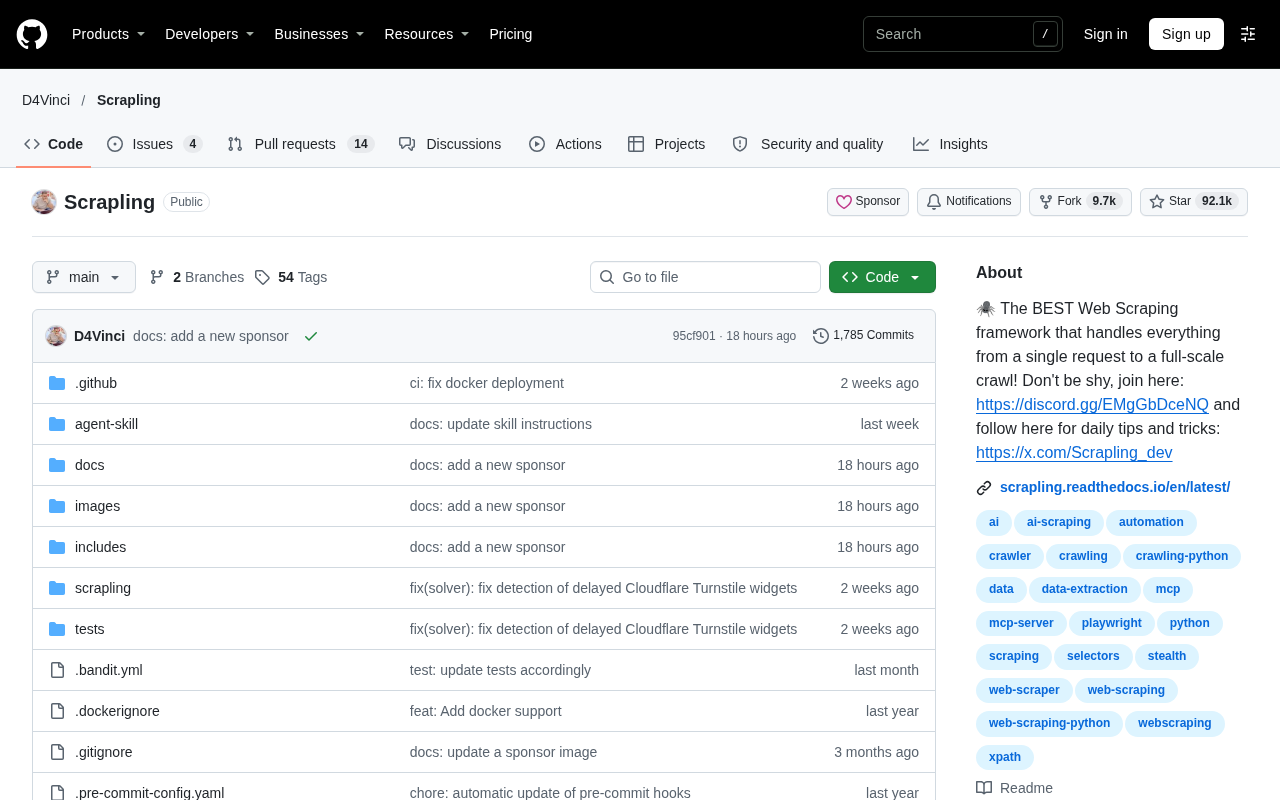
Scrapling is a Python web scraping framework developed by D4Vinci, with over 92,000 GitHub stars and 9,700+ forks and 892 new stars in a single day. Its "Don't be shy" philosophy encourages starting simple and scaling to complex crawling, balancing ease of use and scalability. It is suitable for data science, AI training data preparation, and competitive analysis. The article also reminds users to comply with the robots protocol and relevant laws.
Why Scrapling Is Worth Watching
On GitHub, a Python web scraping framework called Scrapling is rapidly gaining popularity. Developed by D4Vinci, the project currently has over 92,000 stars and more than 9,700 forks, with 892 new stars in a single day, demonstrating extremely high community interest. Scrapling positions itself as handling "everything from a single request to full-scale crawling," aiming to be the ultimate tool in the web scraping space.
Web scraping is a common need in data collection, competitive analysis, and AI training data preparation, but existing tools often struggle to balance ease of use and scalability. Scrapling attempts to solve this pain point by providing a unified workflow.
Core Features and Design Philosophy
Scrapling's design philosophy is "Don't be shy," encouraging users to start with simple requests and gradually expand to complex crawling. Built on Python, it makes full use of asynchronous programming and modern parsing techniques. According to the project description, Scrapling can handle everything from a single HTTP request to large-scale distributed crawling without switching between different libraries or frameworks.
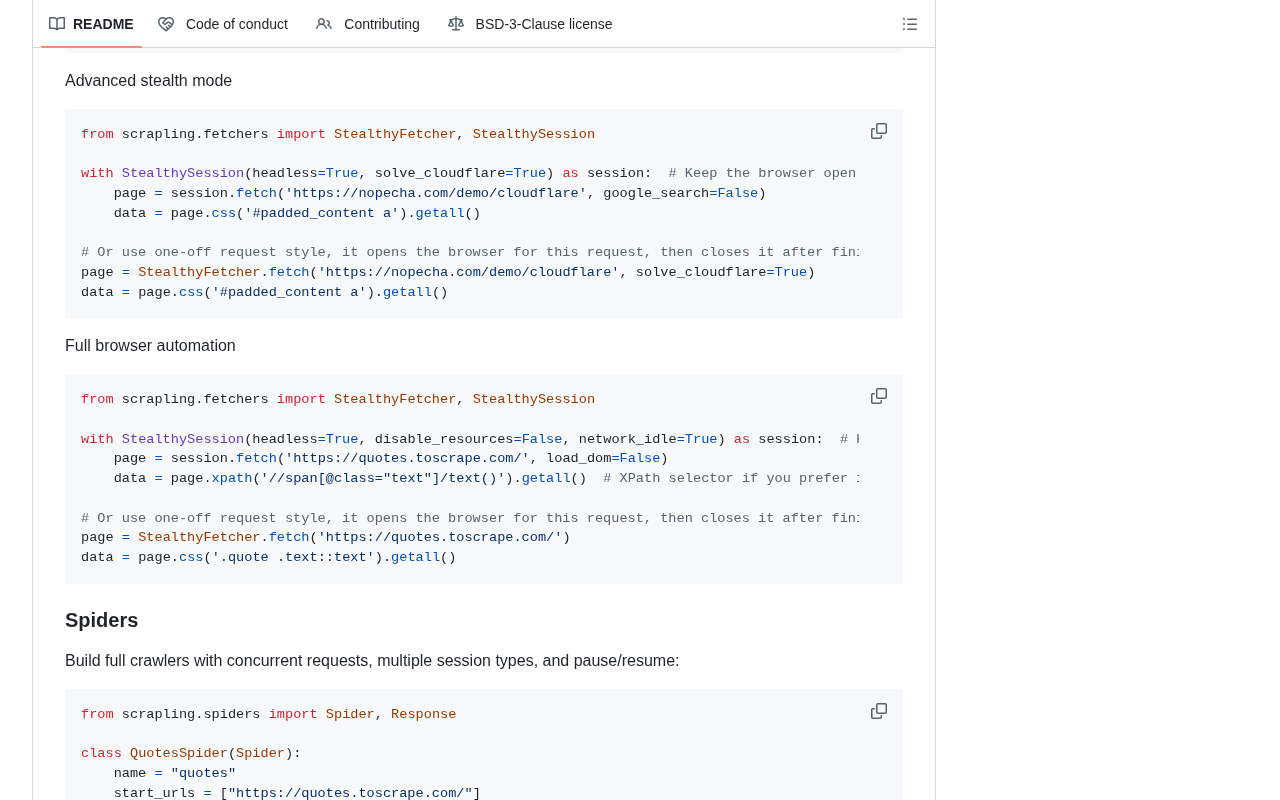
Although the original material does not detail specific features, its positioning suggests that Scrapling likely includes modules for request management, anti-scraping bypass, data parsing, and concurrency control. This integrated design reduces the cost of developers switching between multiple tools, making it especially suitable for teams that need rapid prototyping while hoping for a smooth transition to production environments.
Asynchronous programming in web scraping refers to using async/await syntax and an event loop, allowing a program to concurrently handle other requests while waiting for network responses, thereby greatly increasing throughput. Traditional synchronous crawlers (such as scripts based on requests) block the thread on every request, making it difficult to efficiently handle large numbers of URLs; asynchronous frameworks (such as aiohttp and httpx) can manage hundreds of concurrent connections within a single thread. Scrapling's emphasis on asynchrony means it is better suited to modern high-concurrency scraping scenarios, but it also requires developers to understand the basics of coroutines.
Anti-scraping bypass is a common challenge in web scraping, as websites block automated access through IP blacklists, request header detection, CAPTCHAs, JavaScript rendering, and other methods. Common countermeasures include proxy rotation, User-Agent spoofing, headless browser rendering (such as Playwright), and request rate control. If Scrapling positions itself as an "all-in-one" tool, it likely includes some anti-scraping strategies built in, but users still need to be mindful of compliance boundaries and avoid misuse.
Community and Ecosystem
Scrapling has active community support. The project offers a Discord channel (https://discord.gg/EMgGbDceNQ) for users to communicate and shares daily tips on X (formerly Twitter) via @Scrapling_dev. This dual-platform operation helps quickly respond to user feedback and spread best practices.
The 92,000+ star count indicates that Scrapling has gained broad recognition, but high attention also means higher expectations. Developers need to continuously maintain and update the framework to stay competitive. For potential users, a large community means richer tutorials, plugins, and problem-solving resources.
Use Cases and Competitive Analysis
Scrapling is suitable for a variety of scenarios: data scientists need to quickly scrape web data for analysis; AI engineers need to build training datasets; enterprises need to monitor competitors' prices or content updates. Compared with traditional tools like Scrapy and BeautifulSoup, Scrapling's claimed "all-in-one" approach may reduce configuration complexity, but actual performance needs to be verified in practice.
One detail worth noting: legal and ethical issues in web scraping are becoming increasingly prominent, and Scrapling users should comply with the target website's robots protocol and relevant laws and regulations. The framework's neutrality does not imply the legality of its use cases.
Scrapy is the most well-known crawler framework in the Python ecosystem. It uses an asynchronous architecture based on Twisted and provides complete components such as schedulers, middleware, and pipelines. It is suitable for building large-scale distributed crawlers, but has a steep learning curve and cumbersome configuration. BeautifulSoup is a lightweight HTML parsing library, often used with requests. It is easy to get started with but lacks concurrency and request management capabilities. Scrapling's claimed "all-in-one" approach attempts to find a balance between the two: providing the convenience of simple requests while supporting smooth expansion to full-scale crawling. However, Scrapy's mature ecosystem and stability versus Scrapling's ease of use still need to be weighed in actual projects.
The robots protocol (robots.txt) is a text file in a website's root directory that tells crawlers which paths are allowed or prohibited for scraping, and is a basic norm of crawler ethics. Although compliance with the robots protocol has no direct legal enforcement, it is often used as a basis for judging whether a crawler is "well-intentioned." In addition, web scraping must also take into account regulations such as the Computer Fraud and Abuse Act (CFAA), website terms of service, and data privacy issues (such as GDPR). Developers should ensure that scraping activities do not infringe copyright, do not overload servers, and avoid collecting sensitive personal information.
Future Outlook
Scrapling's rapid rise reflects strong market demand for efficient scraping tools. With the spread of AI and big data applications, the importance of web scraping as a data entry point will only continue to grow. If Scrapling can continue to iterate and solve the challenges of stability, anti-scraping, and distributed coordination in large-scale crawling, it has the potential to become a mainstream choice in the Python ecosystem.
For developers, it is recommended to start with the official documentation and community examples, try it out on a small scale, and then evaluate whether to migrate existing crawler projects. Following its GitHub repository and social media accounts can help you stay up to date with updates.
One-line Summary
Scrapling is a rapidly rising Python web scraping framework that focuses on an integrated experience from single requests to full-scale crawling.
Paragraph Summary
Scrapling is a Python web scraping framework developed by D4Vinci. It has gained over 92,000 stars and more than 9,700 forks on GitHub, with 892 new stars in a single day, indicating extremely high community interest. Its design philosophy is "Don't be shy," encouraging users to start with simple requests and gradually expand to complex crawling, attempting to strike a balance between ease of use and scalability. The project operates its community through Discord and X, and is suitable for scenarios such as data science, AI training data preparation, and competitive analysis. Compared with traditional tools like Scrapy and BeautifulSoup, Scrapling's claimed integrated design may reduce configuration complexity, but actual performance still needs to be verified in practice. The article also reminds users to comply with the robots protocol and relevant laws and regulations, and recommends starting with the official documentation and small-scale trials.
Related articles

DeepSeek Harness in Detail: DIY Your Own Software Like Building with LEGO
What is DeepSeek Harness? Using the metaphor of a car assembly platform, this article explains this equipment system of freely combinable functional modules, analyzes its spatiotemporal composability technical foundation, and shows how ordinary users can DIY exclusive software that does not exist on the market at extremely low cost.

DeepSeek Harness Step-by-Step Tutorial: Master DSH and Its Plugin Ecosystem in 50 Minutes
DeepSeek Harness step-by-step install tutorial: from Node.js environment setup to client installation, covering three plugin install methods — chat, marketplace, and command line — plus practical uses of local file access and plugin extensions.

DeepSeek Open-Sources Super-agent Architecture: A Turning Point for Proactive AI
DeepSeek's open-source Super-agent architecture proposes a new proactive AI paradigm: a central Agent dispatches tasks, sub-Agents execute autonomously, and humans only decide and accept. This article analyzes the watershed between passive and proactive AI, and the implementation logic of proactive Agents in scenarios like short-video lead generation.