ScrollEd Turns Textbooks into TikTok: The Experiment of Short-Form Educational Content

ScrollEd rebuilds textbooks as a TikTok-style feed, betting short-form attention mechanics can reshape learning.
ScrollEd is a Palo Alto startup founded by student couple Utsav Gupta and Rebecca Neff that transforms traditional textbook content into a scrollable feed resembling Instagram or TikTok, combining video, audio, and instant quizzes. The product logic bets on meeting Gen Z where their attention already lives. While it addresses a real gap between textbook formats and modern media habits, it faces deep questions: can fragmented scrolling produce genuine knowledge retention, and can a deconstructed textbook preserve the integrity of a full knowledge system? The company pitched at TechCrunch Disrupt and stands at a pivotal moment — moving from intriguing concept to verifiable learning outcomes.
When Textbooks Meet the Feed
Flipping through a thick textbook and scrolling through short videos on your phone are two fundamentally different experiences. Palo Alto-based startup ScrollEd wants to close that gap — by reimagining traditional textbook content as a scrollable feed similar to Instagram or TikTok, blending video, audio, and in-line quizzes to turn learning into a "scroll-through" behavior.
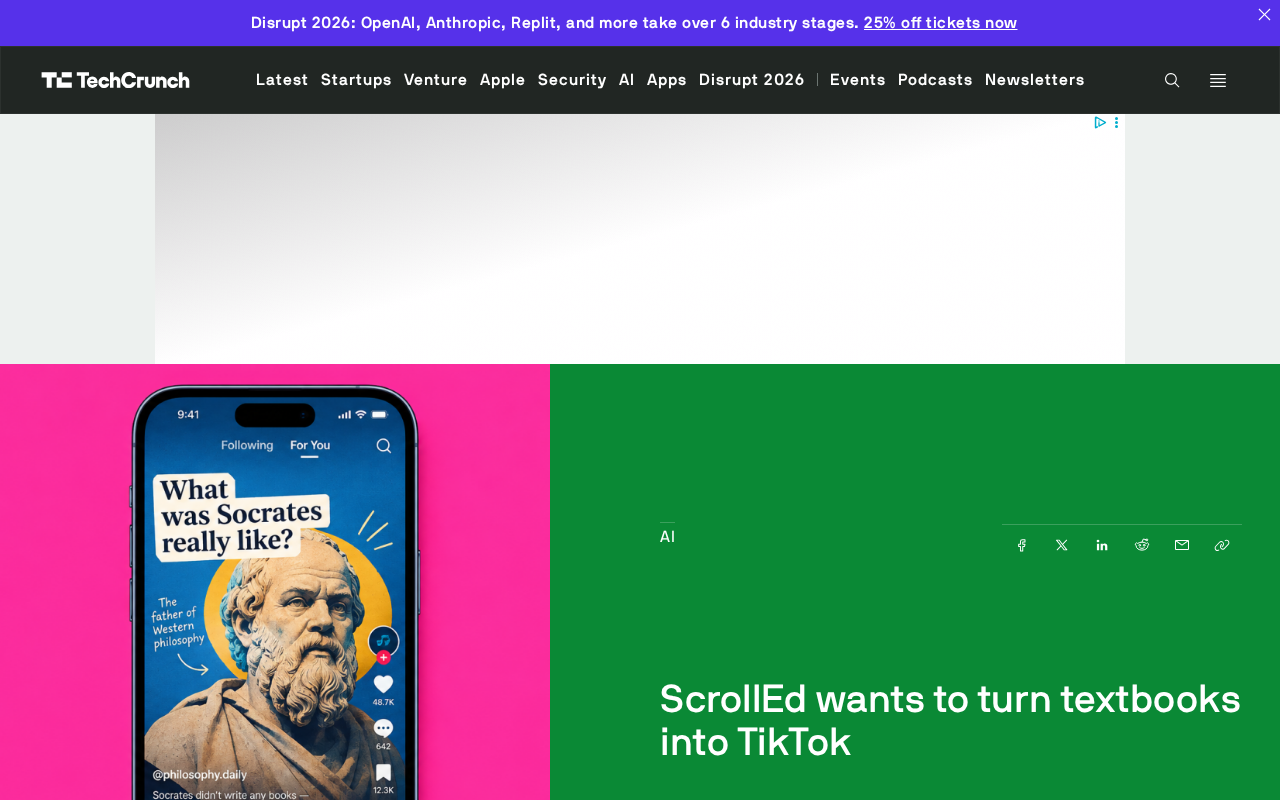
The company was founded by student co-founders — and married couple — Utsav Gupta and Rebecca Neff, who pitched at TechCrunch Disrupt. Approaching an education product from a student's perspective carries an inherent authenticity: they are both observers of the problem and potential users themselves.
The Product Logic: Reclaiming Attention for Learning
Short-form video platforms hold users' attention through instant feedback, bite-sized pacing, and the immersive experience of infinite scrolling. ScrollEd aims to transplant this proven attention-capture mechanism into an educational context.
Its core design features several key elements:
- Scrollable feed: Breaking up long blocks of text into screen-sized cards, reducing the psychological burden of reading in one sitting.
- Multimedia integration: Layering video and audio on top of text to accommodate different learning preferences.
- Instant quizzes: Interspersing quiz prompts so that knowledge is repeatedly activated and tested as users scroll.
The underlying assumption is that students' attention spans have already been "trained" by short-form video platforms. Rather than fighting that habit, ScrollEd leans into it — fitting learning content into the interaction framework users know best.
Opportunity and Concern in Equal Measure
ScrollEd's approach addresses a genuine pain point: there is a growing mismatch between the format of traditional textbooks and the media consumption habits of Gen Z. For students who struggle to sit down and work through an entire chapter, a fragmented, multimedia presentation could genuinely lower the barrier to entry.
But "TikTok-ifying" textbooks comes with concerns worth taking seriously. There is an inherent tension between the shallow, rapid-fire mode of information consumption that short-form video encourages and the sustained focus and systematic thinking that deep learning requires. Fragmentation may boost engagement, but it doesn't necessarily lead to genuine knowledge internalization — and that is the central challenge facing every "edutainment" product.
Content quality and accuracy are equally critical. Deconstructing a rigorously structured textbook into feed-style cards raises the question of how to preserve the integrity of a knowledge system and keep logical chains intact. Whether educational institutions and serious learners accept the product may hinge entirely on that answer.
Cognitive science has a fairly clear definition of "deep learning": it depends on sustained engagement of working memory, the active construction of connections between concepts, and long-term memory consolidation through spaced repetition. Researcher Nicholas Carr argued in The Shallows that hyperlinks and fragmented reading habits erode the brain's capacity for linear, deep thinking. At the same time, the Generation Effect in educational psychology shows that active retrieval and testing do strengthen memory — which is precisely the theoretical basis for ScrollEd's embedded quiz design. With evidence pointing in both directions, the effectiveness of "feed-style learning" likely depends heavily on the specifics of content design: passive swiping and carefully engineered retrieval practice may produce wildly different learning outcomes.
The Dual Identity of Student Founders
The composition of the founding team is worth noting. As student co-founders, Gupta and Neff have a closer feel for the real needs of their target users. This "user-as-founder" model is not uncommon in edtech, and its advantage lies in product intuition — though it often comes with gaps in scaled operations and accumulated educational expertise.
Pitching on a stage like TechCrunch Disrupt signals that ScrollEd is seeking capital and industry attention. For an early-stage product, the defining question is whether it can move from "interesting concept" to "validated learning outcomes" — that is what will determine its long-term value.
The edtech sector has evolved over the past decade from tool-based products to full platforms. Duolingo validated the commercial viability of a "gamified" approach to language learning, while Khan Academy set a different benchmark with free, systematic course content. ScrollEd sits somewhere between the two: lighter and more social than Khan Academy, but to win adoption from schools and institutions, it will need to provide more measurable learning outcome data than a gamified app alone can offer. The real competitive moat in this space typically isn't the novelty of the product format — it's whether the product maps to curriculum standards, whether it offers teacher-facing learning analytics, and whether it can build a sufficiently large content library. These are structural challenges every early-stage team in this space must confront.
Closing Thoughts
ScrollEd represents yet another experiment at the intersection of education and new media interaction paradigms. It reflects a clear trend: education products are being forced to adapt to the attention structures of a new generation of users. Whether this direction is an innovation that improves learning efficiency or another compromise that cedes serious learning to entertainment consumption remains an open question. The product's success will ultimately not depend on how much it resembles TikTok — but on how much users actually remember and understand after swiping through it.
Related articles

Testing the 350K-Star REA in an Isolated Environment: 4-Second Install, but Watch Out for Two Pitfalls
Isolated lab test of the 350K-star open-source reverse-engineering tool REA: 4-second install, 15 seconds to list a screenshot tool's outbound addresses, 565 communication channels mapped, while exposing two pitfalls—user-level settings writes and 31 high-risk tool permissions—plus three safety rules.
Reverse Engineering + AI Agents: The T…
Reverse Engineering + AI Agents: The Technical Truth Behind Cloning Adobe Apps in Weeks
A developer used AI Coding Agents for reverse engineering to build 7 open-source Adobe alternatives in weeks. We explore how it works, the MCP Server that hit 100K stars in 6 days, and the real technical and legal limits.
MCP Protocol Explained: How AI Agents Connect to External Tools
What is MCP (Model Context Protocol)? From APIs and Function Calling to MCP's three-layer architecture, this article explains how AI Agents connect to external tools like calendars and email, and reveals two major security risks—prompt injection and tool poisoning—along with four protection principles.