ScroogeFrog AI: Using AI to Audit Ad Fraud and Protect Marketing Budgets

ScroogeFrog AI uses AI to audit traffic and Google Ads, identifying bot clicks and protecting ad budgets.
ScroogeFrog AI launched on Product Hunt and ranked #1, positioned as a tool for using AI to detect ad fraud and protect marketing budgets. Its core capability is auditing website traffic and Google Ads campaigns, identifying suspicious clicks, bot activity, and inefficient spend, and turning data into actionable remediation recommendations. For agencies and large advertisers, it also offers custom AI fraud detection models trained on clients' own traffic data to improve detection accuracy for anomalous patterns in niche industries. The product received 143 upvotes and 26 comments, indicating genuine market interest, but key information such as detection accuracy, supported ad platform range, and pricing has not been disclosed, and actual effectiveness still requires independent verification.
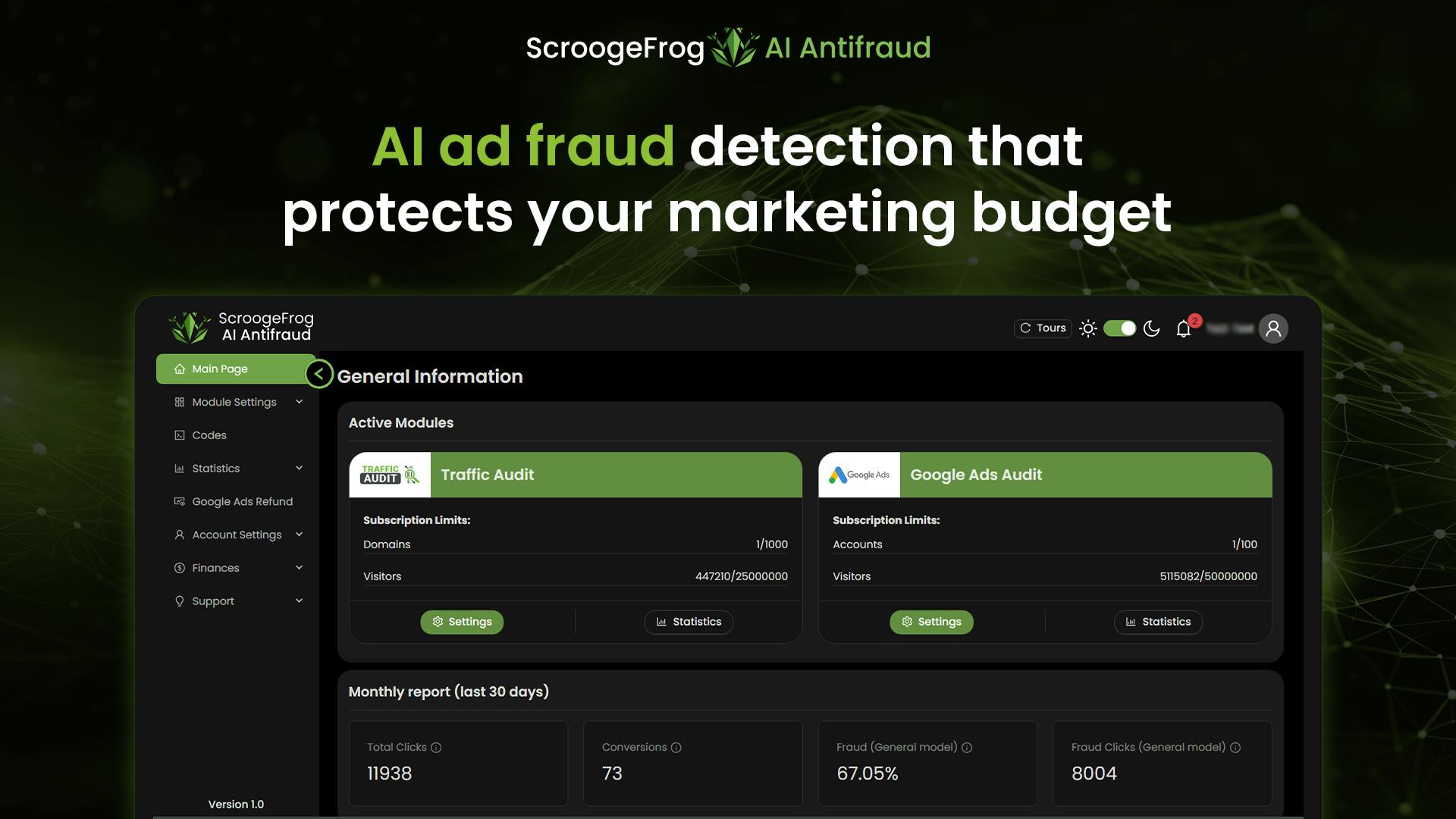
Ad budgets being eaten away by bot clicks and fake traffic is a long-standing pain point in digital marketing. ScroogeFrog AI launched on Product Hunt, positioned as "using AI to detect ad fraud and protect your marketing budget," and ranked #1 for the day. The product aims to use automated audits and customized models to help advertisers see exactly where every dollar is going.
Core Features: From Traffic Audits to Google Ads Diagnostics
ScroogeFrog AI's main capability is auditing website traffic and Google Ads campaigns. It identifies suspicious clicks, bot activity, and underperforming ad spend, and turns complex data into clear remediation recommendations. For advertisers, this means no more manually digging through logs and reports—instead, they get actionable conclusions directly.
The product description emphasizes "less guesswork, more control over every dollar of ad spend." This positioning targets advertisers and agencies with sizable budgets but no dedicated anti-fraud team.
What Are "Bot Clicks" in Ad Fraud?
Click fraud refers to ad clicks generated by automated scripts, crawler networks, or click farms simulating human behavior. This traffic doesn't bring real conversions, but it consumes pay-per-click (CPC) ad budgets and pollutes attribution data, causing advertisers to misjudge channel performance. Common forms include bulk clicks from data center IPs, residential proxy camouflage, and malicious spend targeting competitors' ads. The industry typically identifies anomalies through signals such as IP reputation databases, device fingerprints, and behavioral characteristics (e.g., click intervals, mouse trajectories, dwell time). The "suspicious click identification" that ScroogeFrog AI emphasizes is essentially layering machine learning models on top of these signals to distinguish real users from automated traffic.
Custom AI Models: For Agencies and Large Advertisers
Beyond standardized audit features, ScroogeFrog AI also offers custom AI fraud detection models for agencies and large advertisers. These models are trained on the client's own traffic data, enabling more precise identification of anomalous patterns specific to particular business scenarios.
This is worth noting: generic anti-fraud rules often struggle to cover the traffic characteristics of niche industries, whereas models trained on proprietary data can improve detection targeting. However, the original material does not disclose the training data requirements or implementation costs of custom models, so actual effectiveness remains to be verified.
The Divide Between Custom Models and Generic Rules
Generic anti-fraud rules are typically based on industry-wide common characteristics—such as blacklisted IPs, known botnet fingerprints, or uniform behavioral thresholds. Their advantage is fast deployment without training data; their disadvantage is low tolerance for normal traffic fluctuations in niche industries, making false positives likely. Custom AI models, by contrast, use the client's own traffic data for supervised or semi-supervised training, learning the business's specific conversion paths, geographic distribution, and time-of-day patterns—thereby reducing false positives while catching more subtle anomalies. The trade-off is the need for sufficient historical labeled data, ongoing model maintenance, and handling data privacy and compliance issues. For agencies, training separate models for multiple clients also introduces scaled management costs.
Market Positioning and Competitive Landscape
Ad fraud detection is not a new category, but ScroogeFrog AI's differentiation lies in combining AI audits with actionable optimization recommendations rather than merely providing risk scores. Its Product Hunt results—143 upvotes and 26 comments, ranking #1—indicate genuine market interest in this type of tool.
The team includes Kostia Novofastovskyi, Maria Mashkina, Eugene Chernyak, and Maksym Melnychenko. The product sits at the intersection of marketing, advertising, and artificial intelligence.
Common Technical Approaches to Ad Fraud Detection
Ad fraud detection solutions on the market generally fall into three categories: first, real-time blocking based on rules and blacklists—lightweight to deploy but easy to bypass; second, traffic scoring based on statistics and machine learning, modeling click, impression, and conversion data to output risk scores; third, full-funnel attribution auditing, cross-referencing ad platform reports with website analytics logs to identify invalid traffic not disclosed by the platform. ScroogeFrog AI's positioning is closer to a combination of the second and third categories, emphasizing actionable remediation recommendations after audits rather than stopping at risk scores. Understanding this distinction helps assess its actual differentiation among similar tools.
Usage Recommendations and Limitations
For teams considering a trial, it's advisable to start with a small-scale campaign, compare spending efficiency before and after the audit, and then decide whether to expand to custom models. It's important to note that the original material does not provide specific detection accuracy rates, the range of supported ad platforms (only Google Ads is mentioned so far), or pricing information—these are key gaps for evaluating its actual value.
Overall, ScroogeFrog AI represents the "AI-driven budget protection" direction in ad tech, but whether it can deliver on its promises in real campaigns still requires more independent verification.
One-line Summary
ScroogeFrog AI uses AI to audit traffic and Google Ads, identifying bot clicks and protecting ad budgets.
Paragraph Summary
ScroogeFrog AI launched on Product Hunt and ranked #1, positioned as a tool for using AI to detect ad fraud and protect marketing budgets. Its core capability is auditing website traffic and Google Ads campaigns, identifying suspicious clicks, bot activity, and inefficient spend, and turning data into actionable remediation recommendations. For agencies and large advertisers, it also offers custom AI fraud detection models trained on clients' own traffic data to improve detection accuracy for anomalous patterns in niche industries. The product received 143 upvotes and 26 comments, indicating genuine market interest, but key information such as detection accuracy, supported ad platform range, and pricing has not been disclosed, and actual effectiveness still requires independent verification.
Related articles
Why You Shouldn't Run the Hermes Agent on Your Personal Computer
Why shouldn't you run autonomous AI agents like Hermes on your personal computer? This article analyzes why agents should be deployed to a dedicated VPS instead of your primary device, from four angles: security risks, resource consumption, credential leakage, and autonomy requirements—plus the practical logic of isolated deployment.

Ignite Keynote: Building a Frontier Ecosystem to Bring AI to Life
Microsoft CEO Nadella's Ignite keynote proposes a frontier ecosystem to turn AI advances into real-world impact. This article unpacks the strategy's ecosystem layers and deployment signals.
C++26 Standard Finalized: Key Takeaway…
C++26 Standard Finalized: Key Takeaways from the ISO C++ Meeting
C++26 wraps up at the ISO C++ meeting. This article explains the trip report's implications, the standardization process, and impact on developers and compiler ecosystems.