Second-Order Optimization Breakthrough: How Individual Smoothness Accelerates Finite-Sum Convex Optimization

Using individual smoothness, the complexity lower bound for second-order finite-sum convex optimization improves to Ω(n+n^{5/7}ε^{-2/7}), with a near-optimal Taylor-corrected lazy Newton method proposed.
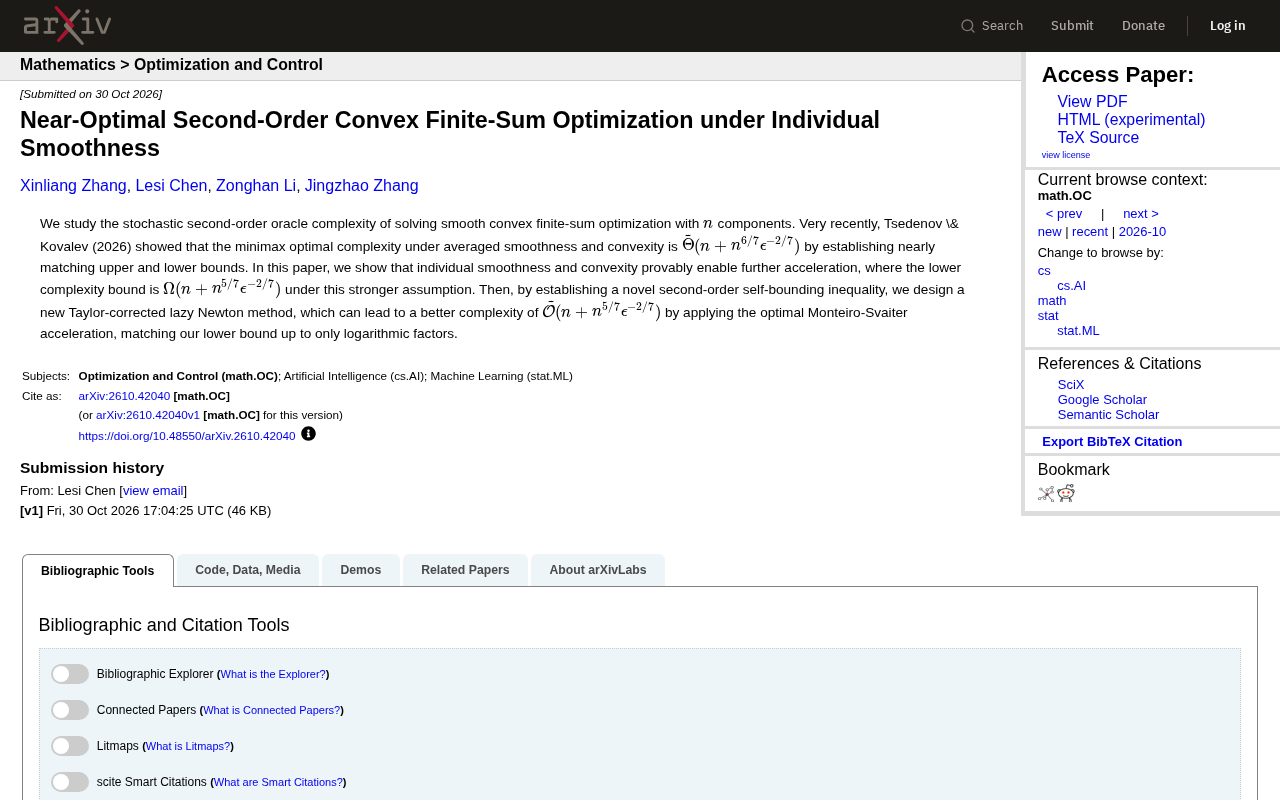
This paper studies finite-sum convex optimization. Under individual smoothness and individual convexity assumptions, it proves a lower bound of Ω(n + n^{5/7} ε^{-2/7}) for the complexity of a second-order stochastic oracle, improving upon the lower bound given by Tsedenov & Kovalev (2026) under average smoothness. To achieve this lower bound, the authors design a Taylor-corrected lazy Newton method. By establishing a novel second-order self-bounding inequality and combining it with the Monteiro-Svaiter acceleration technique, they achieve an upper bound of Õ(n + n^{5/7} ε^{-2/7}), differing from the lower bound only by logarithmic factors. This work shows that individual smoothness can bring substantial acceleration to second-order finite-sum optimization and deepens the understanding of the role of smoothness assumptions in optimization algorithm design.
In the field of machine learning optimization, finite-sum convex optimization problems have long been a research hotspot, with objective functions typically formed as the sum of a large number of component functions. Recently, a theoretical breakthrough has shown that leveraging individual smoothness can significantly improve the efficiency of second-order stochastic optimization.
Background: From Average Smoothness to Individual Smoothness
Traditionally, theoretical analysis of finite-sum optimization is often based on the average smoothness assumption, i.e., all component functions share a single global smoothness constant. However, in practical problems, the smoothness of individual component functions can vary greatly. The recent work of Tsedenov & Kovalev (2026) showed that under average smoothness and convexity assumptions, the minimax optimal complexity of a second-order stochastic oracle is $\tilde\Theta(n + n^{6/7} \epsilon^{-2/7})$. This result establishes nearly matching upper and lower bounds, providing a benchmark for subsequent research.
Stochastic oracle and complexity lower bounds: In optimization theory, the oracle model characterizes the type of information available to an algorithm. A first-order oracle returns function values and gradients; a second-order oracle additionally returns the Hessian matrix (or its product with a vector). A complexity lower bound refers to the minimum number of oracle calls required by any algorithm to reach accuracy $\epsilon$ in the worst case, usually denoted by $\Omega(\cdot)$; an upper bound corresponds to the complexity of a specific algorithm, denoted by $\mathcal{O}(\cdot)$. When the upper and lower bounds coincide up to logarithmic factors, the complexity is called "minimax optimal." In the formulas, $n$ is the number of component functions, $\epsilon$ is the target accuracy, and $\tilde{\Theta}(\cdot)$ hides logarithmic factors. Understanding these notations helps to grasp the comparative significance of this paper and the work of Tsedenov & Kovalev (2026).
Core Contribution: Acceleration Brought by Individual Smoothness
The core of this paper lies in leveraging stronger individual smoothness and individual convexity assumptions. The authors first prove that under these assumptions, the lower bound on complexity is $\Omega(n + n^{5/7} \epsilon^{-2/7})$, which is better than the lower bound under average smoothness, indicating that individual smoothness can indeed bring theoretical acceleration.
To achieve this lower bound, the researchers designed a new Taylor-corrected lazy Newton method. The key to this method is the establishment of a novel second-order self-bounding inequality, combined with the optimal Monteiro-Svaiter acceleration technique, ultimately achieving an upper bound of $\tilde{\mathcal{O}}(n + n^{5/7} \epsilon^{-2/7})$, which differs from the lower bound only by logarithmic factors.
Monteiro-Svaiter acceleration technique: This is a framework proposed by Svaiter and Monteiro for accelerating first-order and second-order methods. Its core idea is to select step sizes by solving an auxiliary subproblem, so that the algorithm maintains function value decrease while obtaining an accelerated convergence rate. This technique is often combined with Newton-type methods to handle self-concordant or more general classes of smooth functions. In this paper, the authors combine Monteiro-Svaiter acceleration with Taylor-corrected lazy Newton steps, so that the step size selection at each iteration both satisfies the second-order self-bounding inequality and achieves the theoretically optimal convergence rate $\tilde{\mathcal{O}}(n + n^{5/7}\epsilon^{-2/7})$. This acceleration technique is one of the key components for matching the upper and lower bounds.
Method Details: Taylor Correction and Lazy Newton
The core idea of the Taylor-corrected lazy Newton method is to introduce Taylor expansion corrections into Newton steps to better adapt to individual smoothness. The lazy update strategy reduces the frequency of computing second-order information, thereby lowering the cost per iteration. This combination enables the algorithm to be practically feasible while maintaining theoretical optimality.
Second-order self-bounding inequality: This is a class of analytical tools that characterize the relationship between algorithmic progress and the current optimality gap. Unlike classical self-concordant function theory, self-bounding inequalities typically take the form "the function value decrease in the next step is at least some power of the current gap," thereby allowing convergence rates to be derived without a global smoothness constant. The novel second-order self-bounding inequality established in this paper is specifically adapted to the individual smoothness structure, allowing the algorithm to adaptively adjust step sizes based on the local curvature information of each component function. Combined with Taylor correction, this inequality enables Newton steps to remain stable even when individual smoothness constants vary greatly, and it is the theoretical core for obtaining the near-optimal upper bound.
Experiments and Theoretical Verification
Although the original paper focuses primarily on theoretical analysis, the matching of upper and lower bounds and the algorithm design ideas provide guidance for practical applications. Numerical experiments (if any) may further verify the theoretical results, but the contribution of this paper lies mainly in the improvement of theoretical complexity.
Significance and Outlook
This research deepens our understanding of smoothness assumptions in finite-sum optimization and demonstrates the potential of individual smoothness in accelerating second-order methods. Future work may explore more general assumptions or extend the method to non-convex optimization scenarios.
Overall, this paper makes important theoretical progress and provides new perspectives for the design of efficient optimization algorithms.
The difference between individual smoothness and average smoothness: Average smoothness assumes the existence of a global constant $L$ such that the gradients of all component functions $f_i$ are $L$-Lipschitz; individual smoothness allows each $f_i$ to have its own smoothness constant $L_i$, requiring only that $\frac{1}{n}\sum_i L_i$ is bounded or that $\max_i L_i$ is comparable to the average. When the $L_i$ vary greatly, average smoothness overestimates the difficulty of the problem, leading to conservative complexity bounds. Individual smoothness can characterize the problem structure more finely, thereby theoretically yielding better complexity lower and upper bounds. This paper precisely leverages this finer-grained assumption to improve the complexity of second-order finite-sum convex optimization from $\tilde{\Theta}(n + n^{6/7}\epsilon^{-2/7})$ to $\tilde{\Theta}(n + n^{5/7}\epsilon^{-2/7})$.
Related articles

Prompt Engineering for Beginners: From Writing Prompts to Engineering Thinking
Starting from the essence and four functions of prompts, this article systematically explains the six-step process, four success criteria, learning value, and practical limitations of prompt engineering to help you build a complete understanding.

Anthropic Launches Nasdaq IPO: AI Giant's Listing and Risk Disclosures
Anthropic officially launches its Nasdaq IPO under ticker ANT, with market valuation expected to potentially exceed SpaceX's record. The prospectus devotes nearly 100 pages to AI risks, while first-half revenue grew over 14x but net losses widened sharply, reigniting the AI bubble debate.

Rust cURL Clone Uses 4,832 unsafe Blocks—Is the Memory Safety Myth Broken?
A Rust cURL clone uses 4,832 unsafe keywords, challenging Rust's memory safety narrative. We analyze what unsafe really means, compare Fil-C, and examine rewrite motives.