Sedentary vs. Nomadic: The Survival Rules of Two Types of Companies

Using the metaphor of sedentary and nomadic companies to reveal that enterprises should accumulate fixed or portable wealth based on the frequency of environmental change.
The article uses the concept of "sedentary and nomadic companies" proposed by a Twitter user to re-examine corporate strategy through an anthropological metaphor. Sedentary companies put down roots and build, accumulating fixed wealth such as factories, patents, and brands, with advantages in economies of scale and deep moats but at the cost of slow transformation. Nomadic companies accumulate portable wealth such as talent, methodologies, and codebases, naturally adapting to volatility but struggling to form monopolistic moats. The core argument is: the frequency and magnitude of environmental change determine which strategy is more effective—stability favors sedentary companies, while technological paradigm shifts can turn heavy assets into liabilities. In reality, successful companies often switch dynamically between the two, such as Amazon's "nomadic first, sedentary later" rhythm. The article suggests entrepreneurs examine the proportion of portable wealth in their asset portfolio and ask what kind of wealth the current environment requires them to accumulate.
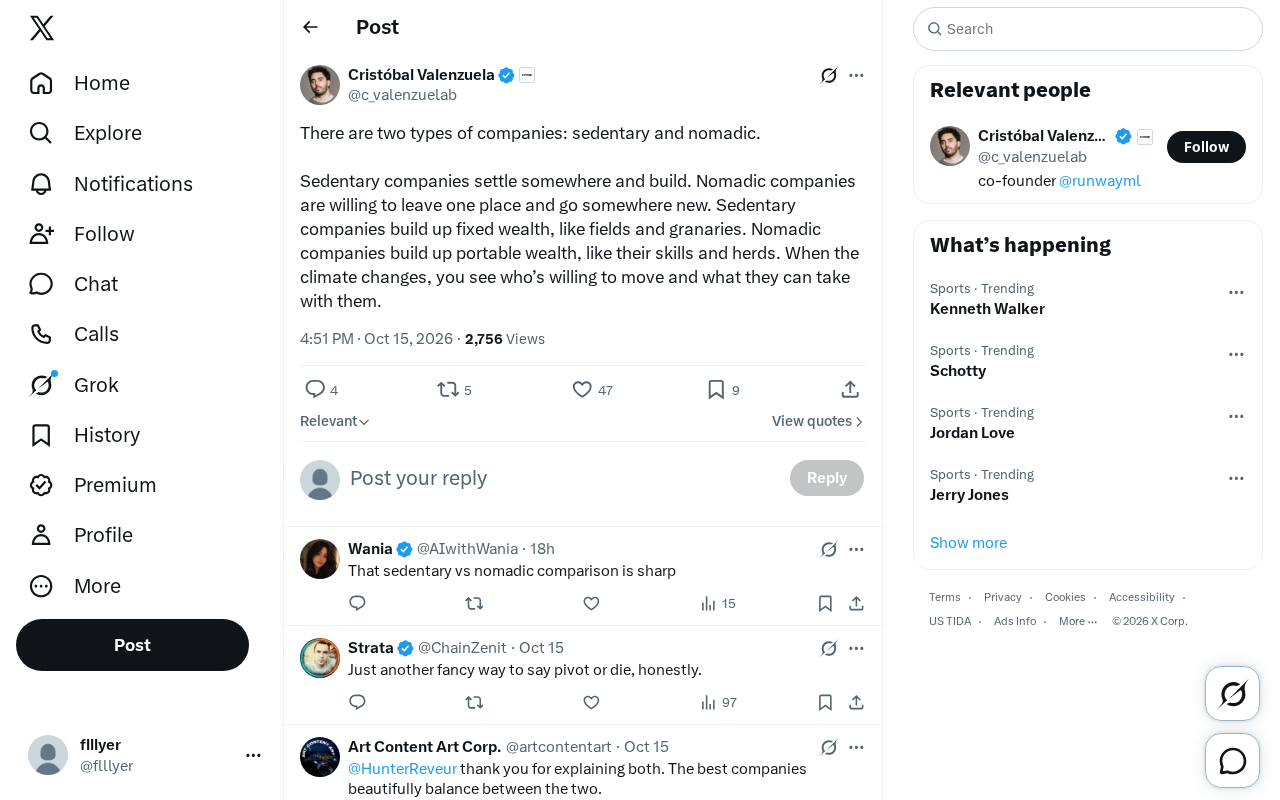
In the business world, corporate strategy is often reduced to a dichotomy between "focus" and "diversification," but a more fundamental classification is sparking discussion: sedentary vs. nomadic companies. This concept, proposed by a Twitter user, uses an anthropological metaphor to reveal the underlying logic of how companies respond to environmental change.
What Are Sedentary and Nomadic Companies?
According to the original tweet's definition, sedentary companies "put down roots in one place and build," accumulating fixed wealth—like fields and granaries. These enterprises invest resources in long-term assets: factories, office buildings, patent portfolios, brand recognition. Their advantage lies in economies of scale and deep moats, but the price is slow transformation.
Nomadic companies are "willing to leave one place and go to a new one." They accumulate portable wealth—like skills and herds. The core assets of such enterprises are talent, knowledge, methodologies, and flexible organizational capabilities. They don't rely on specific geographic locations or heavy assets. When the "climate" changes, they can quickly pack up what's most valuable and move on.
The cleverness of this metaphor is that it doesn't judge which type is better, but points out: the frequency and magnitude of environmental change determine which strategy is more effective.
The Climate Change Metaphor: Who Adapts Better to Uncertainty?
The last sentence of the tweet makes the key point: "When the climate changes, you'll see who is willing to move, and what they can take with them." In a business context, "climate" can mean technological change, regulatory policy, market preferences, or macroeconomic cycles.
Sedentary companies have overwhelming advantages in stable environments. They can amortize fixed costs, build supply chain networks, and cultivate customer habits. But when the technology paradigm shifts, heavy assets can become liabilities—just as Nokia's factories and channels couldn't be directly transferred to the smartphone era.
Nomadic companies are naturally adapted to volatility. Consulting firms, open-source software teams, and small game studios often fall into this category. Their "herds" are codebases, design systems, or customer relationships—assets that can migrate to new domains with relatively little loss. But their weakness is that it's hard to build monopolistic moats, and they easily fall into the trap of "being able to do anything, but not deeply enough in anything."
Technological Paradigm Shift is a key concept for understanding "climate shocks," extended from science historian Thomas Kuhn's "paradigm" theory. In a business context, it refers to a fundamental replacement of the underlying logic of technology, rather than incremental improvement—for example, from feature phones to smartphones, or from on-premise software to cloud computing. The destructiveness of a paradigm shift lies in this: assets, processes, and organizational knowledge accumulated under the old paradigm may not only be ineffective under the new paradigm, but even become resistance to transformation. This is called the "competency trap" or "path dependence." Nokia's case is typical: its manufacturing scale, channel network, and brand were core moats under the feature phone paradigm, but couldn't be directly transferred under the smartphone paradigm—instead, they slowed down organizational restructuring. Understanding paradigm shifts helps judge the magnitude of "climate" change: incremental change favors sedentary companies, while paradigm-level change amplifies the migration advantages of nomadic companies.
The Conversion and Integration of Two Kinds of Wealth
You may not have noticed, but the tweet implies a dynamic process: sedentary companies can accumulate portable wealth (such as methodologies for developing talent), and nomadic companies can also choose to "settle down" at a certain stage (such as establishing a support team after an open-source project is commercialized).
In reality, the most successful companies often switch between the two. Amazon moved from being an online bookstore (nomadic experimentation) to logistics infrastructure (sedentary heavy assets), and then replicated this "nomadic first, sedentary later" rhythm in cloud services. Conversely, some traditional manufacturing companies are modularizing their production lines so they can quickly relocate when tariffs or costs change—this is a case of sedentary companies learning nomadic strategies.
Modular Architecture is the technical foundation for sedentary enterprises to learn nomadic strategies. It refers to splitting a product or production system into relatively independent modules with standardized interfaces, so that each module can be independently replaced, upgraded, or migrated without restructuring the whole. In software, microservices architecture is a typical example; in manufacturing, reconfigurable production lines and standardized component systems fall into this category. The strategic significance of modularization is that it partially converts "fixed wealth" into "portable wealth": although the factory building stays in place, design rules, interface standards, and module knowledge can migrate to new locations or new businesses. This explains why some manufacturing companies can quickly relocate production lines when tariffs or costs change—they have reduced geographic lock-in through modularization. But modularization also has costs: standardized interfaces may sacrifice some performance and depth of customization, and maintaining module boundaries requires ongoing coordination costs.
Implications for Entrepreneurs and Investors
The value of this framework lies in helping decision-makers examine their own "asset portfolio": how much of your wealth is fixed and immovable? How much is portable? When the industry climate shifts abruptly, can you take your core team, intellectual property, and customer trust with you?
For early-stage startups, maintaining nomadism is almost essential for survival—flexibly adjusting direction and quickly validating hypotheses. For mature companies, completely abandoning sedentariness is unrealistic, but they can consciously invest in "portable wealth": employee skills, data assets, modular architecture. These assets are your "herd" in times of crisis.
The tweet's concise metaphor doesn't provide an operating manual, but it offers a useful starting point for thinking: don't ask "which type of company is better," but ask "which kind of wealth does the current environment require me to accumulate".
Real Options thinking can provide a decision-making framework for asset allocation between "sedentary and nomadic." Drawing on the concept of financial options, it refers to companies retaining the right to make flexible choices in the future through small investments, rather than betting once on a fixed path. For example, early-stage startups exploring multiple directions simultaneously (nomadic experimentation) are essentially buying "exploration options"; mature companies investing in modular architecture or data assets are buying "migration options." Real options theory emphasizes that in highly uncertain environments, the value of flexibility itself can be priced, and projects should not be evaluated solely using static net present value. This aligns with the article's core argument—don't ask which type of company is better, but assess how high the option value of "maintaining migratability" is in the current environment. When environmental volatility intensifies, portable wealth and modular capabilities are the call options that companies hold.
One-line Summary
Using the metaphor of sedentary and nomadic companies, this reveals that enterprises should accumulate fixed or portable wealth based on the frequency of environmental change.
Paragraph Summary
The article uses the concept of "sedentary and nomadic companies" proposed by a Twitter user to re-examine corporate strategy through an anthropological metaphor. Sedentary companies put down roots and build, accumulating fixed wealth such as factories, patents, and brands. Their advantage lies in economies of scale and deep moats, at the cost of slow transformation. Nomadic companies accumulate portable wealth such as talent, methodologies, and codebases. They are naturally adapted to volatility but struggle to form monopolistic moats. The core argument is: the frequency and magnitude of environmental change determine which strategy is more effective—stability favors sedentary companies, while technological paradigm shifts can turn heavy assets into liabilities. In reality, successful companies often switch dynamically between the two, such as Amazon's "nomadic first, sedentary later" rhythm. The article suggests entrepreneurs examine the proportion of portable wealth in their asset portfolio and ask what kind of wealth the current environment requires them to accumulate.
Related articles

Meta Muse Wonder Lands on Cursor: 46.1% on CursorBench
Meta Superintelligence Labs' Muse Wonder launches on Cursor, scoring 46.1% on CursorBench at default effort — the highest in the Muse series. Input $4/M tokens, output $20/M tokens.

Cursor Opens Up System Prompt Customization: The Next Step in AI Coding Tool Controllability
Cursor now lets users replace the system prompt: custom prompts override defaults while Rules, Skills, and tool Schemas still load. Rolled out account by account.

GitHub Daily · October 23: Agent Runtimes and Skill Libraries Surge on the Same Day
NVIDIA open-sources OpenShell, a Rust security runtime for autonomous agents; Claude-Red turns security methodology into SKILL.md skills; VoxCPM2 drops the tokenizer.