GitHub Daily · October 23: Agent Runtimes and Skill Libraries Surge on the Same Day

NVIDIA's Rust agent runtime OpenShell, Claude-Red's security skill library, and tokenizer-free VoxCPM2 lead today's GitHub Trending.
Today's GitHub Trending is dominated by AI agent infrastructure: NVIDIA's OpenShell security runtime for autonomous agents, Claude-Red's offensive security skill library in Markdown, plus a tokenizer-free multilingual TTS model and a TypeScript Zi Wei Dou Shu charting engine that gained 500+ stars in a day.
Today's GitHub Trending has a very distinct flavor: AI agent infrastructure is clustering on the charts. On one side there's NVIDIA's security runtime; on the other, an offensive security skill library built for Claude. Add in a Chinese traditional astrology charting engine and a tokenizer-free speech synthesis model, and the lineup is quite a mixed bag.
Let's break them down one by one.
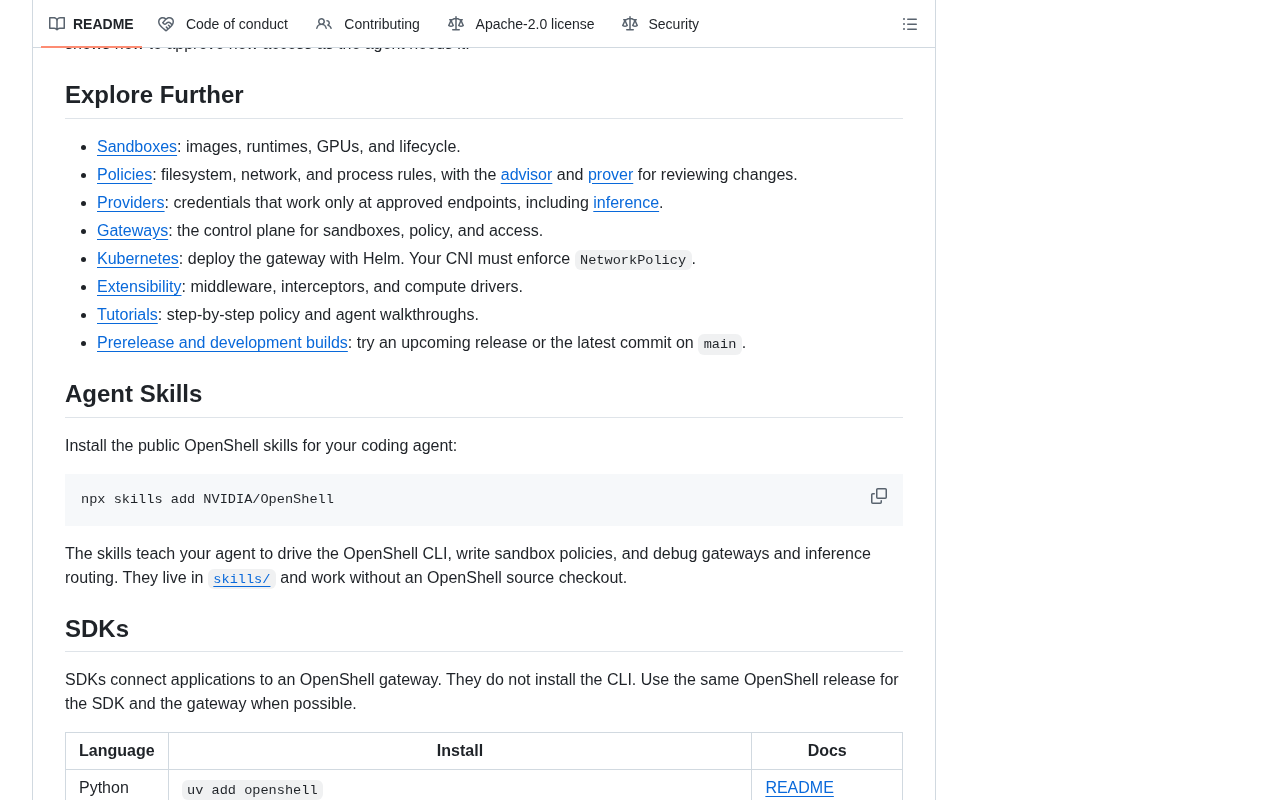
NVIDIA/OpenShell: Building a Locked Room for Autonomous Agents
Project positioning: A security runtime open-sourced by NVIDIA, purpose-built for running autonomous AI agents.
Problem it solves: For an agent to get work done, it needs permissions — to read files, invoke commands, make network requests. These capabilities are cool in demos but a disaster waiting to happen in production. Most teams today either force-fit containers or just run things in a sandbox, with very fuzzy permission boundaries. OpenShell aims to fill this gap by making the agent's execution environment itself something controllable and auditable.
Core features: From the project description, its two keywords are secure — meaning permission isolation and resource constraints — and private — meaning data never leaves the local environment. For teams doing enterprise-grade agent deployment, these two words are the hardest nuts to crack.
Use cases: Plugging agents into internal company systems to let them operate databases, modify code, or handle tickets. In these scenarios, the boss's first question is always: will it go rogue? OpenShell is the answer to that question.
Tech stack: Rust. This choice says a lot. Runtime components fear memory vulnerabilities and unpredictable latency above all else, and Rust treats both. For systems-level developers, NVIDIA betting on Rust for this kind of foundational component is itself a signal.
Stars analysis: Over 18,000 stars, up 200+ today. For a relatively new runtime project, the growth is steady rather than explosive. This suggests it's being followed by people who genuinely have deployment needs, not pushed up by novelty traffic.
Renhuai123/ziwei-doushu: Two-Thousand-Year-Old Astrology Meets TypeScript
Project positioning: An open-source charting engine for Zi Wei Dou Shu (Purple Star Astrology), based on Ni Haixia's Tianji system.
Problem it solves: The Zi Wei Dou Shu community is interesting — there are lots of tools, but the vast majority are closed-source black boxes, and you have no way to verify whether the chart they produce is correct. Different schools also have algorithmic differences, and few explain the rules clearly. This project open-sources the charting algorithm, the Four Transformations system, a pattern knowledge base, and original classical text data — effectively opening the black box for you to see inside.
Core features: Beyond calculating charts, it also includes a pattern knowledge base and original classical texts. So it's not just a calculator — more like a queryable knowledge graph. If you want to know which book a certain pattern comes from and what the original wording was, you can match it directly.
Use cases: Developers building astrology apps can use it directly as a backend engine. Researchers can use it for school comparison and algorithm verification. And of course, plenty of hobbyists use it just to cast their own charts.
Tech stack: TypeScript. This means it's naturally suited to web and mini-programs. Traditional astrology tools are mostly stuck in the desktop software era, so this choice is quite smart.
Stars analysis: Over 6,500 stars, up 500+ today — clearly anomalous growth, one of the biggest gainers on today's list. The Chinese community's viral effect is obvious; once a project with cultural cachet gets shared, it climbs fast.
SnailSploit/Claude-Red: Giving Claude an Attack Playbook
Project positioning: An offensive security skill library for Claude's skills system.
Problem it solves: Claude's skills mechanism lets the model load structured professional methodologies. But nobody had systematically organized security offense and defense. This project turns SQL injection, shellcode, EDR bypass, exploit development, and other areas into individual SKILL.md files — effectively feeding the model expert methodology.
Core features: Each skill is a structured Markdown file that breaks down an attack surface into steps. The benefit of this design is composability and auditability. Red teamers can load skills on demand instead of letting the model guess blindly.
Use cases: Security teams doing authorized penetration testing, attack-defense exercises, or self-auditing their own systems' weak points.
Tech stack: Python, but the real core is that batch of Markdown methodology files. This also reflects a trend: prompts and knowledge files are becoming a new kind of engineering artifact.
Stars analysis: 8,000 stars, up 200+ today. This kind of tool naturally attracts controversial traffic, but its star base shows the security community is genuinely using it.
OpenBMB/VoxCPM: Speech Synthesis Without a Tokenizer
Project positioning: VoxCPM2, a tokenizer-free multilingual speech synthesis model supporting creative voice design and highly faithful voice cloning.
Problem it solves: In traditional TTS pipelines, the tokenizer is an unavoidable step — it determines what the model can read. Removing the tokenizer means a more thorough end-to-end approach, with greater freedom when handling mixed languages, rare expressions, and non-textual vocal information.
Core features: Three clear selling points. Multilingual generation, creative voice design — meaning you can describe a voice and have it generated — and realistic voice cloning.
Use cases: Teams producing audio content, products needing multilingual dubbing, and games or animation projects requiring custom voices. Voice cloning requires extra care around compliance — that's on the user to handle.
Tech stack: Python, typical for a model project. For developers in speech, the tokenizer-free approach is worth studying because it simplifies the entire pipeline.
Stars analysis: Nearly 40,000 stars, up 140+ today. Growing steadily at such a large base means it's past its explosive phase and into sustained use.
nodejs/node: The Veteran Still on the Charts
Project positioning: The official Node.js runtime — no explanation needed.
Problem it solves: It solves the old problem of running JavaScript on the server. Its appearance on the charts today is more about presence — a sign that the ecosystem is still active.
Core features: Cross-platform, event-driven, massive package ecosystem. For most readers, this is common knowledge.
Use cases: Backend services, command-line tools, build scripts, full-stack development. Nearly every web team depends on it.
Tech stack: JavaScript and C++. If you want to study how a runtime is designed, this is a great sample.
Stars analysis: 120,000 stars, up 76 today. For a project this large, that daily gain is perfectly normal — an old tree that stays evergreen.
Today's Common Trends
The first trend is obvious: agent infrastructure is stratifying. NVIDIA handles runtime security, Claude-Red handles capability injection — one covers the foundation, the other the upper layer. This shows the agent ecosystem has moved from writing demos to building engineering systems.
The second trend is that knowledge itself is being engineered. Claude-Red's skills are all Markdown; the Zi Wei Dou Shu project treats classical texts as data. Everyone is organizing domain knowledge into structures machines can consume — this may be a very important thread over the next year.
The third trend is Rust's growing presence in foundational components. NVIDIA choosing Rust for a runtime is no accident.
Today's Must-See TOP 3
First, NVIDIA/OpenShell. If you're working on agent deployment, this is the one to look at today.
Second, SnailSploit/Claude-Red. Friends in security, and anyone studying the skills mechanism, should flip through its SKILL.md structure.
Third, OpenBMB/VoxCPM. The tokenizer-free path for speech synthesis has high technical reference value.
Overall, today's list doesn't have any astonishing new thing, but it's very engineering-heavy. The foundation is getting thicker, and that's good for the whole ecosystem.
One-line Summary
NVIDIA open-sources the Rust security runtime OpenShell, giving autonomous agents permission isolation and private deployment; the Zi Wei Dou Shu charting engine gains 500+ stars in a day as culturally flavored open-source projects spread rapidly in the Chinese community; Claude-Red turns security offense-defense methodology into a SKILL.md skill library, representing the trend of engineering domain knowledge.
Related articles

Let the Agent Be the Director: A Vision for a Fully Local AI Production Workstation
A Bilibili creator envisions building a local AI director workstation with NVIDIA RTX Spark, letting an Agent orchestrate script, storyboard, video generation, voiceover, auto-editing, and review for full AI production.

Zen Browser: The Perfect Replacement for Arc?
Zen Browser, an open-source alternative to Arc, inherits vertical tabs and sidebar workspaces while enhancing privacy and customization. This article analyzes its design philosophy, feature comparison, and community ecosystem, exploring why it's a new choice for Arc users.

Behind a Million Elevator Maintenance Jobs: How TK Elevator Uses AI to Unlock Decades of Knowledge
TK Elevator shares in Cologne how technology gives maintenance technicians fast access to decades of shared knowledge, reducing search time and improving elevator and escalator maintenance efficiency. This article analyzes its knowledge reuse logic and implications for AI in field service.