Selective Tie Learning: A New Solution to Spurious Correlations in Preference Optimization

Selective Tie Learning theoretically selects efficient ties to reduce spurious correlations in preference optimization with less data.
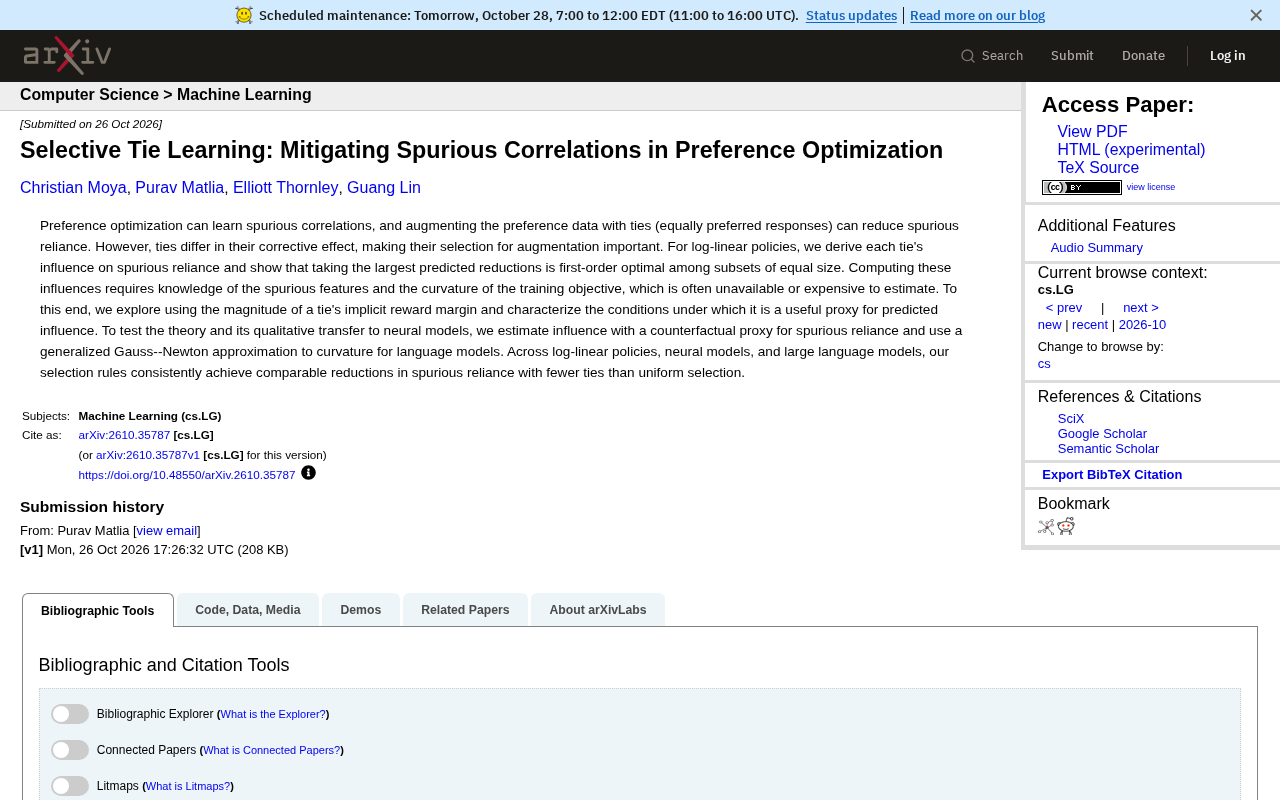
Preference optimization models are prone to learning spurious correlations, i.e., relying on task-irrelevant features for predictions. Injecting tie data (pairs of equally preferred responses) can mitigate this, but different ties vary significantly in effectiveness. A new study proposes Selective Tie Learning: theoretical analysis shows that selecting ties with the largest predicted reduction is first-order optimal, but computing impact requires spurious features and curvature. The researchers explored implicit reward margin magnitude as a proxy and used counterfactual proxies and Generalized Gauss-Newton approximation for impact estimation on neural networks and large language models. Experiments show that compared with uniform selection, selective ties achieve comparable or better results in reducing spurious correlation dependence with fewer ties, providing theoretical guidance and a practical tool for data-efficient debiasing strategies.
Preference optimization (such as reward modeling in RLHF) is prone to learning spurious correlations, where the model relies on features irrelevant to the task when making predictions. One mitigation approach is to inject "ties" (pairs of responses that are equally preferred) into the preference data, but different ties vary greatly in their effectiveness at reducing spurious correlations. A recent study proposes "Selective Tie Learning," which uses theoretical analysis to筛选 out the most effective ties, thereby achieving debiasing effects comparable to or even better than uniform selection with fewer ties.
Where Do Spurious Correlations Come From?
Preference optimization models typically learn human preferences from pairwise comparisons. If spurious associations exist in the training data (e.g., response length correlated with preference labels), the model may rely on these features rather than true quality. Such spurious correlations lead to performance degradation on out-of-distribution data.
Injecting tie data (i.e., two responses labeled as equally preferred) is thought to weaken spurious correlations because ties provide no discriminative signal, forcing the model to ignore irrelevant features. However, ties are not equivalent: some ties can more effectively correct the model's erroneous dependencies, while others may have little effect.
Spurious correlation in preference optimization specifically refers to non-causal associations between input features and preference labels learned by the model. For example, if longer responses happen to be selected more often in the training data, the model may mistake "length" for a signal of "quality." This association may improve fitting within the training distribution, but on out-of-distribution (OOD) data, when length and quality decouple, model performance drops significantly. The root cause of spurious correlations lies in the observational bias of preference data: human annotators' choices are influenced by many factors that are not necessarily aligned with the task objective. Therefore, the goal of debiasing is to make the model rely on features truly relevant to the task rather than these incidentally correlated surface features.
Theoretical Analysis: The Impact of Ties Can Be Quantified
For log-linear policies, the researchers derived the impact of each tie on spurious correlation dependence. They found that within subsets of the same size, selecting the tie with the largest predicted reduction is "first-order optimal." However, computing this impact requires knowledge of the spurious features and the curvature of the training objective, which is often unavailable or computationally expensive in practice.
Therefore, the researchers explored using the implicit reward margin magnitude of ties as a proxy for impact prediction and characterized the conditions under which it serves as a useful proxy. Theory shows that under certain conditions, reward margin magnitude is positively correlated with impact size, providing a convenient signal for practical selection.
Implicit reward margin refers to the difference in reward scores implicitly assigned by a preference optimization model (such as the Bradley-Terry model) to a pair of responses. Specifically, if the model's implicit reward for response A is r(A) and for response B is r(B), then the margin magnitude is |r(A)-r(B)|. In tie data, two responses are labeled as equally preferred, and ideally the model should assign them similar rewards, i.e., the margin magnitude should approach zero. However, before training, the model may assign a large margin magnitude to this tie pair, reflecting the model's degree of discrimination between the two responses. Theoretical analysis shows that ties with larger margin magnitudes often correspond to the model's currently more "confident" erroneous distinctions, so correcting them may be more effective at reducing spurious correlation dependence. This proxy metric requires no knowledge of the true spurious features and can be computed solely from model outputs, providing convenience for practical selection.
From Theory to Practice: Validation on Neural Models
To verify the transferability of the theory to neural network models, the researchers employed a counterfactual proxy to estimate the impact on spurious correlation dependence and used the Generalized Gauss-Newton approximation to estimate the curvature of language models. This allowed them to approximately compute the impact of each tie and select accordingly.
Experiments covered log-linear policies, neural network models, and large language models. Results show that compared with uniform tie selection, the proposed selection rule consistently achieves comparable effectiveness in reducing spurious correlation dependence but requires fewer ties. This means that in scenarios with high annotation costs, Selective Tie Learning can significantly reduce data requirements.
Generalized Gauss-Newton (GGN) is a method for approximating the curvature (Hessian matrix) of neural network loss functions. In preference optimization, curvature reflects the sensitivity of model parameters to the training objective and is a key component in computing the impact of each tie. Exactly computing the Hessian matrix is extremely computationally expensive for large language models (with parameter counts reaching billions), so the researchers adopted the GGN approximation, using the outer product of Jacobian matrices to approximate the Hessian, thereby estimating curvature at acceptable computational cost. GGN significantly reduces computational complexity while maintaining a certain level of accuracy, making impact estimation feasible on LLMs.
Multi-Source Cross-Validation and Consensus
The study integrates theoretical derivations with empirical experiments, and the conclusions are consistent across multiple model architectures, enhancing credibility. Although effect sizes may vary across models, the core conclusion that "selective is better than uniform" is supported by multiple sources.
Implications for Preference Optimization Practice
The significance of this work lies in providing a data-efficient debiasing strategy. In actual RLHF pipelines, collecting tie data is cheaper than pairwise preference data, but there has been a lack of theoretical guidance on how to select ties. Selective Tie Learning provides an actionable criterion: prioritize ties with large implicit reward margin magnitudes.
Of course, this method relies on curvature approximation and may introduce additional computational overhead on extremely large-scale models. Future work could explore more efficient approximation methods or extend the selection strategy to other preference optimization algorithms (such as DPO).
In summary, Selective Tie Learning provides a new theoretical perspective and practical tool for mitigating spurious correlations in preference optimization, promising to advance the development of more robust and data-efficient preference learning systems.
Direct Preference Optimization (DPO) is a preference optimization algorithm that requires no explicit reward model; it merges reward modeling and policy optimization into a simple classification loss through reparameterization. DPO directly updates language models using preference pair data, avoiding the complex reinforcement learning pipeline in RLHF, and is therefore popular in practical applications. However, DPO is also prone to learning spurious correlations, and its loss function handles tie data differently from reward-model-based methods. The core idea of Selective Tie Learning—prioritizing ties with large implicit reward margin magnitudes—can in principle be transferred to DPO, but impact estimation needs to be re-derived for its loss surface. Future work could explore designing efficient selection criteria within the DPO framework to further expand the applicability of this method.
Related articles

Vibe Coding Full-Stack in Practice: AI Programming from Beginner to Enterprise Deployment
From Cursor to Claude Code, this Bilibili AI programming course uses four progressive projects to cover full-stack development, open-source secondary development, and team collaboration. The article analyzes the shock to frontend roles, the efficiency shift from 50 people to 5, and the methodology required for enterprise-grade projects.

David Blaine's Global Quest for Real Magic: From South Africa to Japan and India
David Blaine travels to South Africa, Japan, and India in his Do Not Attempt special, documenting Spinning drivers, black mamba rescuers, iaijutsu masters, and ascetics—exploring the boundary between magic and real human极限 challenges.

Is a Touchscreen MacBook Coming? Vergecast Reveals Apple Executive's Response
Vergecast podcast reveals a conversation between a reporter and Apple executive John Ternus about a touchscreen MacBook and Apple Pencil support. Ternus says iPad is the best device for a stylus, while the reporter bets MacBook will eventually support Apple Pencil.