Self-Consistency Certification Under Correlation: Why Population Reliability Fails

Positive correlation in repeated sampling makes standard self-consistency certification valid only for the realized null; prompt-level e-processes are needed.
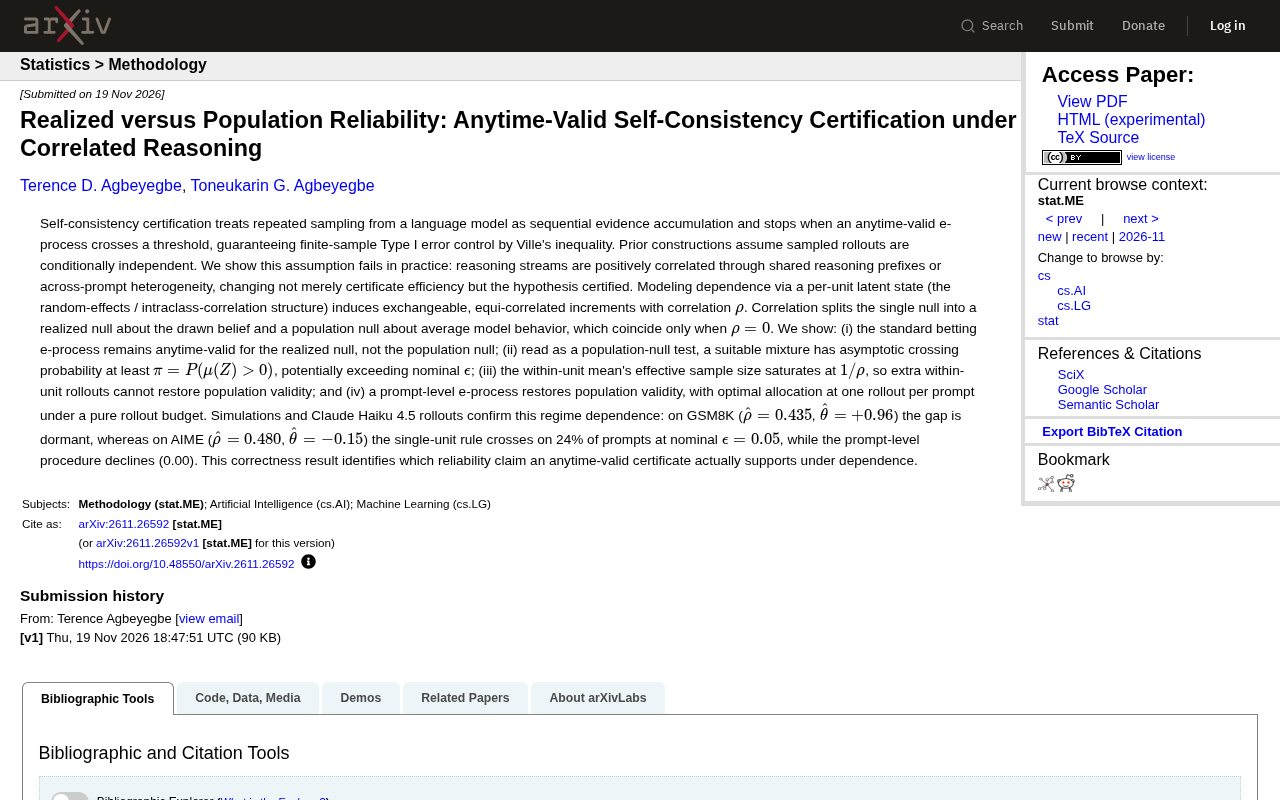
This paper reveals a neglected statistical flaw in self-consistency certification for large model reasoning: with positive correlation in repeated sampling, the standard betting e-process remains anytime-valid only for the "realized null" but cannot support the "population null" of average model behavior. Correlation is characterized by ρ, causing the effective sample size of within-unit means to saturate at 1/ρ, so more repeated sampling cannot restore population validity. Empirically, on AIME the single-unit rule falsely crossed on 24% of prompts, while prompt-level e-processes correctly rejected. The study advocates prompt-level e-processes, with the optimal strategy under a pure rollout budget being one sample per prompt.
The "Self-Consistency" certification commonly used in large model reasoning is facing a neglected statistical assumption crisis. A recent study points out that when repeated sampling is treated as independent evidence for anytime-valid testing, this premise does not hold in practice—the presence of correlation silently changes the reliability claims that the certificate supports.
Core Problem: The Collapse of the i.i.d. Assumption
Traditional self-consistency certification methods treat repeated sampling from language models as sequential evidence accumulation, using e-processes to stop when a threshold is exceeded, thereby guaranteeing finite-sample Type I error control via Ville's inequality. The premise of this framework is that each sampled reasoning trajectory (rollout) is conditionally independent.
However, the study explicitly points out that real-world reasoning streams often exhibit positive correlation through shared reasoning prefixes or cross-prompt heterogeneity. This correlation not only affects the efficiency of the certificate but, more critically, changes the hypothesis being tested itself. By introducing a per-unit latent state (i.e., a random-effects / intraclass correlation structure), the researchers established an exchangeable, equicorrelated incremental model, with correlation characterized by the parameter ρ.
e-process and Ville's Inequality
An e-process (evidence process) is a class of nonnegative martingales whose core advantage is enabling "anytime-valid" hypothesis testing as data continuously arrives, without pre-fixing the sample size or correcting for multiple comparisons. Ville's inequality is the theoretical cornerstone of e-processes, guaranteeing that under the null hypothesis, the probability that the e-process exceeds the threshold 1/ε at any time is at most ε, thereby controlling the Type I error rate. Unlike traditional p-values, an e-process can safely decide after each observation whether to stop the experiment, making it particularly suitable for the sequential "sample until satisfied" scenarios in language model reasoning. However, the validity of Ville's inequality depends on the martingale property of the e-process, which in turn requires that samples are conditionally independent (or at least satisfy predictability). When positive correlation exists between repeated samples, the martingale property of the e-process may be broken, thereby affecting its validity claims.
The Split of Two "Null Hypotheses": Realized vs. Population
The introduction of correlation splits the originally single null hypothesis into two distinct concepts: the "realized null" concerning the sampled belief and the "population null" concerning the model's average behavior. The two coincide only when ρ=0.
The study's core finding is sobering: the standard betting e-process remains anytime-valid for the realized null but is not valid for the population null. If misread as a test of the population null, a suitable mixture strategy has an asymptotic crossing probability of at least π=P(μ(Z)>0), which may exceed the nominal ε level.
Moreover, the effective sample size of the within-unit mean saturates at 1/ρ, meaning that even increasing the number of repeated samples within a unit cannot restore population validity.
Random Effects and Intraclass Correlation (ICC)
Intraclass correlation (ICC) measures the degree of similarity between repeated observations within the same unit, commonly denoted by the parameter ρ. In self-consistency certification, each prompt can be regarded as a unit; multiple rollouts within a unit share the same prompt prefix and latent reasoning path, so positive correlation (ρ>0) naturally exists. The random-effects model treats each unit's true belief μ(Z) as a latent variable drawn from a population distribution, with within-unit observations fluctuating around this latent value. This structure leads to two different null hypotheses: the realized null targets the specific belief of the sampled unit (fixed effect), while the population null targets the model's average behavior across all prompts (random effect). When ρ=0, within-unit observations are independent and the two coincide; when ρ>0, the standard e-process remains anytime-valid only for the former, and testing the latter may severely inflate the Type I error. Understanding ICC is key to grasping the core argument of this paper.
Effective Sample Size Saturation
In the presence of intraclass correlation, the variance of the within-unit mean no longer decreases linearly with the number of repetitions n but instead approaches a lower bound determined by ρ. Specifically, the effective sample size saturates at 1/ρ: when n is much larger than 1/ρ, continuing to increase within-unit repeated sampling provides almost no additional information about the population mean. This is because repeated observations are highly correlated, and the independent information contributed by new samples drops sharply. This phenomenon directly challenges the intuition that "more sampling brings stronger evidence" and provides a theoretical basis for the optimal allocation strategy of prompt-level e-processes—under a pure rollout budget, spreading sampling across more independent prompts is far more effective than repeated sampling on a single prompt.
Empirical Validation: Divergent Behavior on GSM8K and AIME
Simulation experiments and rollout results from Claude Haiku 4.5 confirm this regime-dependent effect. On the GSM8K dataset (ρ̂=0.435, θ̂=+0.96), the gap between the two hypotheses remains latent; on the AIME dataset (ρ̂=0.480, θ̂=-0.15), however, the problem is fully exposed—at nominal ε=0.05, the single-unit rule triggered crossings on 24% of prompts, while the prompt-level procedure correctly rejected crossings (0.00).
This contrast clearly shows that in scenarios with high correlation and an unfavorable effect direction, single-unit certification may give severely misleading reliability signals.
Solution: Prompt-Level e-process
The fix proposed by the study is to adopt a prompt-level e-process to restore population validity. Under a pure rollout budget, the optimal allocation strategy is to perform only one rollout per prompt. This conclusion challenges the intuition that "more sampling brings stronger evidence"—when correlation exists, increasing sampling within the same unit is actually wasteful.
This correctness result ultimately answers a deeper question: under dependence structures, which reliability claim does an anytime-valid certificate actually support. For practitioners building reliable AI systems, this means re-examining the statistical foundations of self-consistency certification rather than simply following standard procedures under the independence assumption.
Mixture Strategies and Asymptotic Crossing Probability
A mixture strategy is a method of weighted averaging over multiple e-processes, commonly used to construct anytime-valid tests under composite null hypotheses. In this paper, if the standard betting e-process is misread as a test of the population null, a suitable mixture strategy has an asymptotic crossing probability of at least π=P(μ(Z)>0), where μ(Z) is the unit's latent belief and π represents the proportion of units in the population whose true belief is positive. When π exceeds the nominal significance level ε, the test will erroneously reject the population null with high probability even if the data come entirely from the null. This result quantifies the severe consequences of misusing the standard e-process and highlights the necessity of the prompt-level e-process—the latter restores valid control of the population null by running e-processes independently on each prompt and then combining them.
One-line Summary
Positive correlation in repeated sampling makes standard self-consistency certification valid only for the realized null, necessitating a switch to prompt-level e-processes.
Paragraph Summary
This paper reveals a neglected statistical flaw in self-consistency certification for large model reasoning: when repeated sampling exhibits positive correlation, the standard betting e-process remains anytime-valid only for the "realized null" but cannot support the "population null" concerning the model's average behavior. Correlation is characterized by the parameter ρ, causing the effective sample size of the within-unit mean to saturate at 1/ρ; increasing repeated sampling cannot restore population validity. In empirical tests on GSM8K and AIME, the single-unit rule falsely triggered crossings on 24% of prompts on the AIME dataset, while the prompt-level e-process correctly rejected. The study proposes adopting prompt-level e-processes to restore population validity and notes that under a pure rollout budget, the optimal strategy is to sample only once per prompt. This finding requires practitioners to re-examine the statistical foundations of self-consistency certification.
Related articles

Vibe Coding End-to-End in Practice: A One-Person Company Development Guide for the AI Era
An analysis of the 80-episode Vibe Coding tutorial: from humans directing AI to write code to a full product loop, covering AI-collaborative development, UniApp multi-platform, and AI-automated operations, while clarifying that workflow orchestration is not AI development.

Aligned Models Are All Alike; Every Misaligned Model Is Misaligned in Its Own Way
A Tolstoy-inspired community observation reveals AI alignment's core challenge: aligned models converge, while misaligned models fail in wildly diverse ways.

Kodak Charmera Mini Camera Drops to $30: Retro Charm Beats Image Quality
Kodak Charmera keychain camera on sale for $30. Review calls image quality mediocre but charm undeniable. Learn about this mini retro camera's positioning and buying advice.