Vibe Coding End-to-End in Practice: A One-Person Company Development Guide for the AI Era
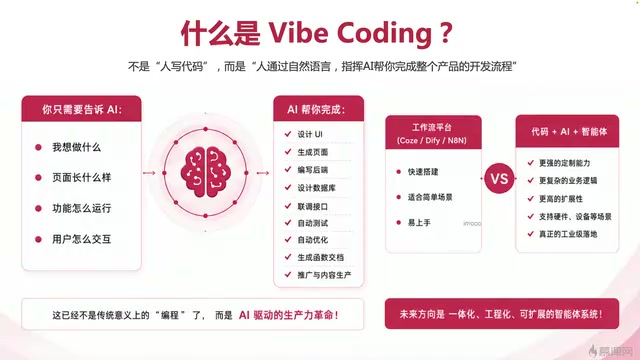
Vibe Coding lets humans direct AI to write code, but industrial-grade delivery still requires engineering and full-loop closure.
Based on Bilibili creator "Storyboard Cinema"'s 80-episode "Vibe Coding: Zero-to-Hero Practical Tutorial," the article outlines the core logic of AI restructuring software development. Vibe Coding is defined as humans directing AI to write code; AI can generate pages, write code, connect to databases, and automatically fix bugs, thereby leveling the technical barrier. The article specifically clarifies a misconception: workflow orchestration tools like Coze, Dify, and n8n are merely basic-level applications—what can truly deliver industrial-grade implementations is the "AI + code + agents + engineering" system. The course emphasizes full-loop closure, covering requirements analysis, UI design, development and testing, deployment, and operations/promotion, and leverages UniApp and AI code generation to achieve "develop once, run everywhere," using AI to automatically generate copy and videos for self-promotion. It ultimately points toward "one-person companies" and super-individuals, but the author reminds us that equal access to tools does not equal equal capability—requirements judgment and quality control still depend on comprehensive human qualities.
AI is evolving from a tool into an entirely new form of productivity, and the way software is developed has been fundamentally restructured as a result. The 80-episode "Vibe Coding: Zero-to-Hero Practical Tutorial" by Bilibili creator "Storyboard Cinema" (分镜影院) is a direct response to this trend—the course attempts to guide zero-foundation learners through the complete product loop, from requirements analysis all the way to operations and promotion. Based on the course's introductory video, this article outlines the core logic of Vibe Coding, common misconceptions, and the path to engineering-driven implementation.
From "Humans Writing Code" to "Humans Directing AI"
In the past, building a product required coordination across product managers, designers, frontend, backend, testing, operations, and more. Anyone wanting to ship a product independently had to understand design, frontend, backend, databases, servers, and even operations all at once. Many people don't lack ideas—they lack the ability to bring those ideas to life.
The core definition of Vibe Coding can be summed up in one sentence: it's no longer humans writing code, but humans directing AI to write code. You tell the AI what pages you want, what those pages should look like, and how the features should work, and the AI can generate pages, write code, connect to databases, automatically test and fix bugs, and even generate documentation and promotional content.
The significance of this model lies in leveling the technical playing field: previously humans had to adapt to code; now AI understands human language. The creator believes the answer to whether everyone will be able to develop software in the future is a resounding yes—but only on the premise that people understand what real AI development actually is.
Don't Mistake Workflow Orchestration for AI Development
The course specifically calls out a widespread misconception: many people's understanding of AI development is still stuck at workflow orchestration tools like Coze, Dify, and n8n, assuming that wiring up a few nodes and running a few processes means they know AI development. The creator makes it clear that these are merely basic-level AI applications.
The core direction that can truly deliver industrial-grade implementations, develop complex systems, and build the AI products of the future is the "AI + code + agents + engineering" system. What will be truly valuable in the future isn't simple chatbots, but applications like AI e-commerce, digital humans, automation systems, and AI enterprise platforms—and all of these ultimately come back to engineering capability.
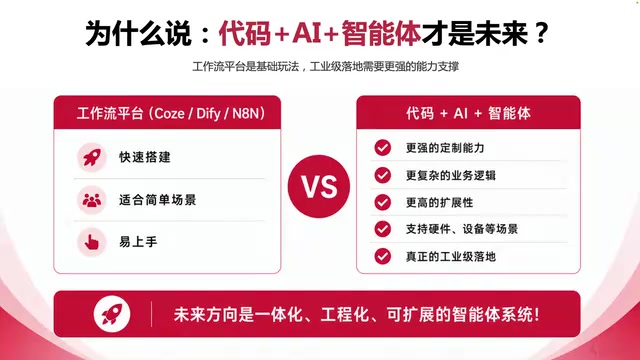
This judgment aligns with current industry trends: low-code workflows lower the barrier to automation, but when facing complex business logic, multi-platform adaptation, and system integration, engineering capability at the code level is still required as the foundation. Vibe Coding is not positioned to replace engineering—it's positioned to amplify engineering capability through AI.
MCP (Model Context Protocol) is an open protocol proposed and promoted by Anthropic to standardize how large language models connect to external tools, data sources, and services. You can think of MCP as the "USB interface of the AI world": models describe which tools they can invoke (such as reading/writing files, querying databases, calling third-party APIs) through a unified protocol, while external systems expose their capabilities according to the protocol—no need to write separate adapter code for each model. Its value lies in enabling AI coding assistants to reliably access project repositories, run tests, and read design mockups, thereby supporting the engineering loop of "AI participating in design, development, testing, and optimization." Skills, meanwhile, are closer to reusable capability encapsulation—packaging prompts, scripts, and tool invocations for specific tasks into standard modules that agents can load on demand in different scenarios. Together, the two form the infrastructure for tool collaboration in Vibe Coding.
Stitch is an AI interface design tool launched by Google that generates UI design mockups from natural language descriptions and exports frontend code, typically used in conjunction with design tools like Figma. It represents the "design-as-code" direction: design mockups are no longer just static images for developers to look at, but can be directly converted into runnable interface code, reducing the translation loss between design and development. In the collaborative system demonstrated in the course, Stitch is responsible for turning descriptions of what a page should look like into structured designs, which are then handed off to coding agents like Claude Code to complete the logic implementation—this is also a key link that enables "humans directing AI" to cover the design phase.
Full-Loop Closure: From Requirements to Operations, Not Just a Demo
The course emphasizes that a real product isn't just handwritten code—it's requirements analysis, UI design, page development, backend logic, databases, testing, deployment, and operations/promotion all connected together. The course's biggest distinguishing feature is full-loop closure—not building a simple demo, but guiding students through a complete product.
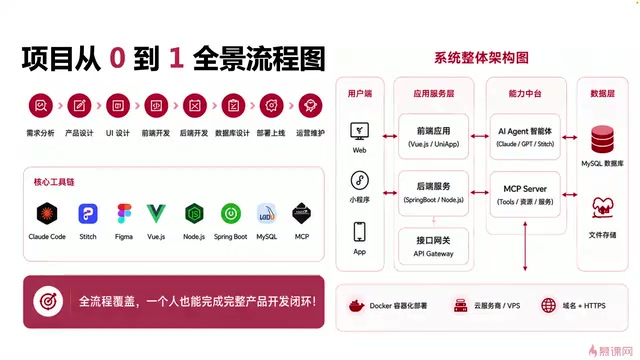
On the tech stack side, the course demonstrates the architecture of AI-collaborative development: tools like Claude Code, Stitch, MCP, Skills, and Figma work together, with AI no longer just chatting but participating in the entire process of design, development, testing, optimization, and operations. For multi-platform development, the course uses UniApp combined with AI-generated code and component reuse to achieve "develop once, run everywhere," dramatically reducing the cost of developing separately for Web, App, and mini-programs.
UniApp is a Vue-based cross-platform development framework where a single codebase can be compiled and published to Web, iOS/Android apps, WeChat mini-programs, H5, and other platforms. Its core mechanism is conditional compilation and a unified component layer that encapsulates platform differences within the framework, so developers only need to maintain one set of business code. In the context of AI-collaborative development, UniApp's significance is further amplified: on one hand, AI-generated page code and components can be reused and cross-compiled, avoiding redundant development for each platform; on the other hand, the componentized structure is naturally suited for AI understanding and generation—models can assemble pages based on existing component libraries rather than writing from scratch. This also explains why the course chose UniApp as the technical foundation for multi-platform delivery—it turns "develop once, run everywhere" from an engineering ideal into a workflow that AI can reliably execute.
AI Operations: Let the Product Promote Itself
Many people think product development ends once the product is built, but the real difficulty lies in promotion. The course points out that AI has already entered the operations domain: it can automatically generate WeChat official account articles, promotional copy, video scripts, and even automatically generate product promotional videos.
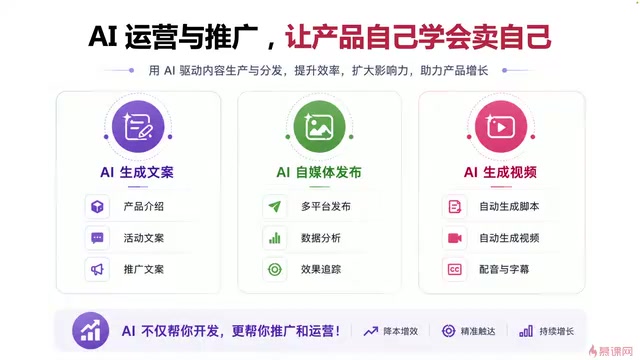
This means AI can help products complete the loop of "promoting themselves." The creator thus offers a judgment: the truly formidable people of the future will be those with dual capabilities in "development + AI operations." After completing the course, learners should possess five capabilities: independent product development, full-loop AI collaboration, AI engineering, multi-platform development, and AI-automated operations—all ultimately pointing toward the goal of "one person building a product."
The Opportunities and Barriers of One-Person Companies
The course states its two goals bluntly: first, learning—mastering engineering-driven AI product delivery rather than just knowing how to use a few AI tools; second, making money—because the future will see a large number of one-person companies, AI entrepreneurs, and super-individuals. For many people, the future may no longer be about finding a job, but about using AI to build products.
This vision has a realistic basis: AI is indeed eliminating large amounts of repetitive labor while also giving rise to super-individuals. But we need to be clear-eyed that equal access to tools does not equal equal capability—requirements judgment, system design, quality control, and operations strategy still depend on human judgment. Vibe Coding lowers the execution barrier while raising the bar for the comprehensive qualities of the "director."
The course ultimately lands on "AI creating products, AI creating value." For zero-foundation learners who want to enter the AI development era from scratch, this kind of full-loop practical course offers a reference path; for those with existing development experience, how to embed AI into existing engineering systems and avoid staying at the tool level is perhaps a question more worth pondering.
Related articles
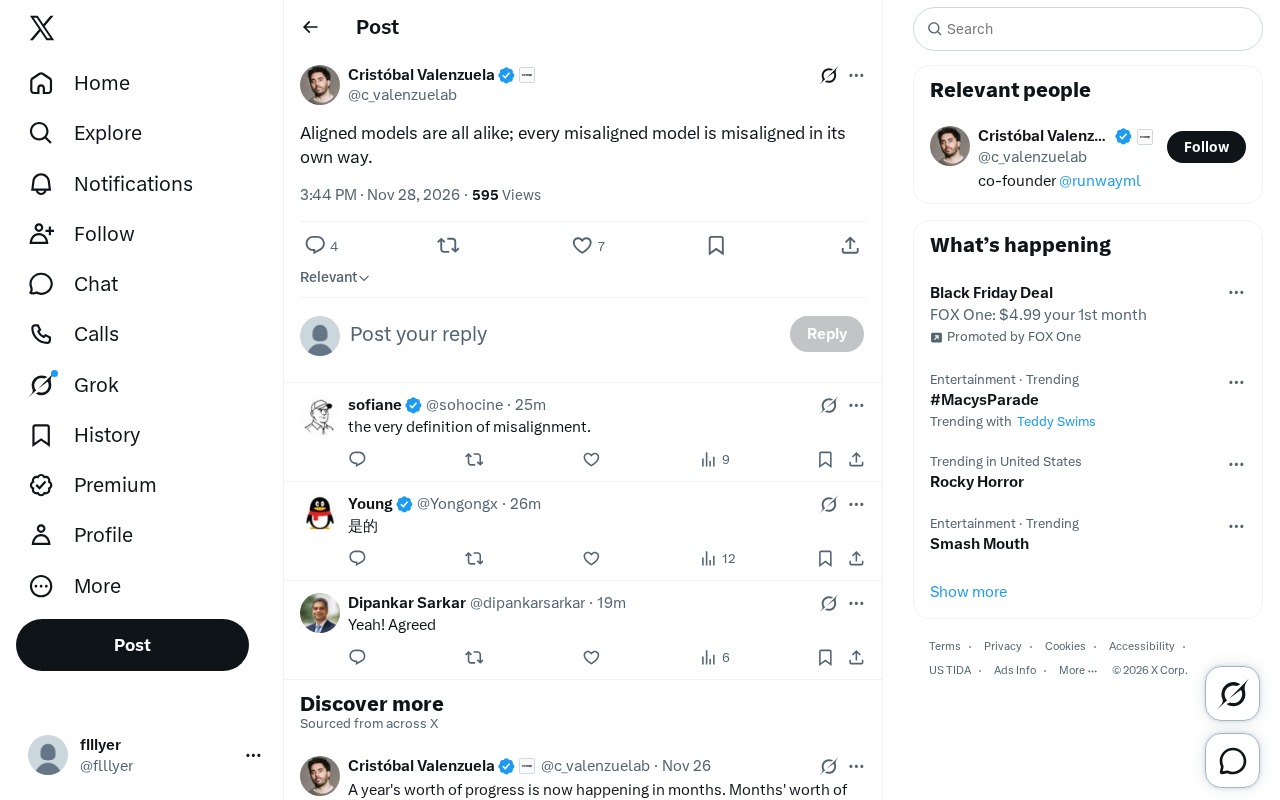
Aligned Models Are All Alike; Every Misaligned Model Is Misaligned in Its Own Way
A Tolstoy-inspired community observation reveals AI alignment's core challenge: aligned models converge, while misaligned models fail in wildly diverse ways.

Kodak Charmera Mini Camera Drops to $30: Retro Charm Beats Image Quality
Kodak Charmera keychain camera on sale for $30. Review calls image quality mediocre but charm undeniable. Learn about this mini retro camera's positioning and buying advice.

Audible Removes Download Option for Purchased Audiobooks, Sparking Fresh Debate Over User Rights
Audible removes the download option for purchased audiobooks, sparking heated discussion on Hacker News about digital content ownership and consumer rights. This article analyzes the background, user reactions, and the future of digital purchases.