Self-Evolving Agent Framework: Enabling Recursive Self-Improvement in Agents

The paper proposes Harness RSI: freezing model weights and revising only software scaffolding to achieve agent self-evolution, with theoretical guarantees.
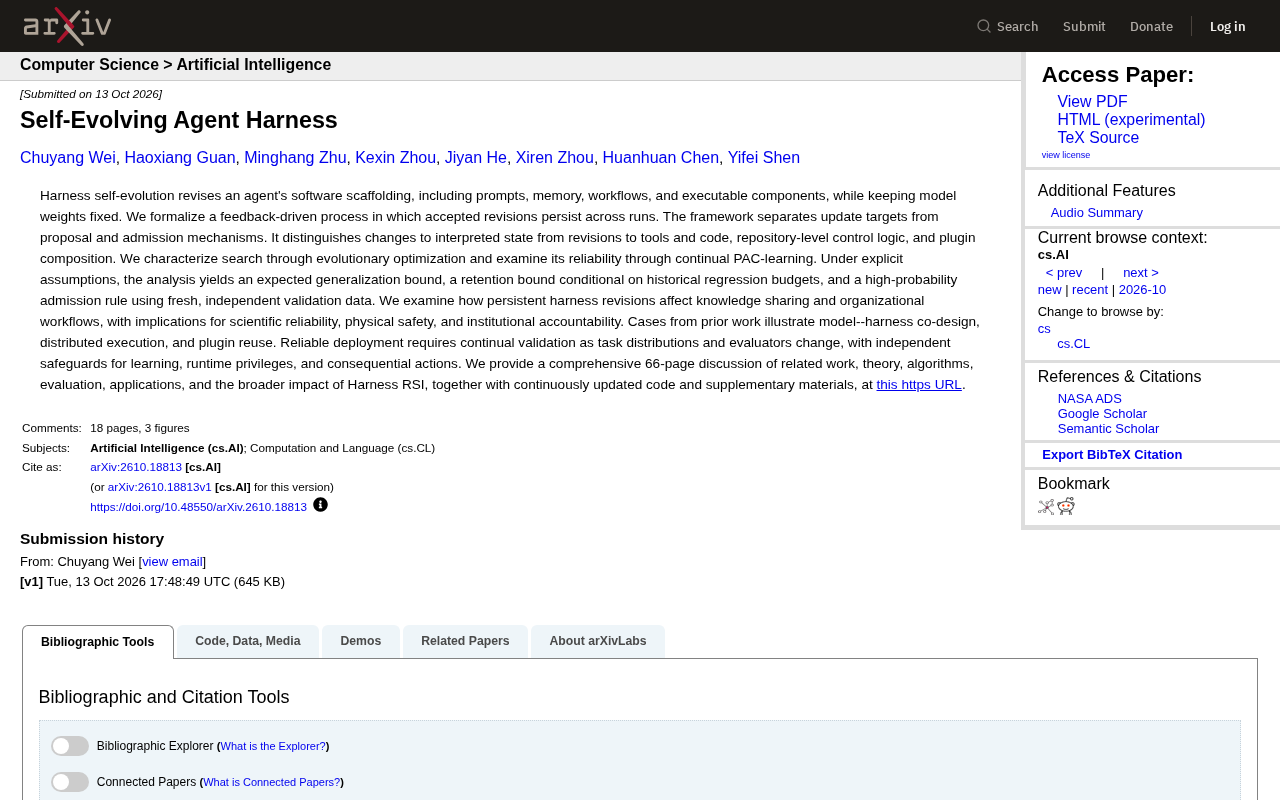
"Self-Evolving Agent Harness" proposes an agent evolution path that does not rely on model weight updates: achieving recursive self-improvement by revising the software scaffolding wrapped around the model (prompts, memory, workflows, executable components), with revisions persisting across runs. The paper decouples the update objective from the proposal and admission mechanisms, and uses continual PAC learning to analyze reliability, providing an expected generalization bound, a retention bound under a historical regression budget, and a high-probability admission rule based on independently verified data. The study also discusses the impact of continual revision on organizational knowledge sharing, scientific reliability, physical safety, and institutional accountability, emphasizing that learning, runtime permissions, and consequential operations require mutually independent assurance. The complete discussion covers theory, algorithms, evaluation, and applications, with code already open-sourced.
Agent capabilities have long depended on updates to model weights. But a study titled "Self-Evolving Agent Harness" proposes another path: achieving self-evolution by revising the agent's software scaffolding while keeping model weights unchanged.
What Is Harness Self-Evolution
The term Harness refers to the software scaffolding wrapped around a model, including prompts, memory mechanisms, workflows, and executable components. The core idea of Harness RSI (Recursive Self-Improvement) is: rather than modifying model parameters, this scaffolding is continuously revised within a feedback-driven loop, and adopted revisions persist across runs.
The value of this framework lies in decoupling—it separates the "update objective" from the "proposal mechanism and admission mechanism." The researchers further distinguish several classes of modification targets: changes to interpretive state versus revisions to tools and code, repository-level control logic, and plugin composition. Each has different properties and different reliability requirements.
Recursive Self-Improvement (RSI) is a core concept in AI safety and theory, referring to a system's ability to modify itself to enhance subsequent self-modification, thereby forming a potentially accelerating loop. Early discussions focused primarily on self-rewriting at the model weight or code level, with the risk that the improvement process could become uncontrollable or unauditable. Harness RSI constrains this concept to the software scaffolding layer: model parameters are frozen, and only external components such as prompts and workflows are revised, thus offering greater controllability and rollback capability. This constraint shifts RSI from theoretical speculation to an engineerable iterative process while preserving the cumulative effect brought by "persistence across runs."
PAC Learning (Probably Approximately Correct learning) is a classic framework in computational learning theory used to characterize the conditions under which a learner obtains an approximately correct hypothesis with high probability given a finite number of samples. Continual PAC learning extends this to scenarios where the task distribution changes over time and the learner continuously receives new data, requiring the model to adapt to new tasks without forgetting old capabilities. The paper uses this tool to provide theoretical bounds on generalization and retention for continual Harness revision.
Search, Theory, and Reliability Guarantees
The paper characterizes the Harness search process from the perspective of evolutionary optimization and analyzes its reliability using continual PAC learning. Under explicit assumptions, the analysis yields three key conclusions:
- Expected generalization bound: Describes the upper limit of the evolved Harness's performance on unseen tasks
- Retention bound: Constrains the degree to which old capabilities are preserved, conditioned on a historical regression budget
- High-probability admission rule: Uses fresh, independently verified data to determine whether a revision should be adopted
The significance of this theory is that it transforms "self-improvement" from a vague engineering intuition into a process with boundary conditions that can be verified. The admission rule is especially critical, because the greatest risk of continual revision is introducing hidden regressions.
The expected generalization bound describes the upper limit of the evolved Harness's expected performance on tasks it has never seen before, typically determined jointly by the complexity of the hypothesis space, the sample size, and differences in task distributions. It answers the fundamental question of "how good can it actually become after self-improvement," preventing accidental success from being mistaken for a general capability improvement.
The retention bound focuses on the degree to which old capabilities are preserved. The greatest hidden danger of continual revision is a scaffolding-level variant of "catastrophic forgetting": a modification may improve performance on new tasks while quietly breaking existing functionality. The retention bound quantifies, conditioned on a historical regression budget, the tolerable decline in old capabilities within a given budget, providing an actionable constraint for revisions.
The high-probability admission rule is the key link in translating theory into practice. It requires using fresh, independently verified data to determine whether a revision should be adopted, rather than relying on data seen during training. This reduces the risk of overfitting and hidden regressions, transforming "self-improvement" from engineering intuition into a decision process with statistical guarantees.
Impact on Organizations and Science
Continual Harness revision changes knowledge sharing and organizational workflows. The paper discusses its implications for scientific reliability, physical safety, and institutional accountability. When an Agent's scaffolding can evolve autonomously, who is responsible for its behavior and how a specific revision is audited become new institutional questions.
The paper cites cases from prior work to illustrate model-Harness co-design, distributed execution, and plugin reuse. A recurring conclusion is that reliable deployment requires continuous verification—because both task distributions and the evaluators themselves change, a revision that passes verification at one stage may not remain safe at the next.
Three Lines of Independent Assurance
The authors emphasize that learning, runtime permissions, and consequential operations require mutually independent assurance mechanisms. In other words, the module responsible for self-evolution should not simultaneously hold the authority to execute high-risk actions. This separation approach is consistent with traditional safety-critical system design.
The complete 66-page discussion covers related work, theory, algorithms, evaluation, applications, and the broader implications of Harness RSI, with code and supplementary materials continuously updated at https://github.com/zgcagi/Harness-RSI.
For practitioners focused on AI programming, AI applications, and frontier research, this direction is worth tracking: it may mean that future Agent improvements will occur more at the code and process level, rather than merely waiting for the next model release.
The separation of powers among learning, runtime permissions, and consequential operations essentially introduces the principle of "separation of duties" from safety-critical system design into agent architecture. The learning module is responsible for proposing and evaluating revisions, the runtime permissions module controls which tools and resources the agent can access, and the consequential operations module executes irreversible or high-impact actions. Independence among the three means that even if the learning module is misled or produces a malicious revision, it cannot directly trigger high-risk behavior. This design draws on defense-in-depth concepts from fields such as nuclear power plants and aviation, aiming to prevent single points of failure from causing systemic risk.
One-line Summary
The paper proposes Harness RSI: freezing model weights and revising only the software scaffolding to achieve agent self-evolution, with theoretical guarantees.
Paragraph Summary
"Self-Evolving Agent Harness" proposes a path for agent evolution that does not depend on model weight updates: achieving recursive self-improvement by revising the software scaffolding wrapped around the model (prompts, memory, workflows, executable components), with revisions persisting across runs. The paper decouples the update objective from the proposal and admission mechanisms, and uses continual PAC learning to analyze reliability, providing an expected generalization bound, a retention bound under a historical regression budget, and a high-probability admission rule based on independently verified data. The study also discusses the impact of continual revision on organizational knowledge sharing, scientific reliability, physical safety, and institutional accountability, emphasizing that learning, runtime permissions, and consequential operations require mutually independent assurance. The complete discussion covers theory, algorithms, evaluation, and applications, with code already open-sourced.
Related articles

Chain of Thought Isn't Just for AI: How Humans Can Use CoT to Improve Thinking Quality
Chain of Thought isn't just a prompt trick for large models. Starting from a Hacker News discussion, this article analyzes why CoT works for human thinking too, breaks down actionable ways to transfer it, and highlights the key differences between human CoT and machine CoT.
Cloudflare Teams Up with OpenAI: Closi…
Cloudflare Teams Up with OpenAI: Closing the Loop from Vulnerability Discovery to Defense with AI
Cloudflare uses OpenAI Daybreak to investigate security vulnerabilities and generate reviewable remediation plans, while developers use Codex to boost coding efficiency and quality.

Orca Multi-Agent Orchestration in Practice: A Guide to Parallel Collaboration with Claude and Codex
Orca is Stable AI's free open-source agent workbench supporting 34 agents like Claude Code and Codex in parallel. Learn its Git worktree isolation, multi-model orchestration, and mobile management.