Self-Evolving Agent Harness: The Self-Improvement of Agent Frameworks

Self-Evolving Agent Harness lets agent runtime frameworks automatically optimize prompts, tools, and scheduling strategies based on historical data, replacing manual parameter tuning.
A low-engagement Hacker News post points to an important direction—Self-Evolving Agent Harness. The Agent Harness is the runtime framework wrapped around an LLM, handling tool invocation, context management, and task orchestration, and its design quality directly affects Agent performance. Self-evolution means letting the Harness automatically optimize prompt structures, tool priorities, and failure strategies based on its operational history, replacing slow manual tuning. Yet it faces three challenges: sparse, delayed evaluation signals that risk random drift; enterprise requirements for auditable, reproducible behavior; and verification costs that may exceed evolution benefits. Community views are divided, but treating Harness configuration as a searchable space and building standardized evaluation pipelines is a pragmatic first step.
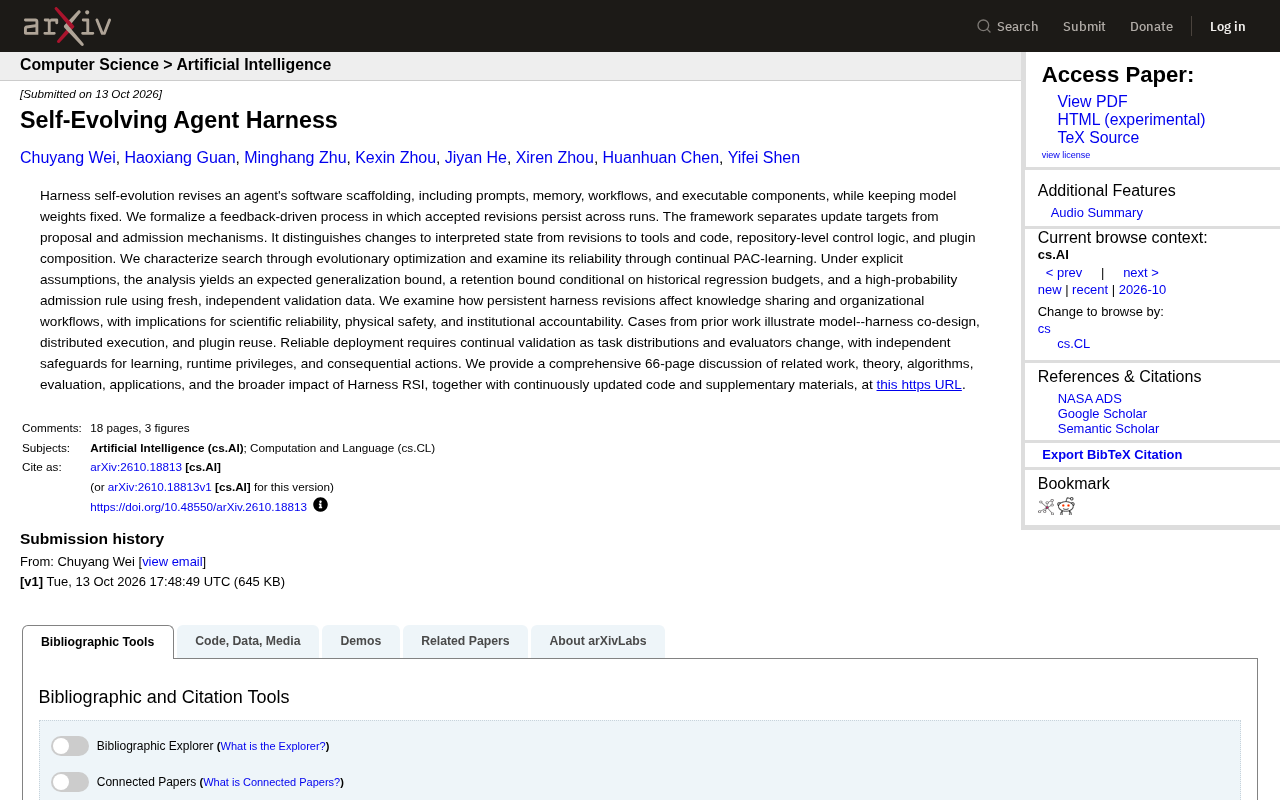
A new project called "Self-Evolving Agent Harness" has appeared on Hacker News. Although the post itself only has 3 upvotes and 0 comments, the concept points to an important direction brewing in the AI agent space: giving the Agent's runtime framework itself the ability to self-evolve.
What Is an Agent Harness
Before discussing "self-evolution," it's necessary to first understand the concept of a Harness. An Agent Harness refers to the runtime framework wrapped around an AI model—it handles tool invocation, maintains context state, orchestrates multi-step task flows, and manages error retries.
You can think of it as analogous to the relationship between an operating system and applications. The underlying large language model provides reasoning capability, while the Harness determines how that reasoning capability is organized, scheduled, and executed. Products like Claude Code, Cursor's Agent mode, and Devin all essentially contain a carefully designed Harness.
The design quality of the Harness directly affects the Agent's actual performance. The same model under different Harnesses can have task completion rates that differ by several times. This is why major AI companies are investing substantial engineering resources at this layer.
Context windows and state management are among the core functions of a Harness. Large language models themselves are stateless—each invocation only processes the token sequence of the current input, without retaining memory across calls. The Harness must design its own context management strategy: when to truncate historical conversation, when to perform summary compression, when to write intermediate results to external storage and retrieve them on demand. These strategies directly determine the Agent's information fidelity across multi-turn tasks. For example, after a code refactoring Agent runs 30 steps, file contents read early on may have been pushed out of the context window. If the Harness lacks an appropriate retrieval-and-reinjection mechanism, the Agent will "lose its memory" and repeat work. Products like Claude Code solve this problem through carefully designed context compression and file reference mechanisms.
What "Self-Evolution" Means
The core idea of Self-Evolving is: rather than having human engineers manually adjust the Harness's prompts, tool sets, and scheduling strategies, let the Harness automatically optimize these components based on its own operational history data.
Specifically, this may include several layers:
Adaptive prompt adjustment. The Harness records which prompting strategies work better on specific task types and dynamically adjusts the structure and content of the system prompt.
Evolution of tool selection. Based on task success rates, automatically adjust the priority and combination of available tools, and even generate new tool wrappers.
Learning from failure modes. When the Agent repeatedly fails on a certain type of task, the Harness can identify the pattern and try different strategic paths rather than simply retrying.
This approach contrasts with traditional "human parameter tuning"—the latter iterates slowly and has limited coverage, while self-evolution mechanisms can theoretically accumulate improvements with each run.
AutoML and hyperparameter search provide an important reference for understanding Harness self-evolution. The core idea of AutoML is to transform configurations originally set by expert intuition—model architecture, learning rate, regularization coefficients, etc.—into optimization problems that can be automatically searched. In the Agent Harness scenario, one can similarly treat prompt templates, tool invocation thresholds, retry limits, and task decomposition granularity as hyperparameters, and use Bayesian optimization or evolutionary algorithms to search for better combinations over historical operational data. The difference is that traditional AutoML's search space is statically defined, whereas self-evolving Harness also involves expansion of the search space itself—such as automatically generating new tools. This upgrades the problem from "finding the optimum within a fixed space" to "continuously exploring in an open space," significantly increasing the difficulty.
Technical Challenges and Practical Constraints
The first difficulty facing self-evolving Harness is the design of evaluation signals. How does the Agent judge that it has "done better"? Task success or failure is often sparse and delayed feedback. Without clear reward signals, self-evolution may degenerate into random drift.
The second challenge is stability and predictability. Enterprise-grade applications require Agent behavior to be auditable and reproducible. A Harness that continuously self-modifies may change its behavior patterns without the user's knowledge, which is difficult to accept in compliance-sensitive scenarios.
The third issue is the contradiction between evolution speed and verification cost. Every modification to the Harness needs its effect verified, and verification itself consumes computational resources and time. If verification costs exceed the benefits brought by evolution, the entire mechanism loses its economic meaning.
Currently, the community has divergent attitudes toward this direction. Some developers believe this is an inevitable path for Agents to move toward true autonomy, while others worry that prematurely introducing self-evolution mechanisms before foundational model capabilities have stabilized will increase system complexity without bringing practical benefits.
Sparse rewards and credit assignment are underlying difficulties that self-evolution mechanisms cannot avoid. In a multi-step Agent task, the final success or failure often only becomes apparent dozens of steps later, and the contribution of each intermediate decision to the final result is difficult to quantify. This is highly isomorphic to the classic credit assignment problem in reinforcement learning. If the Harness cannot reasonably attribute final feedback to specific prompt strategies or tool choices, self-evolution becomes blind parameter perturbation. In practice, one compromise is to introduce a Process Reward Model to give dense scores to intermediate steps, but this introduces additional model training and maintenance costs, and the bias of the scoring model itself may be amplified by the self-evolution mechanism.
Implications for Developers
Regardless of whether Self-Evolving Agent Harness ultimately becomes a mainstream paradigm, the questions it raises are worth every Agent developer's consideration:
In current Harness designs, which parameters are set by intuition rather than data? Can these parameters be optimized through systematic experimentation? Even without achieving complete "self-evolution," establishing continuous monitoring and A/B testing mechanisms for Harness performance is a pragmatic first step.
Another direction worth attention is treating the Harness configuration itself as a searchable space. The AutoML approach—automated hyperparameter search—also applies at the Agent framework level. Rather than having engineers manually trial and error, it's better to build automated Harness evaluation pipelines.
Self-evolving Agent Harness is still in the conceptual exploration stage, and the extremely low engagement on this Hacker News post itself indicates it has not yet entered mainstream view. But the trend it points to—moving from manual engineering toward automated optimization—is a certain direction in the AI infrastructure field.
The special challenges of A/B testing in Agent scenarios deserve elaboration. Traditional web product A/B testing can randomly split users and control variables, but Agent task execution paths are highly dependent on specific inputs, and difficulty varies greatly between tasks. Directly comparing the average success rates of two groups can easily be misleading. A more robust approach is paired experimental design: run the same batch of tasks once each with the old and new Harness versions, and compare paired differences. Additionally, Agent operation costs are much higher than web requests, sample sizes accumulate slowly, and longer experimental cycles are needed. For teams wanting a pragmatic start, they can first establish a standardized task evaluation set (similar to a benchmark suite) and automatically run regression tests after each Harness change—this yields feedback signals faster than waiting for large-scale A/B tests.
One-line Summary
Self-Evolving Agent Harness lets Agent runtime frameworks automatically optimize prompts, tools, and scheduling strategies based on historical data, replacing manual parameter tuning.
Paragraph Summary
A project with very low discussion on Hacker News points to an important direction—Self-Evolving Agent Harness. An Agent Harness is the runtime framework wrapped around a large language model, responsible for tool invocation, context management, and task orchestration, and its design quality directly affects the Agent's actual performance. The core idea of self-evolution is to let the Harness automatically optimize prompt structures, tool priorities, and failure response strategies based on its own operational history, replacing slow and limited-coverage manual parameter tuning. However, this direction faces three challenges: evaluation signals are sparse and delayed, easily causing evolution to degenerate into random drift; enterprise applications require auditable and reproducible behavior, which continuous self-modification struggles to satisfy for compliance; and verification costs may exceed evolution benefits, making the mechanism economically meaningless. Community attitudes are divided, but treating Harness configuration as a searchable space and building standardized evaluation pipelines is currently a pragmatic first step.
Related articles

Chain of Thought Isn't Just for AI: How Humans Can Use CoT to Improve Thinking Quality
Chain of Thought isn't just a prompt trick for large models. Starting from a Hacker News discussion, this article analyzes why CoT works for human thinking too, breaks down actionable ways to transfer it, and highlights the key differences between human CoT and machine CoT.
Cloudflare Teams Up with OpenAI: Closi…
Cloudflare Teams Up with OpenAI: Closing the Loop from Vulnerability Discovery to Defense with AI
Cloudflare uses OpenAI Daybreak to investigate security vulnerabilities and generate reviewable remediation plans, while developers use Codex to boost coding efficiency and quality.

Orca Multi-Agent Orchestration in Practice: A Guide to Parallel Collaboration with Claude and Codex
Orca is Stable AI's free open-source agent workbench supporting 34 agents like Claude Code and Codex in parallel. Learn its Git worktree isolation, multi-model orchestration, and mobile management.