Self-Evolving LLM Agents: No Longer Need Human Guidance?

Sufficiently powerful frozen LLM agents can autonomously build self-learning algorithms and achieve transferable self-improvement with only basic resources and an overall goal.
This study investigates whether LLM agents can improve autonomously with minimal human guidance. A frozen LLM agent is given a compute budget, text editing and experience collection tools, and an overall self-improvement goal—no external training loop or real-world data, only free experimentation in a game. Results show sufficiently capable models autonomously construct learning algorithms, exhibiting metacognitive behaviors (setting subgoals, monitoring progress, adjusting strategies) and spontaneously generating curriculum-like simple-to-complex task sequences. The agent's updated text documents transfer to different game views, mechanics, and 3D navigation tasks, showing generalization. The study suggests reducing micro-management and providing high-level goals and resources as models grow more capable.
Introduction: A Paradigm Shift in Self-Improvement
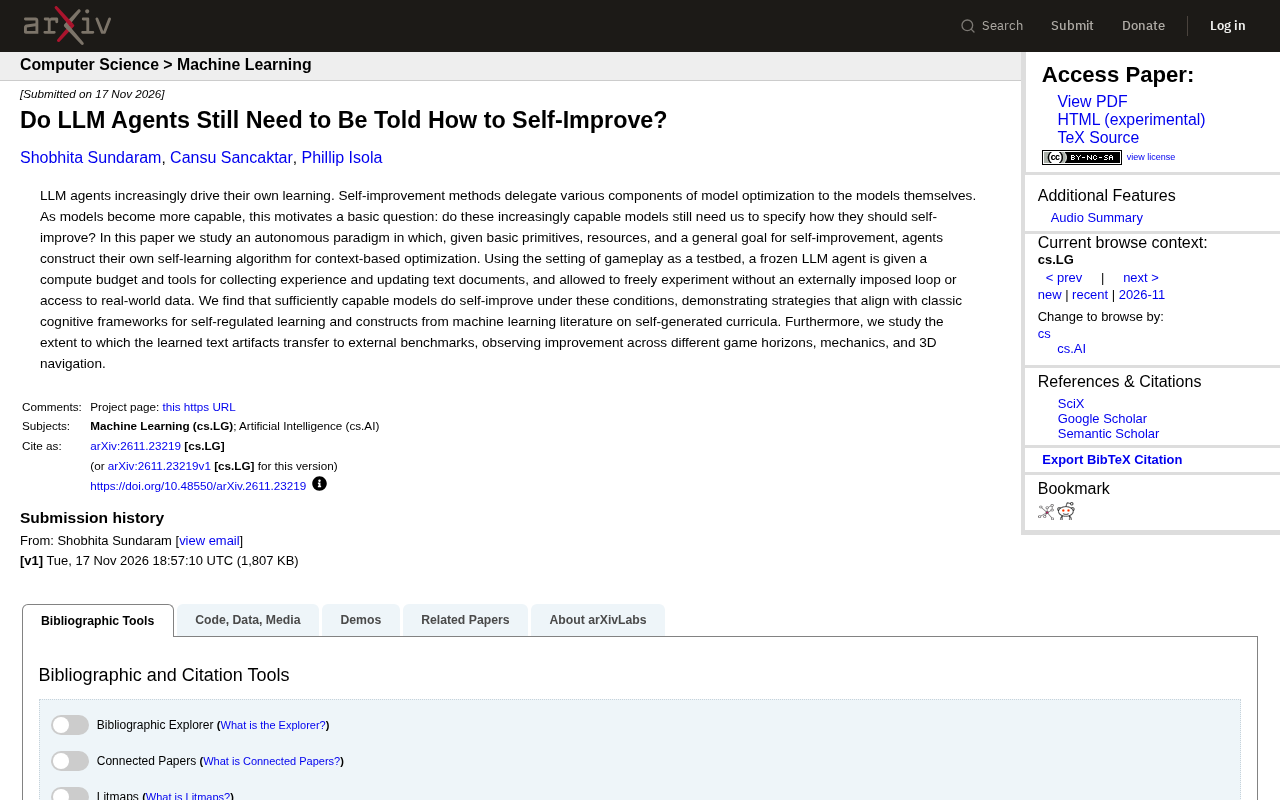
LLM agents are increasingly taking charge of their own learning processes. Self-improvement methods hand multiple components of model optimization over to the model itself. As model capabilities grow, a fundamental question emerges: do these increasingly powerful models still need humans to specify how they should improve themselves? A recent study dives deep into this question, proposing an autonomous paradigm: given basic primitives, resources, and an overall goal of self-improvement, agents can construct their own self-learning algorithms for context-based optimization.
The study uses gameplay as a testbed, giving a frozen LLM agent a compute budget and tools for collecting experience and updating text documents, and allowing it to experiment freely without externally imposed loops or access to real-world data. The research finds that sufficiently powerful models can indeed self-improve under these conditions, exhibiting behaviors consistent with classical cognitive frameworks of self-regulated learning and with strategies from the machine learning literature on self-generated curriculum structures.
Experimental Design for Autonomous Self-Improvement
The study adopts a minimal yet powerful setup: the agent is given basic primitives (such as text editing and experience collection tools), a compute budget, and an overall goal—self-improvement. The key constraint is that the agent has no externally designed training loop and no access to real-world data; it can only experiment freely within a game environment. This design aims to test whether the agent can autonomously construct a self-learning algorithm with minimal guidance.
The agent in the experiment is a frozen LLM, meaning model parameters are not updated during the experiment—all learning occurs at the context level, accumulating knowledge and strategies by updating text documents. This simulates real-world scenarios where models cannot be frequently fine-tuned but can adapt through context. The agent must decide for itself how to collect experience, how to update documents, and how to evaluate progress—all based on its internal capabilities.
Frozen LLM and In-Context Learning: The "frozen LLM" mentioned here refers to model weights that are not updated at all during the experiment; all adaptation occurs at inference time. This contrasts with traditional fine-tuning: fine-tuning modifies parameters via gradient descent, whereas a frozen model can only rely on reorganizing information within the context window. In-Context Learning is when a model, without updating parameters, infers task patterns from examples or instructions in the prompt and adjusts its output accordingly. In this study, the agent "learns" by reading and writing text documents—essentially compressing experience into retrievable text strategies and referencing them in subsequent decisions. The advantage of this approach is that it requires no training infrastructure and can adapt instantly, but it is limited by context length and the model's own reasoning capabilities.
Research Findings: The Stronger the Capability, the More Autonomous the Self-Improvement
The results show that sufficiently powerful models can indeed self-improve under these conditions. The agents not only learned how to play the game but also developed learning strategies consistent with classical cognitive frameworks. For example, they exhibited metacognitive behaviors in self-regulated learning, such as setting subgoals, monitoring progress, and adjusting strategies. At the same time, the agents spontaneously generated structures similar to self-generated curricula in machine learning—they start with simple tasks and gradually increase difficulty, akin to curriculum learning.
More importantly, these learned text artifacts (i.e., the documents updated by the agent) can transfer to external benchmarks. The study finds that the agent showed improvements across different game views, mechanics, and 3D navigation tasks, indicating that the knowledge it learned has some generalization ability. This suggests that the agent did not merely memorize a specific game but extracted transferable strategies.
Self-Generated Curriculum and Self-Regulated Learning: Self-Generated Curriculum refers to a learning system that, without an externally specified task order, autonomously decides what to learn first and what to learn next—typically starting with simple or high-reward subtasks and gradually transitioning to complex ones. This aligns with the idea of Curriculum Learning, but the curriculum is generated by the agent itself rather than designed by humans. Self-Regulated Learning is a classical framework in cognitive psychology that includes metacognitive components such as goal setting, progress monitoring, and strategy adjustment. The subgoal setting and progress monitoring exhibited by the agents in this study are precisely mappings of these theories onto LLM agents, indicating that their behavior is not random trial and error but structured learning control.
Implications for AI Agent Development
This research has multiple implications for AI agent development. First, it suggests that as model capabilities improve, humans may need to reduce micro-management of the self-improvement process and instead provide higher-level goals and resources, letting agents autonomously explore learning algorithms. This can reduce the burden of designing complex training loops and may uncover effective strategies that humans had not considered.
Second, the effectiveness of in-context learning (without updating model parameters) is validated, which is valuable for practical deployment—in many scenarios, frequently fine-tuning models is unrealistic, but significant improvements can still be achieved by letting agents autonomously manage context. Furthermore, the self-generated curriculum capability demonstrated by the agents means they can autonomously design learning paths, which offers ideas for developing more autonomous educational agents and game AI.
However, the study also leaves open questions: Is this kind of autonomous self-improvement equally effective in more complex, open-ended real-world tasks? Will agents develop harmful strategies? How can we ensure the controllability of autonomous learning? These all require further exploration.
Text Artifacts and Generalization: Text artifacts refer to the documents created and modified by the agent during the experiment, including game strategy notes, rule summaries, and failure reflections. These artifacts are the carriers of in-context learning and the medium of knowledge transfer. The "transfer to external benchmarks" mentioned in the study refers to applying the text strategies learned by the agent to untrained game variants (such as different views and mechanics) and 3D navigation tasks. This kind of generalization differs from parameter-level generalization; it relies on abstract strategies distilled in text rather than memorization of specific game states. Its limitation is that transfer effectiveness is constrained by the accuracy of the text descriptions and the model's ability to interpret the text; for highly dissimilar tasks, the transferability of text artifacts will decrease.
Conclusion
This research reveals the potential of LLM agents for autonomous self-improvement: given basic resources and goals, sufficiently powerful models can construct their own learning algorithms and exhibit strategies consistent with human learning theories. This marks a step toward more autonomous AI systems, while also reminding us to rethink the role of humans in AI self-improvement—perhaps in the future, what we need to do more is set goals and boundaries rather than prescribe learning details.
One-line Summary
Sufficiently powerful frozen LLM agents can autonomously construct self-learning algorithms and achieve transferable self-improvement given only basic resources and an overall goal.
Paragraph Summary
This study explores whether LLM agents can improve autonomously with minimal human guidance. The experiment provides a frozen LLM agent with a compute budget, text editing and experience collection tools, and an overall goal of "self-improvement," with no external training loop and no real-world data—only free experimentation in a game. The results show that sufficiently capable models can autonomously construct learning algorithms: they exhibit metacognitive behaviors in self-regulated learning (setting subgoals, monitoring progress, adjusting strategies) and spontaneously generate simple-to-complex task sequences akin to curriculum learning. The text documents updated by the agent can also transfer to different game views, mechanics, and 3D navigation tasks, showing some generalization ability. Based on this, the study proposes that as model capabilities improve, humans should reduce micro-management of the self-improvement process and instead provide high-level goals and resources.
Related articles

Prompt Engineering for Beginners: From Writing Prompts to Engineering Thinking
Starting from the essence and four functions of prompts, this article systematically explains the six-step process, four success criteria, learning value, and practical limitations of prompt engineering to help you build a complete understanding.

Anthropic Launches Nasdaq IPO: AI Giant's Listing and Risk Disclosures
Anthropic officially launches its Nasdaq IPO under ticker ANT, with market valuation expected to potentially exceed SpaceX's record. The prospectus devotes nearly 100 pages to AI risks, while first-half revenue grew over 14x but net losses widened sharply, reigniting the AI bubble debate.

Rust cURL Clone Uses 4,832 unsafe Blocks—Is the Memory Safety Myth Broken?
A Rust cURL clone uses 4,832 unsafe keywords, challenging Rust's memory safety narrative. We analyze what unsafe really means, compare Fil-C, and examine rewrite motives.