Self-Hosted ASR Models vs. Cloud APIs: A Comprehensive Cost and Reliability Comparison

A practical cost and reliability comparison between self-hosted ASR models and cloud speech recognition APIs.
This article provides a comprehensive analysis of the trade-offs between self-hosting open-source ASR models (like Whisper and IBM Granite Speech) versus using cloud APIs from Google, AWS, and Azure. It covers break-even point calculations, hidden infrastructure and operational costs, reliability considerations, and offers practical decision-making guidance for teams evaluating their ASR strategy.
From Dependency to Autonomy: The Real Dilemma of ASR Selection
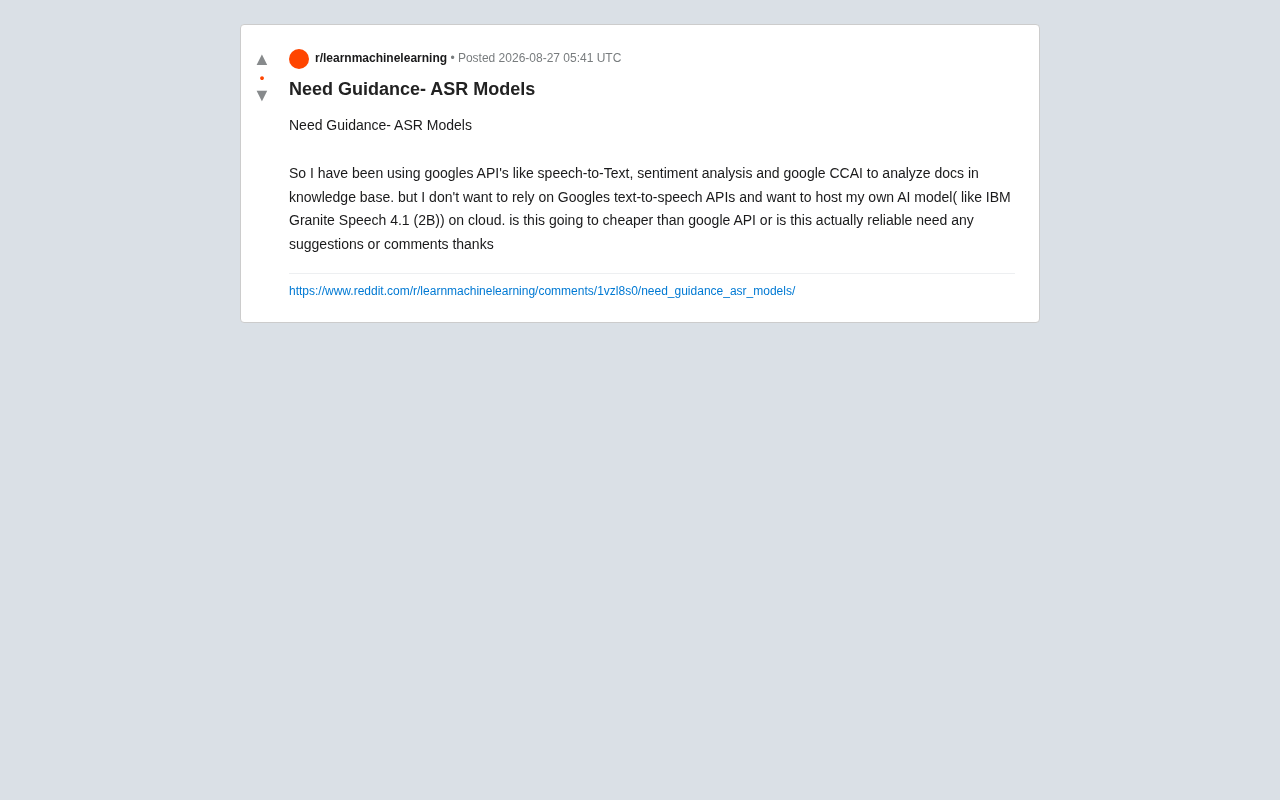
As speech recognition (ASR, Automatic Speech Recognition) applications become increasingly widespread, more developers and enterprises are re-evaluating their tech stack dependencies. A recent Reddit user raised a highly representative question: they had been using Google's Speech-to-Text, sentiment analysis, and Google CCAI (Contact Center AI) to analyze knowledge base documents, but no longer wanted to depend on Google's speech API. Instead, they were considering self-hosting an open-source model in the cloud—such as IBM Granite Speech 4.1 (2B). Their core question was: Would self-hosting actually be cheaper than Google's API? And how about reliability?
Google Contact Center AI (CCAI) is an AI solution suite from Google Cloud designed for customer service call center scenarios. It integrates speech recognition, natural language understanding (Dialogflow), sentiment analysis, Agent Assist, and knowledge base retrieval capabilities, helping enterprises implement intelligent IVR (Interactive Voice Response), real-time call analytics, and automated customer service. CCAI's core value lies in bundling multiple AI capabilities into an end-to-end solution, lowering the barrier for enterprises to integrate each technology individually—but it also deepens dependence on the Google ecosystem, which is precisely the predicament the original poster was trying to escape.
This question seems simple but touches on a critical decision point in today's AI engineering practice: How to weigh the trade-offs between managed services (Managed API) and self-hosted deployment.
The Advantages and Hidden Concerns of Cloud Speech Recognition APIs
Why Everyone Initially Chooses Managed APIs
The speech recognition APIs offered by Google, AWS, Azure, and other providers are popular for obvious reasons: out-of-the-box functionality, zero maintenance, and pay-as-you-go pricing. Developers don't need to worry about model deployment, GPU resource scheduling, model updates, or other tedious tasks—they simply call an HTTP endpoint to get high-quality recognition results. For early validation, small-scale applications, or teams lacking MLOps capabilities, this is almost always the optimal choice.
The Real Motivations Behind "Escaping" Cloud APIs
As business scales grow, the pain points of relying on third-party APIs gradually surface. While the original poster didn't elaborate, the typical reasons driving developers toward self-hosted ASR include:
- Cost spiraling out of control: Google Speech-to-Text charges by audio duration, with the standard model costing approximately $0.016 to $0.024 per minute. When you need to process thousands of hours of audio daily, bills escalate rapidly.
- Data privacy and compliance: Sending sensitive voice data to third-party servers may cross compliance boundaries in healthcare, finance, government, and other regulated industries.
- Vendor lock-in: Over-reliance on a single provider weakens bargaining power and technical flexibility. Notably, vendor lock-in in ASR scenarios extends beyond the API call layer into data formats, model adaptation, and workflow integration. For example, Google CCAI's sentiment analysis result formats, knowledge base index structures, and conversation flow designs all use proprietary interfaces, requiring complete reconstruction of data processing pipelines during migration. Additionally, custom language models, speaker adaptation configurations, and domain-specific vocabularies accumulated on a specific platform typically cannot be directly migrated to other platforms—these "hidden lock-ins" are often harder to escape than the API calls themselves.
- Customization needs: General-purpose APIs are difficult to deeply optimize for specific industry terminology, dialects, or accents.
The True Cost of Self-Hosted ASR
Free Open-Source Models ≠ Cheap Deployment
A common misconception needs to be clarified here: A free open-source model does not mean self-hosting is cheap. Models like IBM Granite Speech 4.1 (2B) can be downloaded and used for free, but the real cost lies in the infrastructure required to run them.
IBM Granite Speech 4.1 is part of IBM's open-source speech foundation model series launched in 2025, belonging to the Granite family. The model features a 2B (2 billion) parameter scale and supports multi-language speech recognition, speech translation, and audio understanding among other multi-task capabilities. The Granite series models use the Apache 2.0 open-source license, meaning enterprises can freely use, modify, and commercially deploy them without paying license fees. The 2B parameter scale occupies a "small but capable" position in the current large model ecosystem, aiming to balance inference performance with computational resource requirements, making it possible to run on a single GPU.
A 2B-parameter speech model typically requires GPU-equipped instances for low-latency inference in the cloud. Regarding GPU selection, NVIDIA T4 (16GB VRAM, Turing architecture) offers the best cost-performance ratio for inference and is suitable for models under 2B parameters; A10G (24GB VRAM, Ampere architecture) provides stronger FP16/BF16 compute capabilities for scenarios demanding lower latency; and A100 (40GB/80GB VRAM) is the choice for large-scale concurrent inference. Beyond the GPU itself, you also need to consider CPU, memory, and network bandwidth ratios. Using major cloud providers as examples—AWS's g4dn (T4) instances, g5 (A10G) instances, and p4d (A100) instances, or the corresponding Google Cloud N1+T4, G2, and A2 instance series—monthly costs can range from $300 to $800, with A100 instances being even more expensive. This is a 24/7 always-on fixed expense, regardless of whether you have any request traffic.
Break-Even Point Calculation
Whether self-hosted ASR is cheaper depends on one critical variable—utilization rate.
- If your audio processing volume is large and continuous (e.g., a call center processing massive call recordings daily), the marginal cost of self-hosting decreases with scale, eventually becoming significantly lower than pay-per-use APIs.
- If traffic is sparse or highly volatile, GPU instances sit idle most of the time, and the actual per-hour processing cost may end up far exceeding API calls.
A simple estimate: Assuming a GPU instance costs $500/month and Google's API charges approximately $0.02 per minute, then theoretically you need to process more than about 25,000 minutes (approximately 416 hours) of audio per month before self-hosting begins to show a cost advantage—provided the hardware can efficiently run at full capacity.
Reliability: The Underestimated Hidden Cost of Self-Hosted ASR
You Must Handle What the Provider Used to Do for You
Reliability is the original poster's other major concern, and it's precisely the aspect most easily underestimated in self-hosting. When using Google's API, behind it is a complete stack of load balancing, auto-scaling, failover, and SLA guarantees. Once you self-host, all of these become your responsibility:
- High availability architecture: What happens when a single instance goes down? Do you need multi-replica deployment?
- Elastic scaling: How do you auto-scale during traffic peaks and scale down during valleys to save money?
- Model operations: Model version management, performance monitoring, anomaly alerting.
In engineering practice, this work is collectively known as MLOps (Machine Learning Operations)—the application of DevOps principles to machine learning systems, covering the entire lifecycle of model development, training, deployment, monitoring, and iteration. In the self-hosted ASR context, MLOps specifically includes: model serving using inference frameworks like Triton Inference Server or vLLM, managing model version updates through CI/CD pipelines, setting up A/B tests to compare old and new model performance, real-time monitoring of inference latency and accuracy drift (model drift), and automated GPU resource scheduling. Teams lacking MLOps capabilities often face the predicament of "able to deploy but unable to sustain operations" when self-hosting models.
For small teams without dedicated MLOps staff, these operational burdens can far exceed expectations and may even offset the cost savings.
Recognition Quality of Open-Source ASR Models Requires Real Testing
Whether open-source model recognition accuracy meets business requirements must be verified through testing with actual data. Open-source models like Granite and Whisper perform excellently in mainstream languages like English, but may not match the level of Google's mature commercial API when it comes to domain-specific terminology, noisy environments, or less common languages. Never judge solely based on model parameter count.
Practical Decision-Making Recommendations for ASR Selection
Taking a comprehensive view, here are some recommendations for navigating the confusion between self-hosting and continuing with cloud APIs:
-
Quantify your usage first: Calculate your actual monthly audio minutes processed, then compute the break-even point between API costs and GPU instance costs. This is the first step in decision-making.
-
Consider more open-source alternatives: Beyond IBM Granite Speech, OpenAI's Whisper and its optimized variants (such as faster-whisper) are currently the most actively developed and ecosystem-mature self-hosted ASR solutions, and deserve priority evaluation. OpenAI Whisper is a general-purpose speech recognition model open-sourced in 2022, supporting 99 languages and offering multiple sizes from tiny (39M parameters) to large-v3 (1.5B parameters). Trained on 680,000 hours of multilingual weakly-labeled audio, its out-of-the-box recognition quality approaches commercial API levels. faster-whisper is a community optimization of Whisper based on the CTranslate2 inference engine, achieving 4-6x inference speedup through INT8 quantization and optimized attention computation while significantly reducing VRAM usage. Additionally, variants like WhisperX add speaker diarization and precise timestamp alignment functionality, further expanding use cases.
-
Adopt a hybrid strategy: It doesn't have to be all-or-nothing. You can route high-frequency, batch, non-real-time tasks to self-hosted models while keeping low-frequency or high-reliability real-time tasks on the API.
-
Validate at small scale before scaling up: First compare recognition quality between open-source models and Google's API using a small amount of real data. Once you confirm it meets business requirements, then invest in infrastructure.
-
Don't overlook hidden labor costs: If your team lacks GPU operations experience, the time investment and potential failure risks of self-hosting may be more "expensive" than the cloud bill on paper.
Conclusion
Transitioning from cloud APIs to self-hosted open-source ASR models is fundamentally a trade-off between cost, control, and operational complexity. There's no universal answer—only the choice that best fits your current business situation. For large-scale, data-sensitive teams with engineering capabilities, self-hosting can deliver significant long-term benefits and autonomy; for scenarios with unstable traffic or lean teams, mature managed APIs remain the more hassle-free choice. The truly wise approach is to calculate the numbers, test the quality, and then make your decision.
Related articles

Python 3.15 New Feature: Is the sentinel Type Better Than None?
Python 3.15 adds the sentinel type, using named unique sentinel objects to replace None and bare object(), resolving confusion among missing values, explicit emptiness, and invalid input while avoiding type hint failures.

Deep Learning's Three Architectures and the Universal Approximation Theorem: A Complete Guide to MLPs, CNNs, and Transformers
Explaining the inductive bias differences among MLP, CNN, and Transformer, the existence meaning of the Universal Approximation Theorem (UAT), and the role of Taylor expansion in approximation analysis, while clearing up common misconceptions.

GitLab Emergency Patch Release: Analysis of Critical Security Fixes
GitLab releases critical patch 19.5.1, sparking 355 points of discussion on Hacker News. This article analyzes the background, upgrade steps for self-hosted instances, and verification points to help DevOps teams respond quickly to security updates.