Self-Hosted Claude Managed Agents: What You Gain, What You Give Up
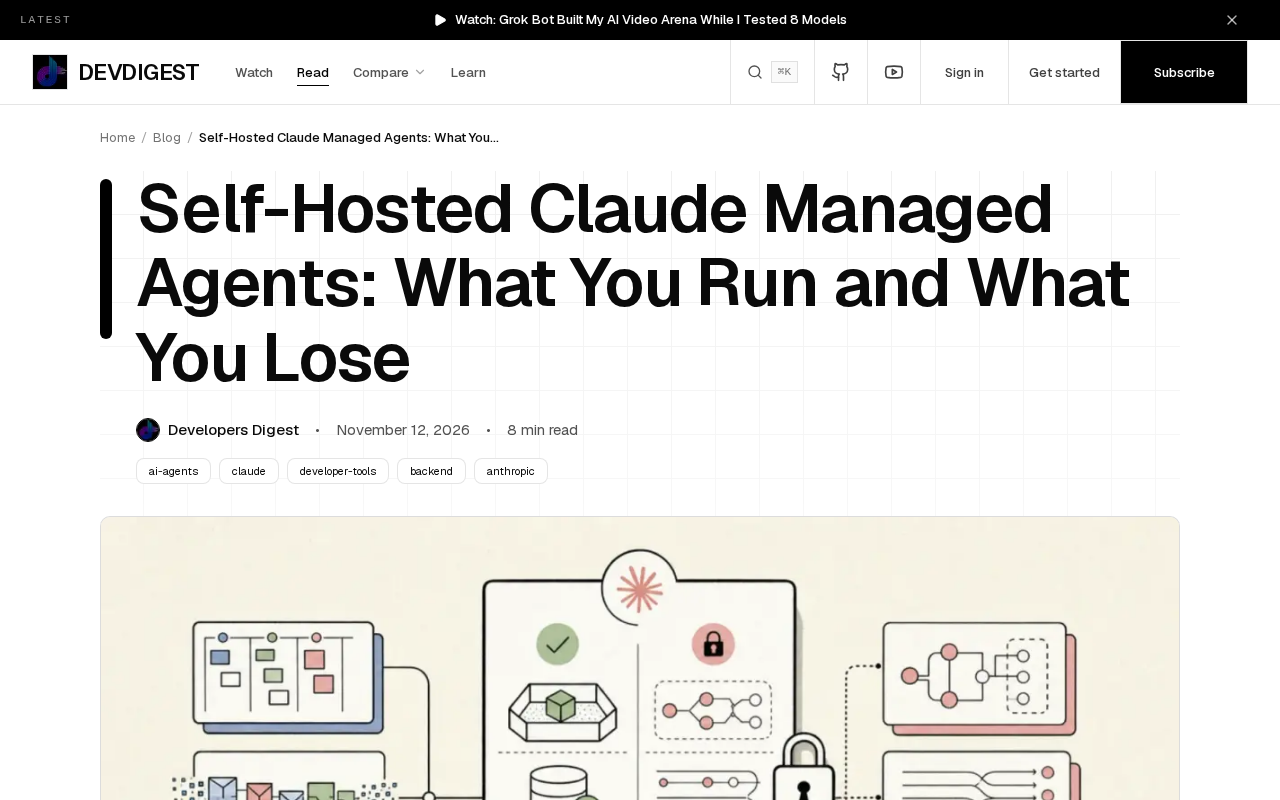
Self-hosted Claude Managed Agents move the service, storage, and sandbox into your own infrastructure while model calls still go through cloud channels, trading operational investment for control.
The article introduces the architecture and trade-offs of self-hosted Claude Managed Agents: the agent service layer, PostgreSQL state storage, and task sandbox run on the user's own hardware, while model inference is still completed through Bedrock, Vertex, Foundry, or a self-built gateway. This division of labor lets organizations control data residency, sandbox isolation policies, and state lifecycle, but the price is transferred operational burden, the disappearance of out-of-the-box monitoring and support, and lagging feature updates. Based on this, the article gives a suitability judgment: teams with platform engineering capabilities and hard compliance requirements are suited to self-hosting, while small teams or teams pursuing iteration speed are better off with the managed version. The ultimate trade-off comes down to control versus total cost of ownership, and there is no universal answer.
The launch of self-hosted Claude Managed Agents offers a new option for teams that want to deploy AI agent capabilities on their own infrastructure. It runs the service itself, PostgreSQL storage, and the sandbox environment on your hardware, while model calls go through Bedrock, Vertex, Foundry, or a gateway. This division of labor looks simple, but it redraws the boundary between control and convenience.
Core Components of the Self-Hosted Approach
According to the original information, self-hosted Claude Managed Agents does not stuff the entire Claude model into your data center. What it runs is the agent service layer, a PostgreSQL database for state management, and the sandbox that executes agent tasks. Model inference still depends on external services—you can choose AWS Bedrock, Google Vertex AI, Microsoft Foundry, or route requests through a self-built gateway.
This architecture means you have direct control over the agent's runtime environment, data storage, and task isolation, but the most core model capability is still obtained as API calls. For organizations constrained by data residency or compliance requirements, this offers a compromise: sensitive task orchestration and intermediate data stay local, while model calls go through approved cloud channels.
Amazon Bedrock, Google Vertex AI, and Microsoft Foundry are managed foundation model platforms offered by the three major cloud providers. Bedrock exposes multiple models (including Anthropic's Claude) as APIs on AWS, integrated with IAM permissions, VPC isolation, and CloudWatch logging; Vertex AI is Google Cloud's counterpart, emphasizing data synergy with BigQuery and GKE; Microsoft Foundry (formerly Azure AI Foundry) provides a model catalog, evaluation, and deployment orchestration within the Azure ecosystem. What they share is that model inference is completed within the cloud provider's compliance boundary, so enterprises do not need to build their own GPU clusters, but call data flows through that cloud region. The article lists them side by side as model invocation channels precisely because each can satisfy different organizations' cloud ownership and data residency requirements.
What You Actually Run
Agent service and storage: Both the service process and the PostgreSQL database run within your infrastructure. This lets you control the lifecycle of agent state, decide on data retention policies, and integrate with your existing backup, monitoring, and access control systems.
Sandbox environment: The sandbox used when agents execute tasks is also hosted by you. The sandbox is the isolation layer for code execution and tool calls; self-hosting means you can configure network restrictions, resource quotas, and image sources according to internal security policies, rather than relying on the default settings of a third-party sandbox service.
Model call routing: Making model requests through Bedrock, Vertex, Foundry, or a gateway lets you use Claude's capabilities within the cloud provider's compliance framework. The gateway option is especially suitable for scenarios that need unified auditing, rate limiting, or switching across multiple model backends.
Sandbox in the context of AI agents refers to a restricted execution environment where agent-generated code, tool calls, and file operations run, isolated from the host machine and other tasks. Common implementations are based on containers (such as Docker or gVisor) or microVMs (such as Firecracker), using namespaces, cgroups, and seccomp to restrict network access, CPU/memory quotas, and system calls. The core value of a sandbox is "blast radius control": even if an agent is induced by prompt injection to execute malicious code, the impact is confined to the isolation layer. A self-hosted sandbox means these network policies, image sources, and resource limits are defined by you rather than accepting a third-party service's default configuration—which is exactly why the article emphasizes that security policies are configurable.
What You Give Up
Self-hosting is not without cost. The most direct point is the transfer of operational burden. You need to handle service high availability, database tuning and scaling, sandbox patching, and security hardening. Failure recovery and version upgrades that the vendor handled in the managed version now fall on your team.
Second is the loss of simplification at the integration and support level. Managed services typically provide out-of-the-box monitoring dashboards, log aggregation, and autoscaling, while a self-hosted approach requires you to build or integrate each of these capabilities. When problems arise, the troubleshooting path also becomes longer—you need to distinguish whether the issue is in your own infrastructure, the agent service, the sandbox, or the model call chain.
There is another easily overlooked loss: the pace of feature updates. Managed services can quickly push new features and fixes, while self-hosted versions require you to actively follow releases and complete upgrade verification, which in highly compliant environments may mean a noticeable lag.
Total cost of ownership (TCO) is a common framework for evaluating self-hosting decisions; it brings hidden expenses beyond subscription fees into the comparison: hardware or cloud resource costs, operations labor, monitoring and backup tools, upgrade verification hours, and the business interruption cost caused by failures. In self-hosted approaches, these items are often scattered across different teams and difficult to quantify, making them easy to underestimate. By contrast, although the subscription fee of a managed service is intuitive, it internalizes operations and upgrade costs. The article's judgment that "control must be paid for with sustained engineering investment" is essentially a reminder for decision-makers to compare the two approaches based on TCO rather than unit price, especially by including the opportunity cost of upgrade lag.
Who It Suits, Who It Doesn't
Self-hosted Claude Managed Agents suits teams that already have strong platform engineering capabilities, have hard requirements around data location and task isolation, and are willing to trade operational investment for control. If your organization already runs Kubernetes, has mature database operations practices, and already routes model calls through Bedrock or Vertex, the added burden is relatively manageable.
Conversely, if the team is small, lacks dedicated infrastructure staff, or has high expectations for the pace of agent feature iteration, the managed version remains the more pragmatic choice. The control that self-hosting brings must be paid for with sustained engineering investment, and this should not be underestimated when making the decision.
Key Trade-Off: Control vs. Total Cost of Ownership
Putting the service, storage, and sandbox on your own infrastructure essentially draws the trust boundary inward. You no longer rely on the vendor's sandbox isolation to protect sensitive tasks, nor do you worry about agent state data landing in external storage. But at the same time, total cost of ownership shifts from subscription fees to labor, hardware, and opportunity costs.
There is no universal answer to this trade-off. It depends on your compliance profile, team capabilities, and long-term plans for agent workloads. The original information clearly draws the boundary: what you run is the orchestration layer and the storage layer, while model capability is still purchased externally. Only by understanding this dividing line can you accurately assess whether self-hosting truly brings the control you need.
One-line Summary
Self-hosted Claude Managed Agents moves the service, storage, and sandbox into your own infrastructure while model calls still go through cloud channels, trading operational investment for control.
Paragraph Summary
The article introduces the architecture and trade-offs of self-hosted Claude Managed Agents: the agent service layer, PostgreSQL state storage, and task sandbox run on the user's own hardware, while model inference is still completed through Bedrock, Vertex, Foundry, or a self-built gateway. This division of labor lets organizations control data residency, sandbox isolation policies, and state lifecycle, but the price is transferred operational burden, the disappearance of out-of-the-box monitoring and support, and lagging feature updates. Based on this, the article gives a suitability judgment: teams with platform engineering capabilities and hard compliance requirements are suited to self-hosting, while small teams or teams pursuing iteration speed are better off with the managed version. The ultimate trade-off comes down to control versus total cost of ownership, and there is no universal answer.
Related articles

Gemini 4 Neon Released: A Balance Between Frontier Intelligence and Efficient Task Execution
Google DeepMind releases Gemini 4 Neon, focused on frontier intelligence and fast end-to-end task execution. This article breaks down its benchmark performance in coding, enterprise analysis, scientific reasoning, and cybersecurity, its four thinking levels, pricing, and safety alignment data.

Is AI the Culprit Behind Global Outages? The Trust Crisis Behind the NSA and FAA Failures
Fourth major failure in five days hits NSA classified network. Microsoft blames a software bug, FAA denies its new AI system, NSA says routine maintenance. Senator Warner suggests AI accelerates vulnerability discovery, leading to rushed fixes — while 39% of Americans already view AI negatively, exposing a deepening trust crisis.

Robot Developer Builds Custom B-rep Kernel with 3,487 Tests
A robot developer builds a custom B-rep geometry kernel with 3,487 tests, exploring why robotics needs dedicated CAD tools and the barriers to building one.