Self-Hosting a GIF Server: A Complete Guide to Tenor Alternatives

A complete guide to self-hosting GIF servers as alternatives to Tenor for data sovereignty.
This guide explores how to build a self-hosted GIF server to replace Tenor, covering three approaches: pure image hosting (Chevereto, MinIO + CDN), searchable GIF management systems with tagging and full-text search, and platform integration via Discord/Slack Bot APIs. It explains the technical principles behind GIF embedding and offers practical recommendations for reclaiming data sovereignty.
Starting from the Tenor Problem
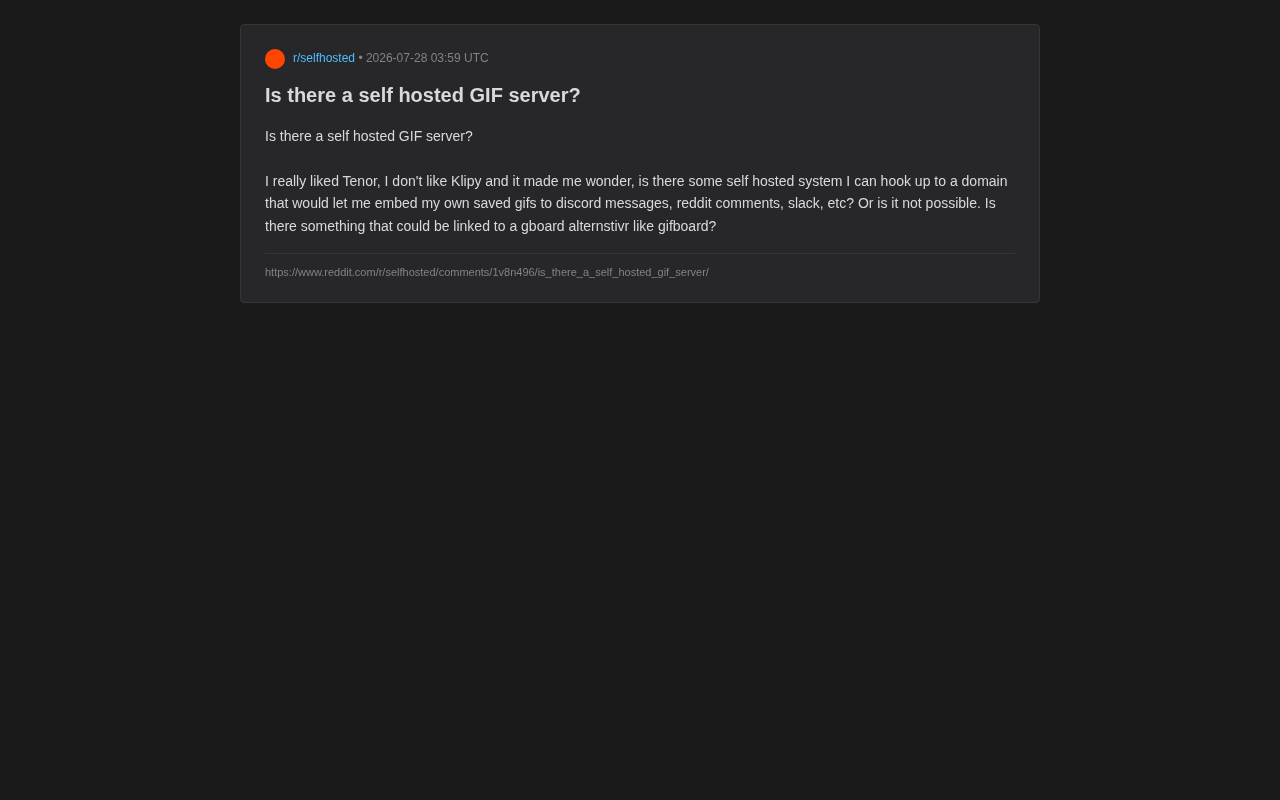
Recently on Reddit, a user raised a highly representative question: as mainstream GIF services like Tenor get gradually consolidated or replaced (for example, by the poorly-received Klipy), is there a self-hosted GIF server that would allow users to embed their saved GIFs into Discord messages, Reddit comments, Slack, and other platforms?
Tenor is a GIF search engine and sharing platform acquired by Google in 2018, processing over 12 billion searches per day, making it one of the world's largest GIF platforms. Through deep integration with Google Keyboard (Gboard), Discord, Slack, WhatsApp, and other mainstream applications, it has become foundational infrastructure for internet GIF communication. Klipy is a newer service that has recently attempted to replace Tenor's position in certain scenarios but has been widely criticized for poor search quality and insufficient content library depth. In fact, GIF—an image format born in 1987—experienced a renaissance in the social media era, becoming a core medium for expressing emotions in online conversations. A complete commercial ecosystem formed around it, including GIPHY (acquired by Shutterstock), Tenor, and Gfycat (now shut down). Gfycat's closure was one of the key events triggering user anxiety.
Behind this question lies a widespread anxiety among technical users about data sovereignty and service controllability. When the free third-party services we depend on get acquired, shut down, or degraded in experience, how to reclaim control over our content becomes a topic worth exploring in depth. The self-hosting philosophy is particularly popular in Reddit's r/selfhosted community (with over 400,000 members), covering everything from personal cloud storage (Nextcloud) and password management (Vaultwarden) to media servers (Jellyfin). The core driving forces behind this movement include: privacy protection, avoiding vendor lock-in, ensuring service continuity, and the pursuit of technical control.
Technical Principles Behind GIF Embedding
To answer "can you self-host a GIF server," we first need to understand how services like Tenor actually work. They essentially do two things:
Storage and Hosting
GIF files are stored on the service provider's servers, and each GIF has a stable public URL. When you send a GIF in Discord, you're actually sending this URL link, and the recipient's client automatically requests and renders the image.
From a technical pipeline perspective, this process relies on the oEmbed protocol or Open Graph protocol. When a user pastes an image URL in Discord, Discord's server first makes an HTTP request to fetch the content at that URL, checks the Content-Type header (e.g., image/gif), then caches and renders the image through its proxy server. This means a self-hosted GIF server must meet several key technical requirements: the URL must be publicly accessible, response speed must be fast enough, Content-Type headers must be correctly set, and it must not be blocked by the target platform's security policies (such as CSP—Content Security Policy). It's worth noting that many modern platforms actually prefer using MP4 or WebM video formats instead of traditional GIFs, because video files can be 80-90% smaller at equivalent quality. Tenor itself converts GIFs to MP4 for transmission behind the scenes—this conversion is just transparent to users.
Search and Platform Integration
Tenor's real value lies in its deep integration with major platforms (Discord, Slack, Gboard, etc.)—through official APIs, users can search and insert GIFs directly within these applications. This layer of integration is achieved through partnership agreements and API access, not something ordinary users can arbitrarily replace.
This brings us to the core limitation of self-hosted solutions: you can fully control the "storage" component, but it's very difficult to replace the "platform-level integration" component.
Three Viable Self-Hosted GIF Server Approaches
For users who want to break free from Tenor dependency, there are different implementation paths depending on the level of need.
Approach 1: Pure Image Hosting for GIFs
The most straightforward approach is to set up an image hosting service, upload your GIFs to get public URLs, and manually paste them into the platforms you need. Available open-source tools include:
- Chevereto: A full-featured self-hosted image host that supports GIF, custom domains, album management, and sharing.
- Lychee: A lightweight album hosting solution based on PHP and MySQL, easy to deploy with an attractive interface.
- PicoShare / Pomf-type tools: Minimalist file sharing services suitable for quick deployment, often requiring just a single binary and simple configuration.
- Object Storage + CDN: Such as self-hosted MinIO for S3-compatible storage, paired with a reverse proxy.
The object storage approach deserves further explanation: MinIO is a high-performance open-source object storage server that is fully compatible with the Amazon S3 API, meaning any tool or SDK that supports the S3 protocol can interact directly with MinIO. The core difference between object storage and traditional file systems is that it uses a flat key-value namespace rather than a hierarchical directory structure, making it naturally suited for storing and distributing large amounts of unstructured data. In a self-hosted GIF scenario, MinIO paired with Nginx or Caddy as a reverse proxy, plus CDN services like Cloudflare for edge caching, can build a file distribution architecture that rivals commercial services. The entire solution's monthly cost can be kept within the range of a $5 VPS.
The advantage of this approach is full control and low cost; the downside is the lack of a smooth "search and insert" experience, requiring manual operations every time.
Approach 2: GIF Management System with Search Functionality
If you want to replicate Tenor's search experience, consider deploying a media management system with tagging and search features. Users can tag each GIF, search through a web interface, and then copy links to use. This type of need can be achieved by adapting general-purpose media library tools (such as partial capabilities of Immich or PhotoPrism), or by developing a lightweight GIF management backend based on a simple database.
A practically viable tech stack would be: using SQLite or PostgreSQL to store GIF metadata (file paths, tags, descriptions), paired with a full-text search engine (such as MeiliSearch, a lightweight search engine written in Rust) for fast retrieval, and a simple Vue or React frontend application to display search results and GIF previews. Such a system doesn't require much development effort but can significantly improve the daily usage experience.
Approach 3: Client Integration via Bot APIs
The original post's idea of "linking to a Gboard alternative like gifboard" is the hardest to implement but most valuable direction. To truly invoke your own GIF library directly within any app requires:
- Integration at the input method level (such as a custom keyboard) with your own GIF source;
- Or using platforms' open Bot/App APIs (Discord Bot, Slack App) to provide custom GIF search.
Discord and Slack both offer bot interfaces, and in theory you can write a Bot that responds to specific commands by returning GIFs from your self-hosted server. This is currently the closest path to "native integration" for self-hosting.
Specifically, the Discord Bot API is based on a hybrid architecture of WebSocket persistent connections and REST API. Developers can register a Bot application, obtain a Token, and then use SDKs like discord.js or discord.py to listen for user commands and return rich media content. Discord's Slash Commands feature allows Bots to register custom commands (such as /gif search cats), providing a near-native interactive experience in the chat box. Slack offers similar capabilities through the Block Kit UI framework and Events API, and even supports no-code integration through Workflow Builder. Both platforms support interactive message components, theoretically enabling a GIF selection interface with a search box and previews. While the experience still isn't as smooth as native keyboard integration, it's the best result achievable by individual developers.
At the input method level, implementing a custom GIF keyboard is much more difficult. Android allows developers to create custom keyboards through the InputMethodService API and send rich media content (including GIFs) to the current application via the commitContent method. iOS offers similar capabilities through Custom Keyboard Extensions in App Extensions, but due to Apple's sandbox mechanism, custom keyboards face strict limitations on network access and other aspects. Open-source projects like AnySoftKeyboard (Android) provide some customization capabilities, but implementing complete GIF search and sending functionality still requires considerable development effort. This is why input method-level integration is considered the hardest direction to implement.
Realistic Trade-offs and Implementation Recommendations
Overall, self-hosting a GIF server is fully feasible technically, but you need to distinguish between different levels of need.
If you just want to reliably host your collected GIFs and avoid the risk of broken links when third-party services change, then a self-hosted image host with your own domain is a mature and low-cost solution.
But if what you're pursuing is Tenor's seamless experience of "one-click search and insert in any app," the reality is harsh—platform-level native integration is in the hands of service providers and platform partners, and personal self-hosting can hardly fully replace it. A compromise is to develop custom integration through official Bot APIs for your most frequently used single platform (such as Discord), minimizing the experience loss.
Action Checklist for Building Your Own GIF Server
- Clarify your core need: do you want "storage control" or "search integration"?
- For the storage layer, choose a mature image host (Chevereto, etc.) or an object storage solution (MinIO + Nginx/Caddy).
- Bind your own domain and configure HTTPS (Let's Encrypt provides free certificates, Caddy can manage them automatically) to ensure links remain stable long-term.
- If platform integration is needed, prioritize developing a Bot for a single high-frequency platform (Discord Bot development has the lowest barrier to entry and the richest community resources).
- Maintain data backups (the 3-2-1 backup strategy is recommended: 3 copies of data, 2 types of media, 1 offsite copy)—the cost of self-hosting is that you bear the operational responsibility yourself.
Conclusion
Starting from a simple Reddit question, what we actually see is a microcosm of the open-source self-hosting ecosystem: technical freedom is never a free lunch. You can reclaim control over your data, but often at the cost of sacrificing some convenience. For seemingly trivial needs like GIF hosting, whether it's worth investing self-hosting effort ultimately depends on how much you value data sovereignty and your hands-on ability. For most users who prioritize convenience, waiting for a better third-party alternative might be more practical; but for geeks, this is yet another great opportunity to keep tools in their own hands.
Related articles

Cheap Cursor Ultra Resellers: The Real Risks and Hidden Dangers Behind the Low Prices
An in-depth analysis of Cursor Ultra low-price resellers, revealing the real risks of account bans, data leaks, and ToS violations behind team seat splitting and regional pricing arbitrage.

Deep Dive into AdPeekr's Real-Time TikTok Ad Monitoring and Alert Feature
AdPeekr launches TikTok Ads Alerts on Product Hunt, offering 24/7 real-time competitor ad monitoring. Deep analysis of core features, cross-platform integration, and competitive landscape.

Hexis: Managing AI Agent Skills and Knowledge Bases with Git
Hexis is an open-source AI agent management tool using Git for version control and access management of skills, tools, and context, with MCP protocol for cross-platform interoperability.