Self-Hosting a Roborock Private Cloud: A Local Solution Without Rooting or Hardware Modifications

Self-host a full Roborock private cloud without rooting or hardware changes, using onboarding exploits and backend replication.
A co-maintainer of python-roborock has open-sourced a Roborock private cloud solution requiring no rooting or hardware modification, motivated by privacy concerns over cameras, microphones, and home maps being uploaded to manufacturer servers. The approach exploits vulnerabilities in the device's onboarding phase to redirect traffic to a custom server, then fully replicates Roborock's MQTT and REST backend so the device believes it's still on the official cloud. It supports Docker, Home Assistant addon, and source builds — and the vacuum functions normally even with public internet access completely cut off.
For smart home enthusiasts, robot vacuums are among the most paradoxical devices: they come equipped with cameras and microphones, hold detailed maps of your entire home, and quietly upload all of that data to the manufacturer's cloud. One co-maintainer of the python-roborock project has taken matters into his own hands — building a complete Roborock private cloud from scratch, without rooting or modifying the hardware, allowing the robot vacuum to run entirely independent of the manufacturer's cloud.
Why Pull a Robot Vacuum Away from the Cloud
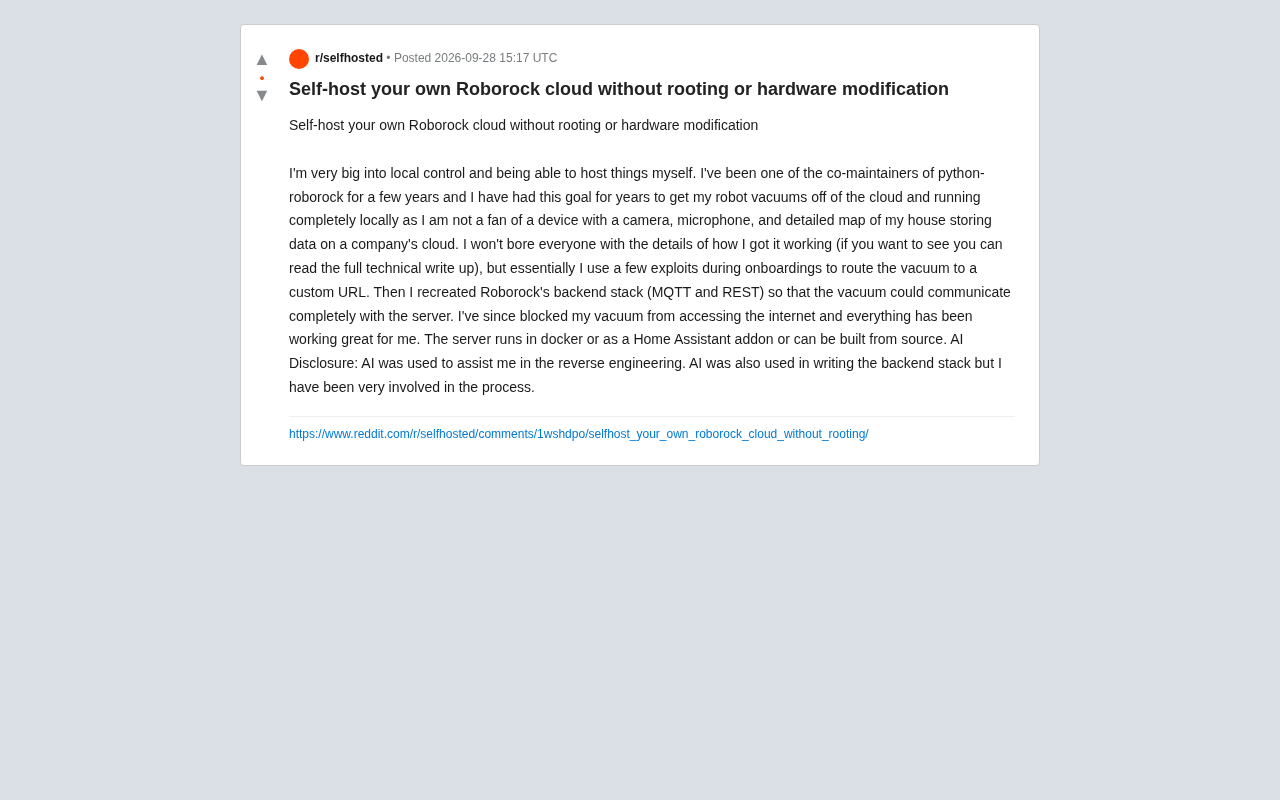
The developer stated plainly on Reddit that he has long been passionate about local control and self-hosted services. His core concern is concrete: a device equipped with a camera, microphone, and a floor plan of your home storing data on a corporate cloud server is inherently a privacy risk.
As a long-time co-maintainer of python-roborock, he has treated "making the robot vacuum run fully locally" as a multi-year goal. This isn't a spontaneous tinkering project — it's a sustained practice centered on device ownership: hardware you purchase should send data wherever you decide.
How This Differs from Traditional Approaches
Previously, getting a Roborock off the cloud typically required rooting or hardware modifications — high barriers with significant risk of bricking the device if anything went wrong. The standout feature of this approach is zero hardware modification and no root required, minimizing any potential for damage.
Rooting a robot vacuum typically involves gaining a root shell via UART or exploiting a vulnerability, then replacing or modifying service endpoints in the system firmware. This process carries real risk: mistakes can permanently brick the device, and manufacturers typically void warranties as a result. Some models also implement Secure Boot, which verifies firmware signatures and raises the bar even further. By contrast, this solution bypasses the firmware layer entirely and instead operates during the device's initial network provisioning (onboarding) phase — a stage that tends to have weaker security protections, as the device actively seeks out and connects to a configuration server, creating an opportunity to redirect traffic. This makes the entire process non-destructive to the device and requires no hardware debugging skills.
Technical Approach: Intercept Onboarding + Rebuild the Backend
The developer didn't expose every technical detail (full documentation is available separately), but outlined the key methodology. The solution proceeds in two steps.
The first step involves exploiting several vulnerabilities during the device onboarding phase to redirect the robot vacuum's communication traffic to a custom URL instead of Roborock's official servers. This is the heart of bypassing the root requirement — rather than modifying the system itself, the interception happens at the network connection stage.
The second step involves fully replicating Roborock's backend stack, including the MQTT messaging channel and REST API. Only by faithfully reconstructing the cloud's communication protocols will the robot vacuum "believe" it's still connected to the official servers — continuing to send and receive commands, upload status, and sync map data normally — while all of this happens on the user's own server.
Still Fully Functional After Going Offline
Once the solution was running, the developer went further and completely cut off the robot vacuum's public internet access. He reports that the device operates normally in a fully offline state, with all features intact. This also validates the completeness of the backend replication — the vacuum's dependency on the external cloud has been entirely taken over by local services.
MQTT (Message Queuing Telemetry Transport) is a lightweight publish/subscribe messaging protocol originally designed for low-bandwidth, high-latency IoT scenarios, and has since become the de facto standard for smart home devices communicating with the cloud. Roborock vacuums use MQTT channels to report cleaning status in real time, receive commands, and sync sensor data. REST endpoints handle request-response interactions such as map data retrieval and device configuration updates. To get the robot vacuum to "accept" a private server, both protocol layers must be fully implemented — the MQTT broker maintains persistent connections and message routing, while the REST API responds to the device's HTTP queries. Any missing protocol fields or format discrepancies can cause the device to disconnect or refuse to operate, which is precisely why reverse engineering projects like this are technically demanding.
Flexible Deployment That Fits the Smart Home Ecosystem
The self-hosted service offers thoughtfully designed deployment options in three forms:
- Docker container: Ideal for users with a NAS or home server — spin it up with a single command.
- Home Assistant addon: Integrates directly into the leading open-source smart home platform, with virtually no additional overhead for HA users.
- Build from source: Aimed at advanced users who want deep customization or wish to audit the code.
For Home Assistant users, the addon form is especially convenient. It means local control of the robot vacuum can be seamlessly integrated into an existing automation setup without maintaining a separate standalone system.
Home Assistant is one of the most popular open-source smart home platforms available, written in Python and supporting thousands of device integrations. Its "addon" mechanism allows users to run third-party services as containers within the Home Assistant OS environment, with lifecycle management, logging, and networking all handled centrally by HA's Supervisor. For users who have already connected lights, sensors, door locks, and other devices to Home Assistant, running the Roborock private cloud as an addon means the vacuum's cleaning tasks and zone commands can participate directly in HA Automations and Scripts — for example, "automatically start a whole-home clean when everyone leaves" or "schedule cleaning according to a calendar" — with all data flow remaining on the local network.
Transparent Disclosure of AI Involvement
To his credit, the developer proactively disclosed his use of AI: the reverse engineering process was assisted by AI, as was the writing of the backend stack — but he emphasizes that he was deeply involved throughout the process, rather than simply handing things off to the tools.
This kind of transparency is increasingly important in open-source projects. Reverse engineering and protocol reimplementation inherently involve extensive trial and error; AI can accelerate protocol analysis and code scaffolding, but the final judgment on security and reliability still requires a human in the loop. The developer's own assessment reflects this — AI is an accelerator, not a replacement.
Why This Matters
The value of this project goes beyond "yet another robot vacuum tinkering tutorial." It demonstrates a low-destructive path to device localization. As more and more home devices default to mandatory cloud binding, being able to reclaim data sovereignty without hardware modifications or rooting is a meaningful, tangible option for privacy-conscious users.
That said, its limitations deserve honest acknowledgment: the approach relies on specific vulnerabilities in the onboarding phase, and whether it remains effective after future firmware updates is uncertain; rebuilding the backend also requires a degree of operational ability. It's better suited to technically inclined users who want local control and are willing to put in the work, rather than everyday consumers. But as a concept, it provides a reproducible template for the principle that "the hardware I bought should be mine to control."
Related articles

Chain of Thought Isn't Just for AI: How Humans Can Use CoT to Improve Thinking Quality
Chain of Thought isn't just a prompt trick for large models. Starting from a Hacker News discussion, this article analyzes why CoT works for human thinking too, breaks down actionable ways to transfer it, and highlights the key differences between human CoT and machine CoT.
Cloudflare Teams Up with OpenAI: Closi…
Cloudflare Teams Up with OpenAI: Closing the Loop from Vulnerability Discovery to Defense with AI
Cloudflare uses OpenAI Daybreak to investigate security vulnerabilities and generate reviewable remediation plans, while developers use Codex to boost coding efficiency and quality.

Orca Multi-Agent Orchestration in Practice: A Guide to Parallel Collaboration with Claude and Codex
Orca is Stable AI's free open-source agent workbench supporting 34 agents like Claude Code and Codex in parallel. Learn its Git worktree isolation, multi-model orchestration, and mobile management.