Self-Hosting n8n on Railway in 40 Seconds: Deployment Speed and Cost, Tested
Deploy a full n8n + Postgres stack on Railway in 40 seconds — but watch the always-on memory costs.
This article documents a hands-on test of deploying the open-source automation tool n8n on Railway. The key finding: using Railway's n8n template (which includes a Postgres database), the entire process from running the deployment command to a passing health check and a live editor takes roughly 40 seconds. However, the convenience comes with a clear cost structure — Railway charges based on actual usage, and n8n consumes around 600MB of memory even at idle, meaning 24/7 uptime generates continuous charges. The article distinguishes two use cases: Railway's managed approach suits rapid prototyping and lightweight personal projects, while high-frequency production workloads or cost-sensitive long-term deployments are better served by a fixed-rate VPS.
Deploy n8n With a Single Command
Just how fast can you self-host an automation tool? A hands-on video from YouTube delivers a pretty remarkable answer: on the Railway platform, the entire process from running the deployment command to having a live service takes just 40 seconds.
The whole deployment hinges on a single command. That command invokes an n8n template on Railway and spins up a Postgres database alongside it. For anyone familiar with self-hosting workflows, this is the key advantage — no manual database configuration, environment variables, or container orchestration required. The template bundles all those dependencies for you. n8n, as an open-source workflow automation tool, needs a persistent database to store workflows and credentials by default, and Postgres is the recommended choice for production environments.
Once the command runs, Railway queues the n8n job and starts both the n8n and Postgres services. This "template-as-deployment" model compresses what used to be a half-hour (or longer) manual setup into something that feels nearly one-click.
n8n (pronounced "n-eight-n") is a node-based, open-source workflow automation platform similar to Zapier or Make (formerly Integromat), but with full self-hosting support. It connects hundreds of services (GitHub, Slack, Google Sheets, etc.) through a visual drag-and-drop interface, and also lets you write custom JavaScript logic nodes. Railway is a developer-focused cloud platform that sits somewhere between Heroku and AWS — it abstracts away server management without the full weight of a major cloud provider. Railway's "Templates" feature lets developers package a pre-configured set of services (app + database + environment variables) into a one-click deployment unit. Any user can reproduce that entire environment in their own account with a single CLI command or button click, with no need to manually handle image pulls, network configuration, or service linking.
Health Check Passes at the 40-Second Mark
The speed is what really stands out. The timer in the video shows that 40 seconds after the deployment command was issued, the service's health check returned OK, and the n8n editor opened on its assigned Railway URL.
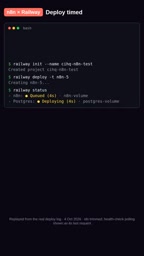
A passing health check means the service is genuinely available — not just that the container started. For developers who want to quickly validate an automation idea or spin up a temporary test environment, this kind of speed dramatically lowers the cost of experimentation. Compared to setting up Docker from scratch on your own VPS, pulling images, and configuring a reverse proxy with SSL, Railway's managed experience is noticeably more approachable.
That said, the 40-second result was measured under ideal conditions — a mature template and good network performance. Real-world deployment times may vary slightly depending on image pull speeds and regional nodes, but "available within minutes" is a credible expectation.
The Trade-Off: Usage-Based Billing and Persistent Memory
Speed and convenience aren't free. The video makes this point explicitly: Railway uses a pay-for-what-you-use billing model.

With n8n specifically, even at idle, the service consumes roughly 600MB of memory. More importantly, that resource is occupied around the clock — because automation workflows typically need to stay running at all times to respond to webhook triggers or scheduled tasks.
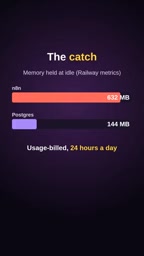
What does this mean in practice? Usage-based billing is great for bursty, short-lived tasks, but for an automation service that needs to be online 24/7, persistent memory and runtime will generate continuous charges. In other words, the real cost of self-hosting n8n on Railway isn't that 40-second deployment — it's the monthly bill from always-on resource consumption. You'll need to assess whether that ongoing expense makes sense given your workflow frequency and uptime requirements.
Railway bills based on the product of vCPU usage time and memory usage time, typically calculated in GB·hours. Using 600MB as the baseline for always-on operation: 0.6 GB × 24 hours × 30 days ≈ 432 GB·hours/month. As of 2024, Railway's memory pricing is approximately $0.000231/GB·hour, which means memory alone costs roughly $0.10/month — but your actual bill also includes CPU usage and egress traffic. Railway offers a $5/month free credit (Trial plan), which may be enough to cover n8n's idle costs for a light personal project. However, if your workflows trigger frequently and generate significant compute or network traffic, costs will climb noticeably. By comparison, renting a minimum-spec VPS on Hetzner or DigitalOcean (around $4–6/month flat) and self-hosting n8n there offers more predictable long-term costs — at the expense of managing your own system security and service availability.
Who Is This Setup For?
All things considered, the Railway + n8n template combination is compelling in a few specific scenarios:
- Rapid prototyping: Want to test whether an automation workflow is feasible without wrestling with server configuration? Being live in 40 seconds lets you start immediately.
- Lightweight personal projects: If you have a small number of workflows with manageable trigger frequency, the cost of 600MB of persistent memory stays within an acceptable range.
- Teams that don't want to maintain infrastructure: Railway handles the underlying operations, saving you from patching, monitoring containers, and similar maintenance work.
For high-frequency, large-scale production automation — or long-term deployments where cost sensitivity is high — a self-hosted VPS at a fixed monthly rate may be more economical over time.
The video author also teased a follow-up: actually running a real workflow in this environment, which is the true test of whether a self-hosting setup is genuinely usable. Deployment speed is just the starting point. The stability, response latency, and cost curve once things are actually running — those are what determine whether a setup is sustainable for the long haul.
Related articles

Felix Rieseberg Personal Homepage
Felix Rieseberg's personal homepage sparks attention on Hacker News. This article covers the Slack engineer's technical background, the rise and fall of nativefier, and the value of a developer homepage as a tech calling card.

@ai-sdk/vue 3.0.306 Patch Release Syncs with [email protected] Update
@ai-sdk/vue 3.0.306 released, synced with [email protected]. A routine patch release for the Vercel AI SDK ecosystem with no public API changes; the Vue adapter layer stays version-aligned with the core package.

Gemini 4 Argon API Launches: The Era of Million-Token Output Begins
Google launches Gemini 4 Argon with sparse MoE architecture, up to 1M output tokens, and a 68.90% Vals Index score, available across API, AI Studio, and the Gemini app.