Semantic-Registry: Precision Tool Matching and Continuous Learning for LLM Agents

semantic-registry uses semantic retrieval and learning from corrections to help Agents pick the right tool amid tool bloat.
semantic-registry addresses the accuracy drop LLM Agents face as tools proliferate by treating tools, skills, and prompts as retrievable semantic assets. It uses a two-stage process: semantic similarity narrows candidates from the full set to a few highly relevant items, then the LLM makes the final judgment—controlling context overhead while retaining model flexibility. A correction-feedback mechanism records wrong selections or user corrections to adjust subsequent recall ranking, so the registry improves with use. Compared to full injection and rule-based routing, it balances flexibility and cost, but effectiveness depends on description quality and accumulated feedback data, making it best suited for Agent projects with expanded tool ecosystems hitting selection bottlenecks.
Title
Semantic-Registry: Precision Tool Matching and Continuous Learning for LLM Agents
Meta Description
Semantic-registry helps LLM Agents select accurately from massive tools, skills, and prompts via semantic retrieval and learning from corrections, solving tool bloat challenges.
Article Content
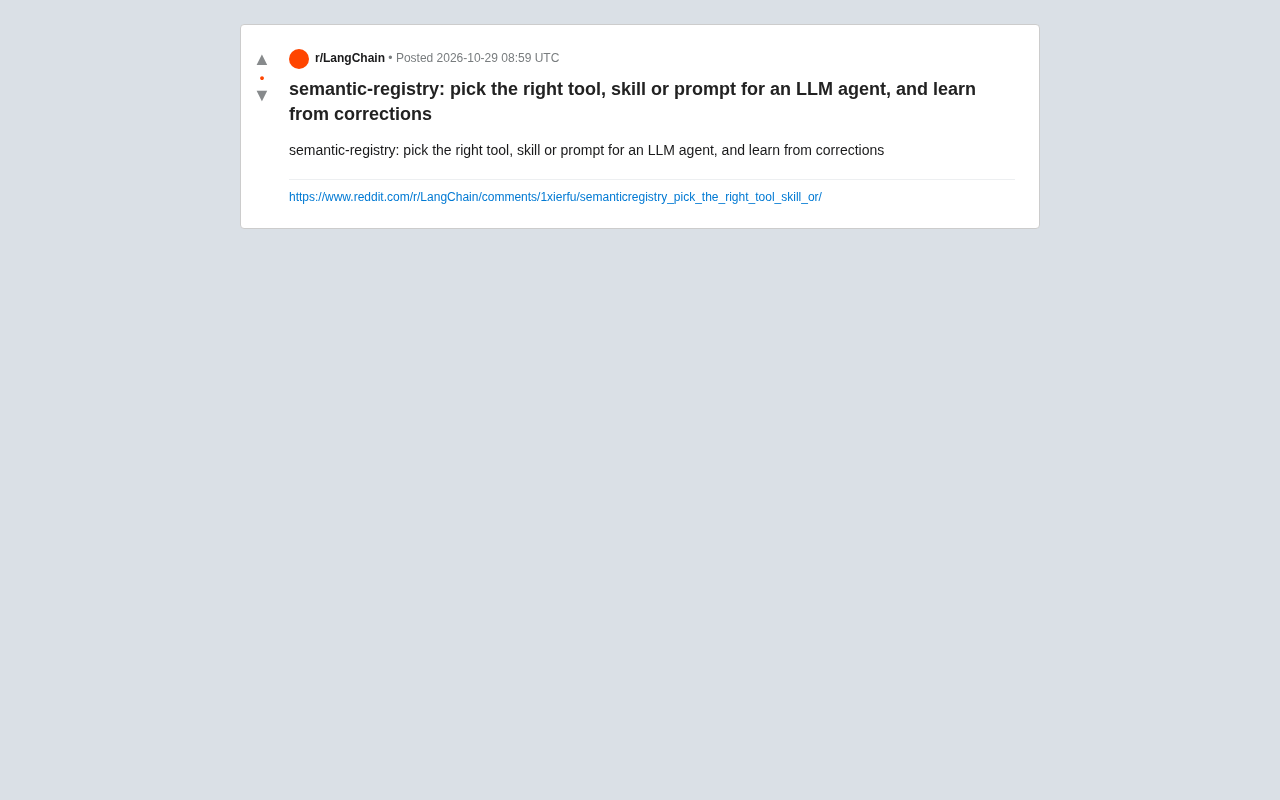
As LLM Agents move from experiments to production, a core challenge is increasingly prominent: when facing massive tools, skills, and prompts, how can an Agent quickly make the right choice? The semantic-registry project, recently discussed on Reddit, attempts to solve this with semantic retrieval and feedback learning.
Core Problem: The Agent's Selection Dilemma
When the number of tools an Agent can call grows from single digits to dozens or even hundreds, the traditional approach of "stuffing all tool descriptions into context" starts to fail. The context window gets occupied by large tool definitions, and the model must choose from lengthy candidate lists, causing accuracy to drop.
semantic-registry treats tools, skills, and prompts as retrievable semantic assets. Whenever an Agent faces a task, the system first recalls the most relevant candidates from the registry via semantic matching, then hands the final decision to the model. This is like giving the Agent an "intelligent toolbox index" rather than having it search the entire warehouse every time.
From community discussion, this direction isn't unique. Multiple developers mention that selection accuracy after tool bloat is a common pain point in current Agent deployments, and semantic retrieval is one natural solution.
Semantic Retrieval here means: mapping tool, skill, and prompt descriptions into high-dimensional vectors via embedding models; when a task arrives, the task description is similarly vectorized, and approximate nearest neighbor (ANN) search finds the closest candidates in vector space. Unlike keyword matching, semantic retrieval captures "same meaning, different words" associations—e.g., "summarize document" and "extract text key points" might be very close in vector space. This enables the system to quickly narrow candidates from hundreds of tools without relying on precise rules. However, recall quality heavily depends on description coverage and distinctiveness; when descriptions are too vague or overlap, distances in vector space lose discriminative power—a common engineering challenge for such approaches.
How It Works: Semantic Routing and Learning from Corrections
Two-Stage Selection Mechanism
semantic-registry uses a two-stage process. The first stage performs semantic similarity matching based on task description, narrowing candidates from the full set to a few highly relevant items; the second stage has the LLM make the final judgment among the refined candidates. This design controls context overhead while retaining the model's judgment flexibility in edge cases.
Learning from Corrections
The "learn from corrections" in the project name points to another layer of value: when an Agent selects the wrong tool or a user corrects the selection, the system records this feedback to adjust subsequent recall ranking. This makes the registry not a static catalog but a knowledge base that gradually improves with use.
According to the original Reddit post, the project uses correction signals as the basis for improving retrieval quality rather than directly fine-tuning the model. This lightweight approach is friendly to teams seeking rapid iteration.

Learning from Corrections here does not mean fine-tuning the LLM itself, but using correction signals to update the retrieval layer's ranking strategy. Specifically, when a user or system determines a tool selection was wrong, this record (task description, wrong tool, correct tool) is stored in a feedback log. The system can then adjust recall ranking—e.g., via a reranker model or simple similarity weighting—to give higher priority to tools that are similar to the task description and historically corrected as correct. Advantages: lightweight, interpretable, no large model training. Limitations: sparse feedback during cold start limits ranking optimization, and a reasonable feedback decay mechanism is needed to prevent outdated correction signals from dominating ranking long-term.
Differences from Traditional Tool Calling Approaches
Common tool calling approaches fall into three types: full injection, rule-based routing, and embedding-based retrieval.
- Full injection is simple and direct, but hits context limits once tools grow numerous and dilutes model attention.
- Rule-based routing relies on manually maintained mapping tables; highly interpretable but limited in coverage for open tasks and costly to maintain.
- Semantic retrieval balances flexibility and cost, but recall quality depends on description text quality.
semantic-registry belongs to the third category, with the increment being incorporating "correction feedback" into the retrieval optimization loop. Some developers in the community note that description writing standards greatly affect recall performance—still a common challenge for such approaches. Others argue that learning from corrections has limited effect during cold start and requires a certain usage volume to show value.
Embedding is the technique of converting discrete text into continuous vectors. In tool calling scenarios, each tool's name, function description, parameter specs, etc. are concatenated and fed into an embedding model to generate a fixed-dimension vector. Embedding models are typically pretrained on large-scale text and can map semantically similar text to nearby positions in vector space. Thus, when an Agent receives a task description, it only needs to compute cosine similarity between the task vector and each tool vector to rank and recall. Embedding quality depends on model choice and description standardization: the more specific the description and the better it distinguishes tool boundaries, the more accurate the recall. Conversely, if multiple tool descriptions are highly similar, their embeddings will also be highly close, making it hard for the retrieval layer to distinguish them and pushing selection pressure back to the LLM.
Who Should Try It
semantic-registry is better suited for Agent projects whose tool ecosystems have already expanded and are hitting selection accuracy bottlenecks. For scenarios with few tools and fixed task scope, the benefits of introducing a registry may be limited.
Another noteworthy scenario is multi-Agent collaboration: when different Agents share a tool library, a unified semantic registry can reduce duplicate descriptions and maintenance costs.
Summary
semantic-registry points to a clear engineering trend: Agent capability expansion isn't just about "connecting more tools" but also "managing tools more intelligently." Semantic retrieval plus learning from corrections is a pragmatic path, with actual effectiveness depending on description quality and accumulated feedback data. For teams building production-grade Agents, this project offers a design worth referencing.
Related articles
AI Buzz Weekly: GPT-6.5 Leak, New Claude Model, and MiniMax's Cost-Effectiveness
This week's AI buzz roundup: suspected GPT-6.5 leak, Microsoft configs showing GPT-6.1 Tera, Anthropic's new model that can identify entire classes of bugs, disappointing early Gemini 4 Carbon results, and MiniMax M3.1 Flash beating Claude Opus 5 and GPT-5.6 Sol in benchmarks at extremely low cost.

AI Briefing: Gemini 4 Carbon Released, Ant Open-Sources Ling-3.1
AI Briefing: Google releases Gemini 4 Carbon qubit model, claiming to surpass Opus 5.5 with half-price tokens; Ant open-sources Ling-3.1-1019 for real-task Personal Agents; domestic AI drug discovery succeeds in 18 of 19 projects, hitting all 6 GPCR targets; zero-revenue company valued at $20B raises another $1B; Sichuan convenience store robot sales fail.
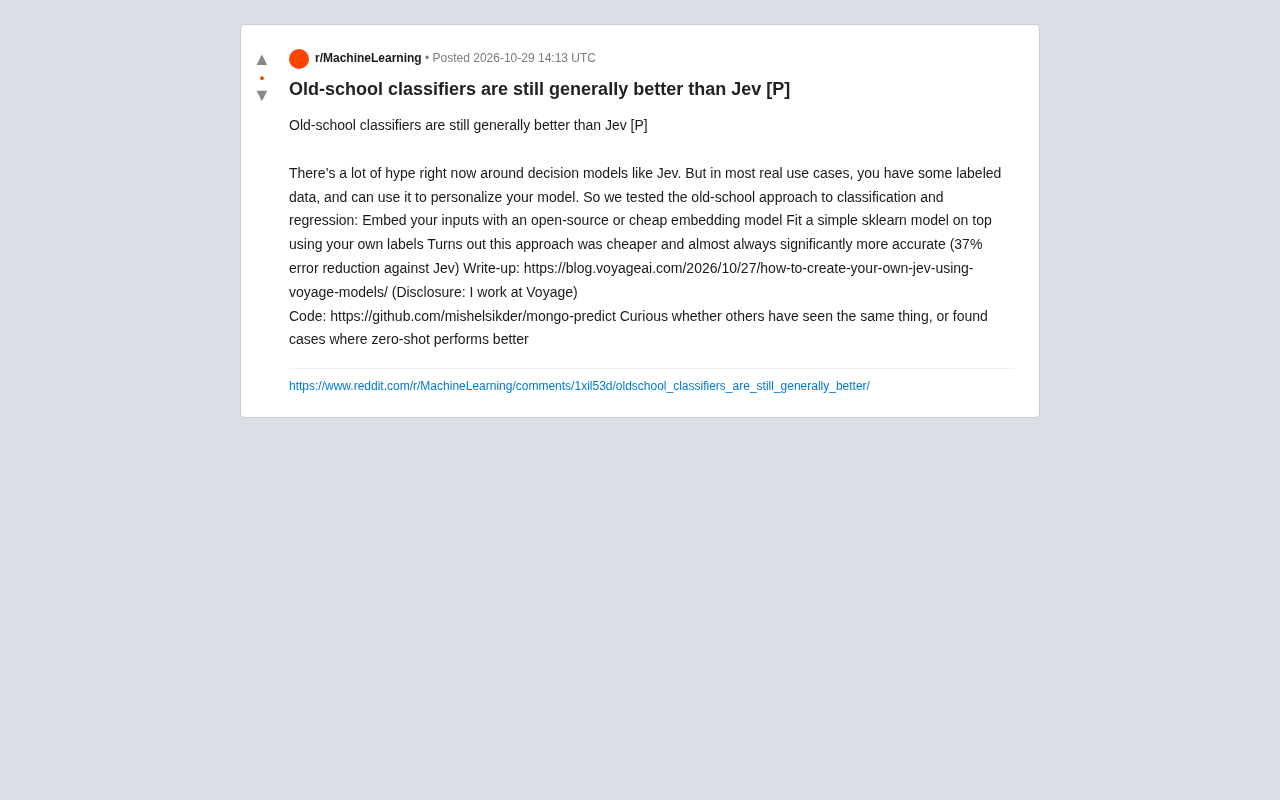
Old-School Classifiers Still Beat Jev: Embeddings + sklearn Cuts Error by 37%
Voyage AI engineers found that an old-school approach using open-source embedding models plus sklearn classifiers is cheaper and cuts error by 37% versus the popular decision model Jev. Discussing whether traditional methods are undervalued when labeled data exists, and the boundaries between zero-shot and supervised learning.