Semantica: A Traceable 'Black Box' for AI Agent Decision-Making

Semantica adds traceable decision records and data provenance to AI Agent workflows.
Semantica is an open-source project with 8,600+ GitHub stars that acts as a decision record layer beneath AI Agents. It saves input materials, judgment results, rules, and contextual relationships in a queryable knowledge graph, enabling full traceability of AI decisions. With features like rule validation, conflict detection, visual Knowledge Explorer, multi-Agent memory sharing, and MCP integration, it addresses growing compliance demands in regulated industries.
Why Did the AI Decide That? An Unavoidable Question
Imagine this scenario: you have an AI Agent reviewing loan applications, and it ultimately returns a "rejected" verdict. Three months later, the customer comes back to challenge the decision — what documents were used? Which rules were triggered? Were there any similar cases handled before?
If you're relying on standard logs, all you might see is a cold "task completed" message. And chat history? It can only tell you what the model said at the time, but it can't reconstruct the complete evidence chain behind the decision.
In AI systems, "Explainability" and "Traceability" are two concepts that are frequently confused but fundamentally different. Explainability focuses on the model's internal reasoning mechanisms — for instance, why a neural network assigns higher weight to a particular feature. Traceability, on the other hand, focuses on the external evidence chain of a decision — what data was used, which rules were triggered, and what outcomes were produced. In regulated industries like finance and healthcare, regulations such as the EU's AI Act and the U.S. Algorithmic Accountability Act already explicitly require high-risk AI systems to maintain complete records of their decision rationale. Model logs or chat records alone fall far short of meeting these compliance requirements, as they lack structured evidence-linking capabilities.
This is precisely the problem that Semantica, an open-source project with over 8,600 stars on GitHub, aims to solve. It saves input materials, judgment results, rules applied, and contextual relationships together, allowing you to trace back to every source that informed a decision at any point in time.
What Is Semantica: A Decision Record Layer Beneath the Agent
Think of Semantica as a record-keeping system that sits beneath your Agent layer. It doesn't try to replace your existing tech stack — your LLMs, vector databases, and Agent frameworks can all continue working as before. Semantica is responsible for just one thing: storing external materials and decision records, and organizing them into a queryable relationship graph.
This design draws from the core ideas of Knowledge Graphs. Knowledge graphs use a "entity-relationship-entity" triple structure to represent real-world knowledge networks, first proposed and applied to search engines by Google in 2012. Unlike traditional relational databases, graph structures are naturally suited for expressing multi-hop associations — for example, starting from a loan rejection decision, tracing along relationship chains back to the original credit report, the risk control rules that were triggered, and a similar case from three months ago. This kind of chain-based tracing requires extensive JOIN operations in tabular databases, but in a graph structure, it's simply natural path traversal.
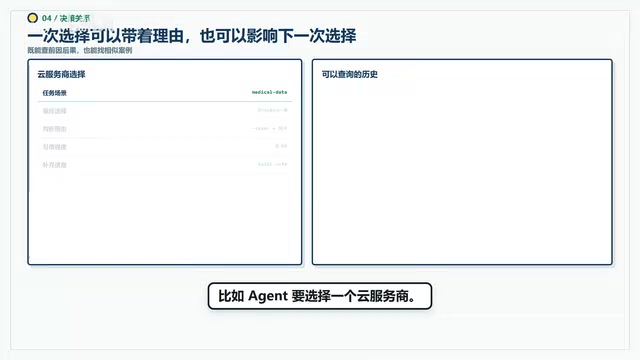
Take "an Agent choosing a cloud service provider" as an example. You can record the task scenario, the final choice, the reasoning behind it, the confidence level, and other supplementary information. If a related decision occurs later, the two decisions can be linked together to show "who influenced whom." When it's time for a review, you can examine the full chain of cause and effect, or search for similar cases that were handled before.
Rule Validation: The Last Checkpoint for AI Compliance
Sematica can also check whether a current decision violates pre-defined rules. For example, if company policy states "medical data may only be stored with service providers that have signed agreements," then after the Agent makes its choice, Semantica will run another check to see whether the result violates this requirement. This is especially critical for compliance-sensitive business scenarios.
Data Provenance and Version Management: Every Conclusion Has a Paper Trail
Sematica's core value lies in traceability. Every conclusion is bound to its source materials — which PDF it came from, which database segment, which import batch — all of this can be traced further back. Even if data is modified later, the system retains timestamp and version information, preventing the loss of history that comes from "new content directly overwriting old content."
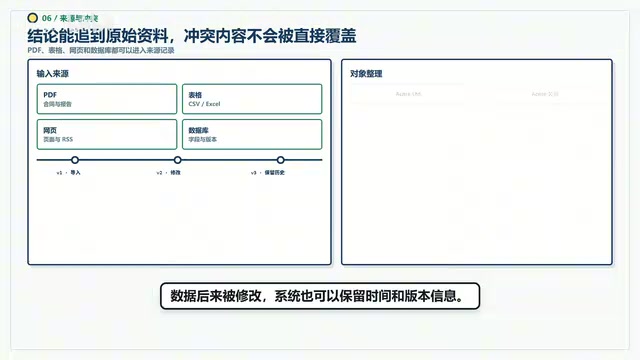
In terms of data processing capabilities, Semantica supports materials from PDFs, spreadsheets, web pages, and databases. It identifies people, companies, events, and relationships from the content, and automatically merges duplicate entities. When two sources contradict each other, it doesn't crudely overwrite old content with new — instead, it flags the conflict and leaves the resolution to the user.
This involves two classic challenges in data governance. The first is Entity Resolution — determining whether names appearing in different documents refer to the same real-world object, such as "Microsoft" and "Microsoft Corp.," or "Wei Zhang (Finance Dept.)" and "Wei Zhang (Tech Dept.)." Traditional entity resolution relies on string matching and rule systems, while modern approaches combine vector similarity with contextual semantic analysis. The second is information conflict detection — when two reports give different revenue figures for the same company, simply overwriting old data with new data might mask important discrepancy signals. Semantica's choice to flag conflicts rather than auto-overwrite reflects a design philosophy known in data governance as a "conservative merge strategy," which is particularly suited for audit-sensitive scenarios.
Knowledge Explorer: A Visual Knowledge Map
The project comes with a browser-based workbench called Knowledge Explorer. When you open it, you'll see a relationship graph made up of nodes and edges. You can search for a specific entity, view only its immediate relationships, or follow a timeline to see how the entire graph has evolved over time.
The decision page displays the cause and effect of a particular decision, while the source page lets you trace further back to the original materials. If you discover that two names actually refer to the same entity, you can inspect and merge them directly in the interface.
Multi-Agent Collaboration and MCP Ecosystem Integration
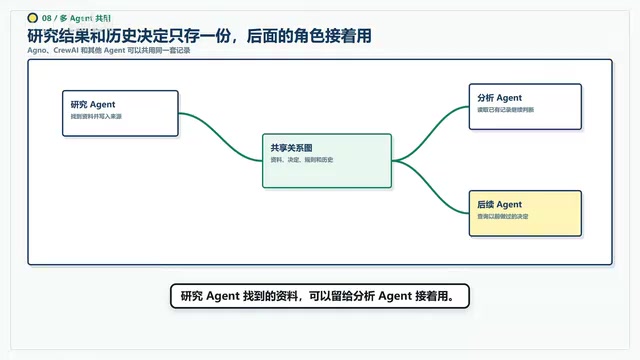
If you're already using frameworks like Agno or CrewAI, you can have multiple Agents share this record-keeping system. Agno (formerly Phidata) emphasizes lightweight Agent construction, while CrewAI focuses on role division and task orchestration. In multi-Agent systems, a core challenge is the "memory silo" problem: each Agent independently maintains its own context window and memory store, meaning critical information found by Agent A can't be directly utilized by Agent B. Traditional solutions involve passing information through shared databases or message queues, but these lack semantic-level relationship management.
Sematica serves as a shared "structured memory layer" that not only passes the data itself but also preserves causal relationships and temporal information between data points. This means: materials found by a research Agent can be left for an analysis Agent to use next, and subsequent Agents can look up decisions made earlier — without each role maintaining its own separate, inconsistent memory.
Additionally, Semantica provides an MCP Server. MCP (Model Context Protocol) is an open protocol released by Anthropic in late 2024, designed to establish standardized communication interfaces between AI models and external tools. Before MCP, each Agent framework had its own tool-calling approach, forcing tool developers to repeatedly adapt for different frameworks. MCP's design is similar to what USB-C is for hardware devices — it defines a unified interface specification so that any MCP-compatible AI client (such as Claude Desktop, Cursor, etc.) can directly invoke capabilities provided by any MCP Server. Semantica's MCP Server supports recording decisions, querying history, tracing causes, and reading relationship graphs, allowing it to seamlessly integrate into modern Agent workflows.
Flexible Deployment Options
It's worth noting that the core functions of building relationship graphs, recording provenance, and running rules can operate without connecting to an LLM. You only need to configure corresponding models and vector tools when you want to automatically extract people and relationships from documents, or perform similar content searches.
Data can be kept entirely on your own servers. For production deployments, you'll typically need to integrate graph storage like Neo4j and configure access permissions. Neo4j is one of the most mature native graph databases available today, using the Cypher query language to operate on graph data. A "native graph database" means it organizes data as a graph at the storage level (nodes and edges are directly connected through pointers), rather than simulating graph structures on top of a relational database. This gives it far superior performance for deep association queries compared to traditional databases — and decision tracing scenarios are filled with exactly these kinds of multi-hop query needs, like "from Decision A, find Material B, then find Rule C, then link to Historical Case D."
Capability Boundaries and Security Considerations
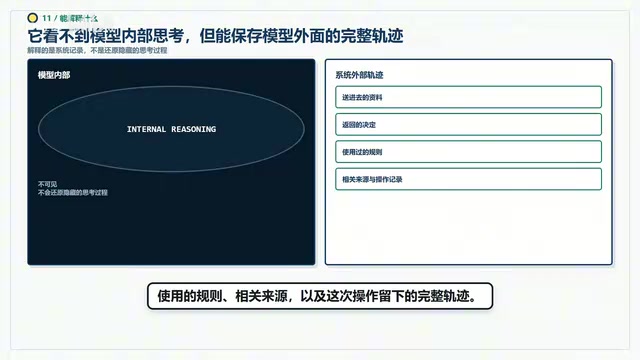
It's important to be clear about Semantica's capability boundaries: it cannot see how the model thinks internally at each step, nor can it reconstruct the model's hidden reasoning process. What it can explain is the system "outside" the model — the materials fed in, the decisions returned, the rules applied, the related sources, and the complete trail left by each operation.
The latest stable version is 0.6.5, released on August 11. This is a significant security update that fixes critical issues including missing authentication on Explorer endpoints and graph database query injection. These two types of security vulnerabilities are typical in AI infrastructure. Graph database query injection (a variant of SQL injection for graph databases) allows attackers to read, modify, or even delete all data in the graph database by crafting malicious Cypher query statements. Missing API authentication means anyone who can reach the service port can directly manipulate all decision records and knowledge graphs in the system. This combination of vulnerabilities is not uncommon in open-source AI tools — many projects deprioritize security during rapid feature iteration, only patching these issues after community audits or security incidents. Existing users should upgrade as soon as possible. When deploying Explorer on a server, make sure to set an API Key and never expose anonymous mode and service ports directly to the public internet.
Should You Use Semantica? A Rational Decision Framework
The project is currently updated frequently and has some open issues being addressed. If you plan to integrate it into a production environment, it's recommended to first run through a complete cycle of import, query, permissions, and backup using your own data.
To determine whether you need Semantica, apply a simple standard:
- If you just want a personal assistant to remember a few preferences, a simple memory tool will be more efficient;
- When Agents influence high-risk decisions like loans, healthcare, contracts, or internal company approvals, Semantica truly proves its value — when something goes wrong, you can at least find out what it looked at and what trail it left behind.
As AI Agents increasingly permeate critical business operations, "explainable, traceable, and auditable" is shifting from a nice-to-have to a hard requirement. As regulations like the EU AI Act are enforced globally, an enterprise's ability to hold AI decision processes accountable will no longer be optional — it will be a compliance baseline. What Semantica provides is exactly this kind of accountability-oriented infrastructure.
Related articles
StyleX vs Tailwind: Choosing a CSS Framework in the Age of AI Agent Coding
Analyzing why Meta's StyleX may outperform Tailwind CSS when AI Agents write code—from type safety and compile-time checks to correctness at scale.

The AI Pivot Myth: From Buzzword Bandwagoning to Real Transformation
From the joke about Allbirds pivoting to AI compute, we analyze the "everything is AI" hype, show how to spot real vs. fake AI pivots, and why business fundamentals still matter.
Devin CLI Model Picker: A Deep Dive into One-Click Model Switching and Cost Comparison
Devin CLI adds a Model Picker feature for viewing available models, comparing costs, and switching effort levels. A deep dive into its three core capabilities and practical value for AI coding workflows.