Semantica: Graph-Native Context Infrastructure That Gives AI Agents True Contextual Understanding

Semantica uses knowledge graphs instead of traditional RAG to give AI agents true contextual understanding.
Semantica is an open-source, graph-native context infrastructure that transforms raw text into structured knowledge graphs for AI agents. By replacing traditional vector-based RAG with entities, edges, and decision intelligence, it enables more accurate context understanding, traceable decision-making, and multi-agent context sharing. The project features LLM-powered graph construction, a visual explorer, MCP protocol support, and seamless integration with coding agents like Claude Code and Codex.
From Strings to Knowledge Graphs: A Paradigm Shift in AI Context
As AI agents evolve rapidly, a core pain point is becoming increasingly apparent: how do you make agents truly "understand" context, rather than simply stuffing a massive block of text into an LLM's prompt? Semantica is an open-source project built to solve exactly this problem. It's a graph-based infrastructure designed specifically for AI systems that need context awareness and accountability.
Sematica's core idea is straightforward — transform raw string text into richly structured knowledge graphs. Through graph structures, agents can more accurately understand relationships between entities, leading to higher-quality decisions. The project documentation explicitly compares vector databases and RAG approaches with graph-native methods, clearly pointing out that graph structures hold significant advantages over traditional methods along two dimensions: "retrieving context" and "understanding context."
To appreciate this advantage, it helps to first clarify the technical differences between vector databases and knowledge graphs. Vector databases (such as Pinecone, Weaviate, Milvus, etc.) work by converting text into high-dimensional vectors through embedding models, then using approximate nearest neighbor (ANN) search to find semantically similar content. This approach excels at "retrieval" — finding document fragments semantically close to a query — but it inherently loses the explicit relationships between entities. For example, vector search can tell you that "Apple" and "iPhone" are close in semantic space, but it cannot directly express the structured fact that "Apple Inc. launched the iPhone in 2007." Knowledge graphs, on the other hand, use triples (Subject-Predicate-Object) as their fundamental unit, explicitly storing relationships between entities, making reasoning and multi-hop queries possible. This is precisely the essential difference Semantica describes between "retrieving context" and "understanding context."
It's also worth noting that today's mainstream RAG (Retrieval-Augmented Generation) solutions face similar limitations. RAG is an LLM knowledge augmentation paradigm proposed by Meta in 2020. Its basic workflow is: user asks a question → relevant document fragments are retrieved from an external knowledge base → retrieved results are concatenated into the prompt → LLM generates an answer. RAG effectively mitigates LLM hallucination and knowledge staleness issues, but when associative reasoning across multiple document fragments is needed, simple vector retrieval often returns isolated fragments and fails to capture the global entity relationship network. Moreover, when the context window is filled with large volumes of retrieved results, LLMs tend to suffer from the "Lost in the Middle" phenomenon — significantly reduced attention to information positioned in the middle of the context. These limitations are precisely what Semantica aims to overcome through its graph-native approach.
The traditional approach feeds a large block of context directly to an agent as a query, but this often leads to misunderstanding — when the context is too long and too dense, the agent easily focuses on the wrong points or misses critical information. Semantica breaks it down into nodes and edges, supplemented with decision guidance, making the agent's understanding far more precise.
Architecture Deep Dive: The Complete Pipeline from Data Source to Visualization
Sematica's architecture is remarkably clear, and the entire workflow can be broken down into several key stages.
Context Injection and Parsing
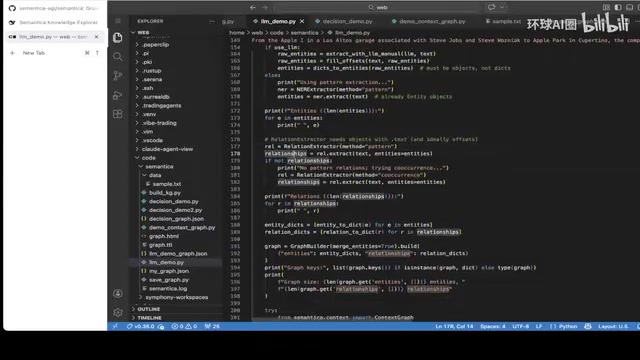
The pipeline begins with the Source — the raw context text. After the system ingests this context, it parses it, normalizes objects, and splits them into distinct Entities and Edges. During the extraction process, Semantica includes a built-in conflict detection mechanism that identifies and removes contradictory information to ensure graph quality.
Conflict detection carries significant technical importance in knowledge graph construction. When building knowledge graphs from unstructured text, information conflicts are a universal challenge — the same entity may have contradictory attribute descriptions across different texts (e.g., inconsistent founding dates from different sources), temporal changes may cause information to become outdated (e.g., CEO changes), and the inherent ambiguity of natural language can introduce errors. Traditional knowledge graph construction pipelines often require manual conflict resolution, which is extremely costly. By automatically identifying contradictory information during the graph construction phase, Semantica directly impacts the reliability of downstream agent decisions.
Storage and Retrieval
Once graph construction is complete, Semantica supports two storage and retrieval methods: a Vector Store for storing embedding vectors and supporting semantic retrieval, and a Graph Store for exporting and visualizing the graph.
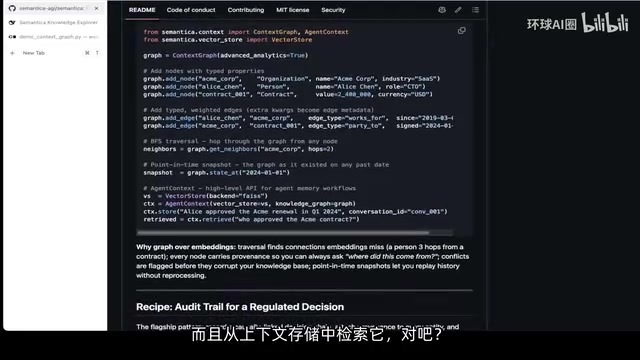
For data retrieval, the project offers multiple interface options, including REST-based services, the MCP (Model Context Protocol), and direct library calls, enabling flexible integration with various application scenarios.
The MCP protocol deserves special mention. MCP (Model Context Protocol) is an open protocol released by Anthropic in late 2024, designed to establish standardized communication interfaces between AI models and external data sources and tools. Before MCP, every AI application needed custom integration code for different data sources, creating a massive "N×M" adapter problem. MCP uses a client-server architecture and defines unified capabilities for resource exposure, tool invocation, and prompt templates, allowing any MCP-compatible AI client (such as Claude Desktop, Cursor, etc.) to plug-and-play with any MCP server's capabilities. Semantica's support for MCP means it can serve as a standardized context service, directly callable by various AI tools and coding agents, dramatically reducing integration costs.
Decision Intelligence: Making Every AI Agent Decision Traceable
One of Sematica's most distinctive capabilities is Decision Intelligence. It doesn't just help agents understand context — it also records and manages the decision-making process itself.
Decision Intelligence is an emerging interdisciplinary field championed by Google's Chief Decision Scientist Cassie Kozyrkov and others, blending decision science, data science, and management science, with an emphasis on translating data-driven insights into actionable decisions. In the AI domain, decision explainability and auditability are becoming core regulatory compliance requirements — the EU AI Act explicitly requires that the decision-making process of high-risk AI systems must be traceable and explainable. Semantica records the decision process in graph structure form, making every reasoning step verifiable. This not only meets technical debugging needs but also provides infrastructure-level support for compliance auditing.
Specifically, you can:
- Record decisions: Save each decision in graph form
- Trace decision chains: Clearly see how a particular decision was made step by step
- Find similar decisions: Leverage historical experience to assist new decisions
- Analyze decision impact: Evaluate the cascading effects of a decision
- Check decision rules: Ensure decisions comply with established norms
The core value of this mechanism is that it transforms the agent's decision-making process from a "black box" into something explainable and accountable. In the demo, created decisions are visualized as a Decision Tree — for instance, "Decision One" and "Decision Two" are clearly displayed in the explorer, ultimately outputting a decision graph.
Two Graph Construction Methods: Regex Extraction and LLM-Powered Extraction
Sematica offers two paths for building graphs, suited to different data scenarios.
Traditional Regex Approach
Entities and relationships are extracted from text through predefined regex rules. This is ideal for data with high structural regularity and well-defined patterns.
LLM-Powered Extraction
This approach uses large language models to automatically read context and extract all entities and relationships. The system first uses an LLM to extract entities, then employs a relationship extractor to build edges, and finally feeds both entities and edges into a graph builder to generate the complete graph.
Taking a context passage about Apple Inc. as an example (covering what Apple is, how it was founded, who the founders are, etc.), Semantica breaks it down into 114 nodes and over 10 edges. Once construction is complete, the graph can be exported as a JSON file and handed to Semantica Explorer for visualization.
Visual Explorer: Examining Knowledge Graphs from Multiple Dimensions
Sematica comes equipped with a feature-rich visualization tool called Explorer — the most intuitive part of the entire project.
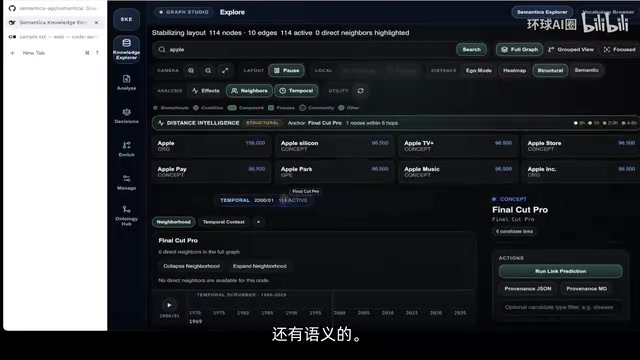
In the explorer, you can perform the following operations:
- View node details: Click any node to see its detailed information and relationships with other nodes
- View direct neighbors: Click a node (e.g., the "2007" node) to see its connections to iPhone, Apple, and other nodes
- Temporal context analysis: Observe the evolution of entity relationships across a timeline
- Link prediction: Predict potential associations between nodes
- Smart search: Searching "Apple" returns all related nodes, such as "Apple Inc. concept," "Apple Park," etc.
- Aggregate views and heatmaps: Provides both structural and semantic heatmaps, as well as grouped views and full graph views
These multidimensional views allow developers to examine context from different angles, significantly improving comprehension efficiency for complex knowledge structures.
Multi-Agent Shared Context: Breaking Down Information Silos
In multi-agent collaboration scenarios, Semantica demonstrates unique value. It supports a Shared Context mechanism — a single context can be used simultaneously by multiple different agents.
Multi-Agent Systems are one of the hottest directions in AI engineering during 2024-2025. From AutoGen and CrewAI to LangGraph, a variety of multi-agent orchestration frameworks have emerged, all centered on the core idea of decomposing complex tasks across multiple specialized agents working collaboratively — similar to how human teams divide labor. However, one of the biggest challenges facing multi-agent systems is context sharing — agents often independently maintain their own conversation histories and working memory, leading to information silos and duplicated work. Traditional solutions include shared message queues and centralized state stores, but these approaches lack semantic-level understanding.
Sematica's graph-native shared context mechanism enables multiple agents to collaborate on the same semantically rich knowledge structure, offering an innovative approach to this pain point. For example, you can create a shared context and connect both a "researcher agent" and an "analyst agent" to it, or even organize multiple agents into teams, letting the entire system share the same context on a unified graph-native infrastructure. This is particularly critical for building complex multi-agent systems, effectively preventing the information fragmentation that occurs when each agent maintains its own context independently.
Getting Started: Deployment and Configuration Guide
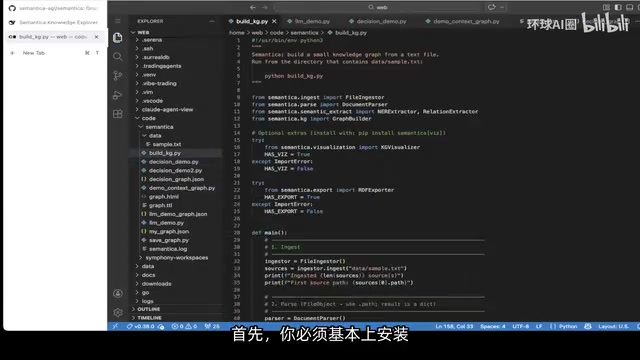
Sematica's deployment process is relatively straightforward, with the following main steps:
- Install the Ripple environment: Clone the repository and complete the configuration and installation per the documentation
- Install LLM dependencies: If using the LLM extraction method, install the OpenAI-related libraries
- Install the Python environment: Required for vector storage and embedding functionality
There are multiple startup options: you can launch the Semantica server (REST service) or start Explorer separately for data exploration and visualization.
Key Environment Variable Configuration
There are several important configuration items to note during deployment:
- Allowed Origins: Must be correctly set if deployed on a VPS
- API Key: Obtain a Semantica API key
- Allow Anonymous: Can be set to true for testing, but must be set to false in production to ensure security — never enable anonymous access in public environments
- Model Configuration: Set the OpenAI API key and base URL. The demo uses GPT-series models, but local models like Ollama are also supported
Deep Integration with Coding Agents
Sematica's most practically valuable aspect is that through MCP or its backend server, it can seamlessly integrate with various coding agents, including Claude Code and Codex.
This means developers can have Codex or Claude Code directly call Semantica to create decision trees and run queries, incorporating graph-native context capabilities into everyday AI programming workflows. For teams exploring the production deployment of Agent engineering, this is an integration direction worth serious attention.
Conclusion
Sematica represents an advanced approach to AI context management — shifting from simple "text stacking" to "structured graphs." By transforming strings into knowledge graphs composed of entities and edges, and layering on decision intelligence and visualization capabilities, it provides AI agents with more reliable and explainable decision support. For developers hitting understanding bottlenecks with vector databases and RAG solutions, the graph-native approach is a worthwhile complementary or alternative solution. As an open-source project, Semantica's low-barrier deployment process and rich integration capabilities also give it strong practical value.
Related articles

Chain of Thought Isn't Just for AI: How Humans Can Use CoT to Improve Thinking Quality
Chain of Thought isn't just a prompt trick for large models. Starting from a Hacker News discussion, this article analyzes why CoT works for human thinking too, breaks down actionable ways to transfer it, and highlights the key differences between human CoT and machine CoT.
Cloudflare Teams Up with OpenAI: Closi…
Cloudflare Teams Up with OpenAI: Closing the Loop from Vulnerability Discovery to Defense with AI
Cloudflare uses OpenAI Daybreak to investigate security vulnerabilities and generate reviewable remediation plans, while developers use Codex to boost coding efficiency and quality.

Orca Multi-Agent Orchestration in Practice: A Guide to Parallel Collaboration with Claude and Codex
Orca is Stable AI's free open-source agent workbench supporting 34 agents like Claude Code and Codex in parallel. Learn its Git worktree isolation, multi-model orchestration, and mobile management.