Semantica: The Open-Source Reasoning Engine That Creates Complete Evidence Chains for AI Decisions

Open-source reasoning engine that makes every AI decision traceable, auditable, and explainable for regulated industries.
Semantica is an open-source deterministic reasoning engine designed to solve AI explainability challenges in heavily regulated industries like finance, healthcare, and law. It constructs knowledge graphs from enterprise data, applies formal logic-based reasoning instead of probabilistic neural networks, and generates W3C PROV-compliant provenance records for every decision. With 6000x query acceleration through index rewriting, native MCP server support, and mandatory self-hosted deployment, it provides a complete evidence chain solution for compliance auditing.
When Regulators Ask "Why"
Imagine this scenario: an AI system approves a credit application, and months later a regulatory body comes knocking with a seemingly simple yet devastatingly difficult question — "Why did you make that decision?" For most black-box models based on deep learning, this question is nearly impossible to answer. They can produce results, but they cannot fully reconstruct the reasoning path.
Deep learning models are called "black boxes" because their decision-making processes are distributed across weight matrices containing millions or even billions of parameters, making them impossible for humans to intuitively understand. Although the academic community has proposed post-hoc explanation methods like LIME, SHAP, and Attention visualization, these techniques are essentially approximate descriptions of model behavior — not true reasoning path reconstruction. Under regulatory frameworks like the EU AI Act and the U.S. Equal Credit Opportunity Act, financial institutions must be able to explain decision reasons to rejected applicants. This "right to explanation" far exceeds the capabilities of existing post-hoc attribution techniques.
This is precisely the core pain point that the open-source project Semantica aims to solve. It doesn't try to make AI "smarter" — instead, it makes every step of AI decision-making traceable, auditable, and explainable. In high-risk, heavily regulated domains like finance, healthcare, law, and government, this kind of "explainability" is often more important than accuracy itself.
How Semantica Builds a Complete Pipeline from Enterprise Data to Evidence Chains
Sematica's workflow can be broken down into several clear stages. First, it ingests an enterprise's raw data into the system, transforming unstructured or semi-structured information into structured semantic units through entity and relation extraction. Entity and Relation Extraction is a critical prerequisite step for building knowledge graphs — it uses NLP techniques to identify named entities and their relationships from unstructured text. For example, from a contract document, it can extract entities like "Party A," "Party B," "collateral," and "amount" along with their legal relationships, converting natural language into structured representations that machines can reason over.
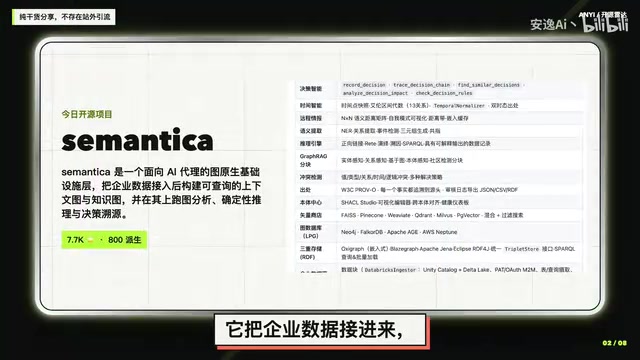
Building on this extraction, Semantica constructs two critical graphs — the Context Graph and the Knowledge Graph. The former carries the relationship network within specific business scenarios, while the latter accumulates domain knowledge and ontology structures. A knowledge graph is a structured knowledge representation based on triples (subject-predicate-object) as its basic unit. Popularized by Google in 2012, it has become core infrastructure for enterprise-level semantic systems. Unlike vector databases that rely on similarity retrieval in embedding spaces, knowledge graphs support precise logical reasoning and relationship traversal. Together, these two graphs form the foundational infrastructure for reasoning.
The real key lies in the reasoning stage: Semantica uses a Deterministic Reasoning Engine rather than probabilistic neural networks. Deterministic reasoning engines are rooted in the Symbolic AI tradition, using formal logic rules for deduction. Their core characteristic is idempotency — the same input produces exactly the same output at any time, in any environment. This stands in fundamental opposition to probabilistic models based on neural networks: large language model outputs are affected by temperature parameters, sampling strategies, and even floating-point arithmetic precision, meaning the same prompt can produce different answers. In audit scenarios, determinism means reasoning results can be independently reproduced and verified by third parties — a basic prerequisite for compliance auditing.
Finally, every decision comes with a provenance record based on the W3C PROV standard. W3C PROV is a family of data provenance description standards published by the World Wide Web Consortium in 2013. It defines three core concepts: Entity (data objects), Activity (processing steps), and Agent (executors). Through these concepts, it can completely describe the full lifecycle of any data from creation, transformation, to usage. In audit scenarios, the PROV standard allows any decision to be traced back to its original data sources, intermediate processing steps, and final reasoning rules, forming a legally meaningful complete evidence chain. In other words, from data ingestion to decision output, the entire reasoning chain is fully recorded.
This design stands in stark contrast to mainstream large models: LLMs pursue generalization and generation capabilities, while Semantica pursues verifiability and compliance. This also defines its positioning — it explicitly states that it's "not for lightweight chatbots."
Developer Experience and IDE Integration
Despite targeting serious enterprise scenarios, Semantica has put considerable effort into developer experience. The project has already garnered 7.7K stars on GitHub, demonstrating significant community attention.
In terms of integration, it provides native plugins for mainstream AI coding IDEs like Claude Code, Cursor, and Codex, allowing developers to invoke its capabilities directly within their familiar workflows.
More importantly, Semantica offers a complete MCP (Model Context Protocol) server, with the team claiming 30-second integration with any MCP-compatible client. MCP is an open protocol launched by Anthropic in late 2024, aimed at standardizing interactions between AI models and external tools and data sources. It uses a client-server architecture and defines three core capabilities: tool invocation, resource access, and prompt templates. MCP's emergence solved the previous fragmentation problem in AI tool integration — where every tool required customized API adaptation. Currently, mainstream AI development tools like Claude, Cursor, and Windsurf natively support MCP, making it the de facto standard for AI application interoperability, similar to HTTP's role for web applications. This native support significantly lowers the integration barrier.
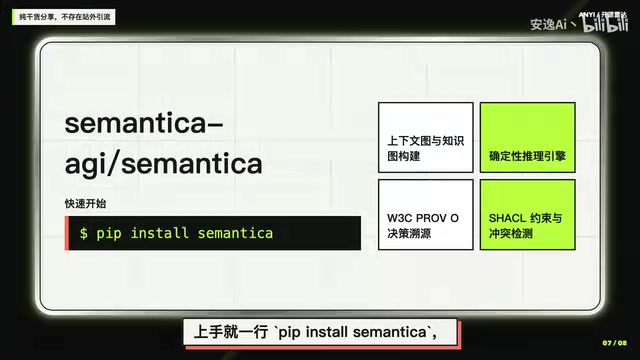
From installation to verification, the process is equally minimal: a single pip install semantica packages all capabilities, followed by running semantica doctor to complete installation verification in 5 seconds.
All core capabilities can be invoked directly from the terminal, covering over 20 command groups spanning ingestion, extraction, graph construction, reasoning, decision recording, ontology governance, and visualization export. For engineers accustomed to command-line workflows, this is a remarkably complete toolchain.
Knowledge Graph Query Performance: 6000x Acceleration Through Index Rewriting
For graph databases and reasoning systems, query performance is often the bottleneck for scaling to production. Semantica delivers a rather impressive number in this regard.
In a production-grade graph benchmark with 118,000 nodes, node search latency dropped from 24 milliseconds to 0.004 milliseconds — approximately a 6000x acceleration.
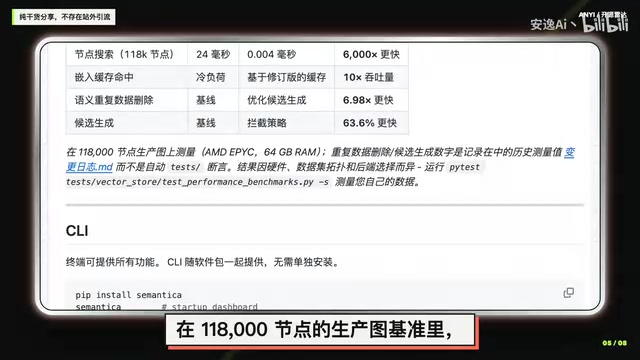
This improvement doesn't rely on hardware stacking but comes from underlying index rewriting. Graph database query performance is highly dependent on indexing strategies. Traditional full-graph scans exhibit linear or even super-linear complexity growth as node counts increase, while optimized index structures (such as B+ tree variants, skip lists, bitmap indexes, or purpose-built graph-native indexes) can reduce lookup operations to near O(1) constant time complexity. The leap from 24 milliseconds to 0.004 milliseconds essentially represents an optimization from lookup paths that require traversing numerous intermediate nodes to directly locating target nodes through precise indexing.
For applications requiring frequent real-time reasoning on large-scale knowledge graphs, this magnitude of performance optimization directly determines whether a system is production-viable. The jump from milliseconds to microseconds means that even complex multi-hop reasoning can maintain low-latency responses — because a single complex query might involve dozens of consecutive node lookups, and any single lookup delay cascades multiplicatively.
Self-Hosted Deployment: The Bottom Line for Data Sovereignty and Compliance
Sematica makes a clear and important choice regarding deployment — it only supports self-hosting, with no option to send data to third-party SaaS platforms.
This decision aligns perfectly with its target customers. Finance, healthcare, law, and government sectors face strict data compliance constraints, and sensitive data is often prohibited from leaving an enterprise's own infrastructure. Data Sovereignty refers to the principle that data is subject to the laws of its location. In practice, the EU's GDPR prohibits personal data transfers outside the EU without adequate protection; China's Data Security Law and Personal Information Protection Law impose strict security assessment procedures for important data exports; and the U.S. HIPAA has explicit physical security requirements for medical data storage and access. Self-hosted deployment ensures data always remains on enterprise-owned or controlled infrastructure, architecturally eliminating compliance risks around cross-border data transfers and third-party access — the fundamental reason why financial and healthcare industries remain cautious about SaaS models.
While self-hosted deployment increases deployment and operations complexity, it safeguards the bottom line of data sovereignty and compliance. From this perspective, Semantica's overall design logic is internally consistent: deterministic reasoning guarantees reproducibility, W3C PROV records guarantee auditability, and self-hosting guarantees data never leaves the domain. Together, these three elements form a complete answer for regulatory scenarios.
Conclusion: AI Explainability Is Becoming a Hard Requirement
As AI increasingly enters high-risk decision-making scenarios, "whether the result is correct" is no longer the sole criterion — "why was this decision made" is becoming equally critical. Semantica represents a technical approach fundamentally different from mainstream large models — it doesn't push the boundaries of generation capabilities, but instead makes explainability, traceability, and compliance its first-principles objectives.
For technical teams in heavily regulated industries, a tool that can deliver complete evidence chains may be exactly the answer they've been looking for. When regulators ask "why" again, the answer is already fully preserved in that graph.
Related articles

Chain of Thought Isn't Just for AI: How Humans Can Use CoT to Improve Thinking Quality
Chain of Thought isn't just a prompt trick for large models. Starting from a Hacker News discussion, this article analyzes why CoT works for human thinking too, breaks down actionable ways to transfer it, and highlights the key differences between human CoT and machine CoT.
Cloudflare Teams Up with OpenAI: Closi…
Cloudflare Teams Up with OpenAI: Closing the Loop from Vulnerability Discovery to Defense with AI
Cloudflare uses OpenAI Daybreak to investigate security vulnerabilities and generate reviewable remediation plans, while developers use Codex to boost coding efficiency and quality.

Orca Multi-Agent Orchestration in Practice: A Guide to Parallel Collaboration with Claude and Codex
Orca is Stable AI's free open-source agent workbench supporting 34 agents like Claude Code and Codex in parallel. Learn its Git worktree isolation, multi-model orchestration, and mobile management.