Semos.ai: The AI Management Assistant Built for Managers

Semos.ai Manager Agents learns from your meetings to remind you of the leadership tasks you keep overlooking.
Semos.ai Manager Agents is a vertically focused AI tool for enterprise managers that analyzes daily meeting content to automatically identify and surface easily neglected soft-side responsibilities — including overdue feedback, forgotten recognition, avoided conflicts, and repeatedly postponed growth conversations. Its differentiation lies not in task efficiency but in helping managers build feedback loops and develop leadership awareness. The product earned 154 upvotes on Product Hunt, landing at #4, and represents AI Agents evolving from personal productivity toward organizational collaboration — though it faces real challenges around meeting data privacy compliance and the difficulty of quantifying leadership impact.
In a world overflowing with AI tools, most products focus on code generation, content creation, or customer service automation. Yet managers — the critical connective tissue of any organization — have rarely had tools built specifically for them. Semos.ai's Manager Agents aims to fill that gap, shifting AI's attention from "getting tasks done" to "improving leadership." The product launched on Product Hunt to 154 upvotes and 22 comments, landing at #4 on the day's leaderboard.
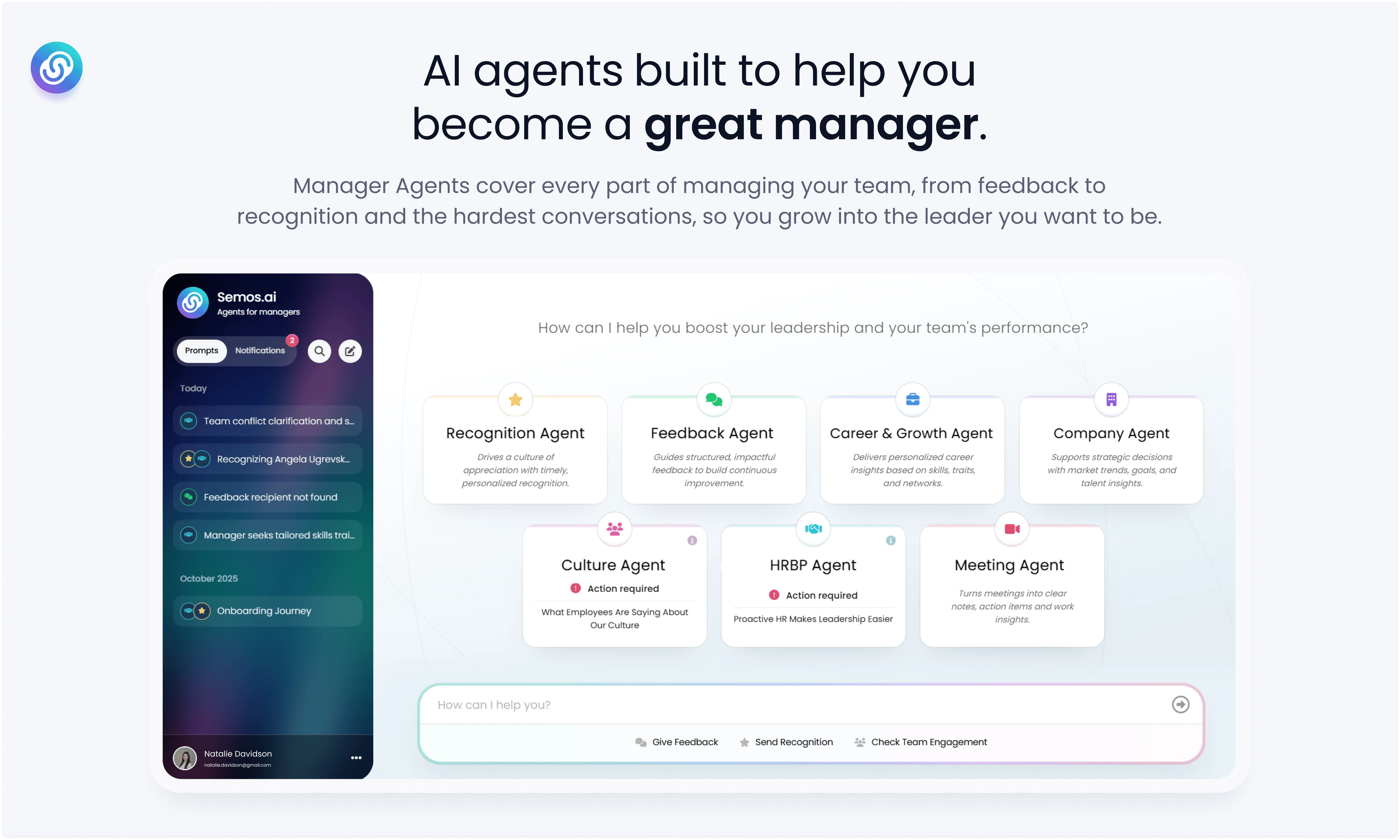
Learning from Meetings to Cover Your Blind Spots
The core logic behind Manager Agents is straightforward: it learns from your day-to-day meetings and proactively reminds you of what deserves your attention next. The examples the product team highlights are vivid and relatable — overdue feedback you never got around to giving, team recognition you overlooked, conflicts you've been avoiding, and growth conversations that keep getting pushed back.
These are precisely the soft-side responsibilities most easily neglected in management work, yet most impactful to team health. Unlike hard task tracking, this kind of "people management" rarely comes with a built-in reminder system — it relies entirely on a manager's memory and personal discipline. Semos.ai's approach is to make these implicit responsibilities explicit, using AI as a "management coach" that never forgets.
Beyond Reminders: Learning the "Why"
What sets Manager Agents apart from a standard to-do reminder tool is its emphasis on feedback loops and capability growth. The product description notes that over time, you'll come to understand "what works, what doesn't, and why" — genuinely becoming a more effective people leader.
This positions it as a continuous learning system rather than a one-off automation script. For frontline managers without formal management training, or founders leading early-stage teams, this "learn by doing" style of support may be far more practical than reading a management book. It breaks down abstract leadership principles into concrete, actionable steps in the moment.
From a technical standpoint, Manager Agents represents a specific implementation of AI Agents. Unlike standard question-and-answer AI, an AI Agent can perceive context, set goals, execute multi-step tasks continuously, and adjust its behavior based on feedback. The loop of "learn from meetings → identify management blind spots → offer suggestions → track execution" is exactly what distinguishes an Agent from a single-turn conversational tool — it operates persistently across time rather than responding one question at a time. This "longitudinal companion" style of Agent is still an emerging direction in enterprise software. The core challenge lies in maintaining sufficiently long contextual memory and cross-session behavior tracking — areas where current large language models still have meaningful limitations, typically requiring additional memory modules and structured data storage to compensate.
Vertical Focus, Real Pain Points
Looking at its category tags, Semos.ai spans Meetings, Artificial Intelligence, and Human Resources — clearly targeting enterprise management scenarios. This vertical positioning makes sense: managers exist in significant numbers across every organization, yet they've long been underserved by the tooling ecosystem.
That said, products in this space face inherent challenges. First is data privacy — Manager Agents needs access to meeting content in order to "learn," and how it handles sensitive team communications will directly shape enterprise adoption. Second is effectiveness validation — leadership improvement is hard to quantify, and whether AI-generated suggestions are genuinely better than a manager's own judgment will require long-term real-world validation.
Data privacy challenges are especially pronounced in enterprise AI tools. Meeting content often includes personnel decisions, compensation discussions, and performance evaluations — exactly the type of sensitive information protected under GDPR and various local labor regulations. Before adopting tools like this, enterprises typically need to assess whether data leaves their private network, whether it's used for model training, and whether employees have been informed and have consented — all standard compliance considerations. Some enterprise AI products address this through on-premise or private cloud deployments, though this significantly increases implementation costs. For an early-stage startup like Semos.ai, finding the right balance between feature completeness and data compliance often determines whether the product can make it onto large enterprises' procurement shortlists.
A Direction Worth Watching
Semos.ai Manager Agents represents a new frontier for AI Agent deployment: moving from serving "individual productivity" to serving "organizational collaboration and interpersonal management." At a time when countless tools are competing for the developer and content creator market, focusing AI capabilities on managers is a meaningfully differentiated entry point.
Whether it can genuinely help managers improve team relationships remains to be validated through long-term feedback from real users. But at minimum, it raises a question worth sitting with: AI shouldn't only help us move faster — it should help us lead better and care more about the people we manage.
Related articles

Chain of Thought Isn't Just for AI: How Humans Can Use CoT to Improve Thinking Quality
Chain of Thought isn't just a prompt trick for large models. Starting from a Hacker News discussion, this article analyzes why CoT works for human thinking too, breaks down actionable ways to transfer it, and highlights the key differences between human CoT and machine CoT.
Cloudflare Teams Up with OpenAI: Closi…
Cloudflare Teams Up with OpenAI: Closing the Loop from Vulnerability Discovery to Defense with AI
Cloudflare uses OpenAI Daybreak to investigate security vulnerabilities and generate reviewable remediation plans, while developers use Codex to boost coding efficiency and quality.

Orca Multi-Agent Orchestration in Practice: A Guide to Parallel Collaboration with Claude and Codex
Orca is Stable AI's free open-source agent workbench supporting 34 agents like Claude Code and Codex in parallel. Learn its Git worktree isolation, multi-model orchestration, and mobile management.