Senior SWE Transitioning to MLOps: Which Skills Should You Prioritize?

How a senior SWE with a math background can close the gaps and transition into MLOps quickly.
A senior engineer with a math master's degree and seven years of software engineering experience is targeting a move into ML infrastructure and MLOps. His technical foundation is strong — Python, Kubernetes, CI/CD, MLflow, and real experience building data pipelines for foundation models — but he has clear gaps in AWS, production model serving, ML-specific observability, and distributed GPU infrastructure. The article uses his case to distill advice for anyone making a similar transition: prioritize AWS (highest ROI), use an end-to-end ML orchestration project as your portfolio, interview while you fill gaps rather than studying in isolation, and focus on the hidden interview topics — system design and failure handling — rather than the tool names listed in job descriptions.
A senior software engineer and tech lead with roughly seven years of experience is looking to move into a product-driven company and build a career in ML infrastructure and MLOps. He posted on Reddit with a detailed breakdown of his background, skill gaps, and four specific questions about making the transition. The post captures a struggle shared by countless backend, data, and DevOps engineers today: when AI engineering becomes a hot career track, how do traditional software engineers make the leap as quickly as possible?
His Hand: Strong Math Fundamentals and Solid Engineering Chops
This engineer's résumé is genuinely impressive. He holds a bachelor's and master's degree in mathematics, has roughly seven years of software engineering experience, and has worked as a research engineer building data pipelines for foundation models. His tech stack hits the core requirements of most MLOps roles:
- Strong Python skills
- Production-grade data pipelines and ETL
- Docker / Kubernetes
- CI/CD and automated testing
- ML engineering experience with MLflow and workflow orchestration
- Hands-on experience building data-intensive systems
He also previously taught a data mining course as an associate professor and published an NLP paper in 2019 — back when Transformers weren't yet mainstream. That combination — mathematical theory, distributed systems engineering, and some ML research background — makes him a strong candidate profile for MLOps roles.
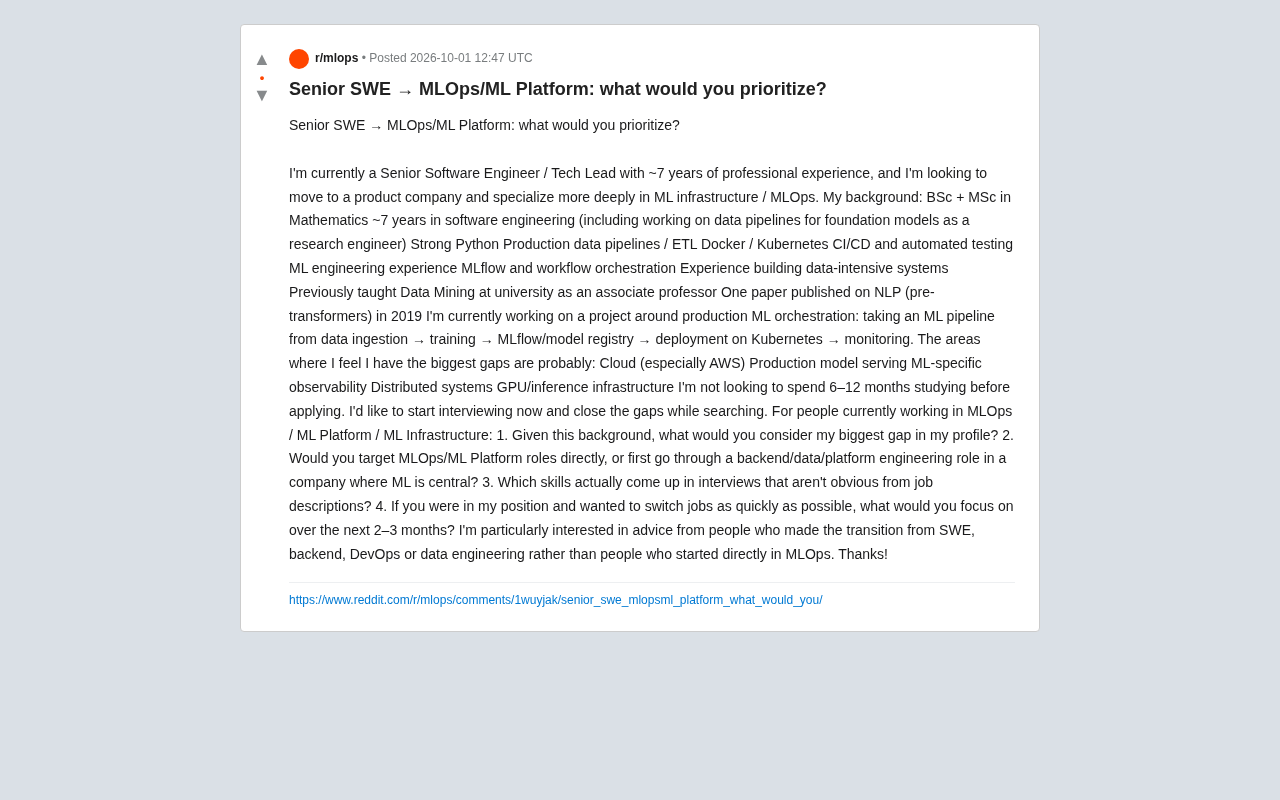
He's currently building an end-to-end production ML orchestration project covering: data ingestion → training → MLflow / model registry → deployment on Kubernetes → monitoring. That project alone is a compelling portfolio piece.
The Five Skill Gaps He's Identified
What's notable is how clearly he understands his own weaknesses. He called out several areas where he feels least confident:
Cloud Platforms (especially AWS)
This is almost universally the most common hurdle when traditional engineers transition to MLOps. Many MLOps roles are fundamentally about "running ML workflows reliably and efficiently on a specific cloud platform," with AWS services like SageMaker, S3, EKS, and IAM popping up constantly in interviews. A lack of cloud experience can directly hurt your pass rate.
AWS SageMaker is currently the most frequently mentioned managed ML platform in MLOps job descriptions. It bundles data labeling, model training, hyperparameter tuning, deployment, and monitoring into a single service chain. Interviewers often ask candidates to walk through how they'd use SageMaker Pipelines to orchestrate a complete train-to-deploy workflow. EKS (Elastic Kubernetes Service) is the key bridge for transferring existing Kubernetes knowledge into the AWS ecosystem — for candidates already familiar with K8s, picking up EKS is far cheaper than learning cloud platforms from scratch. IAM (Identity and Access Management) is one of the most underrated interview topics: production ML systems typically involve cross-service calls (training jobs accessing S3, inference services accessing a model registry), and misconfigured permissions are a major source of MLOps incidents. Understanding the principle of least privilege and Service Role design is a classic question that separates junior from senior candidates.
Production Model Serving
There's a huge amount of engineering work between a trained model artifact and an actual low-latency, high-availability inference service: model versioning, batch vs. real-time inference, A/B testing, canary releases, and more. This is what distinguishes ML Platform roles from ordinary backend positions.
A few open-source and managed solutions are worth knowing in the model serving space: Triton Inference Server (from NVIDIA) supports high-performance concurrent inference across multiple frameworks and is well-suited for GPU scenarios; TorchServe is PyTorch's official serving framework; BentoML and Ray Serve lean more toward flexible Python ecosystem integration. Common interview dimensions include: how to handle live model updates without dropping traffic (blue-green or canary deployments), how to design dynamic batching to improve GPU utilization, and how to balance latency against throughput. For candidates with training experience but limited serving experience, the fastest way to close the gap is to wrap an existing model in a FastAPI + Docker REST API, deploy it to K8s, and then gradually introduce the frameworks mentioned above.
ML-Specific Observability
Traditional APM (application performance monitoring) is just the baseline. ML systems also require monitoring for data drift, feature distribution shifts, and model accuracy degradation. This "ML-specific observability" layer is often described vaguely in job postings but probed deeply in interviews.
ML system observability essentially breaks into two layers: infrastructure (service latency, GPU utilization, out-of-memory errors) and model health (data drift, concept drift, prediction distribution shift). Data drift refers to the statistical distribution of inputs diverging from training data after deployment — for example, user behavior patterns shifting seasonally. Concept drift refers to the underlying input-output relationship itself changing — for example, financial fraud patterns evolving as regulations change. Common detection methods include PSI (Population Stability Index), the KS test (Kolmogorov–Smirnov Test), and feature importance monitoring. On the tooling side, Evidently AI, Whylogs, and Arize are the most prominent open-source and commercial ML monitoring solutions. Being able to name specific tools and explain the design trade-offs in an interview is a meaningful differentiator.
Distributed Systems and GPU / Inference Infrastructure
As models grow larger, distributed training, GPU resource scheduling, and inference acceleration (quantization, batching optimizations, etc.) have become the core competencies of senior MLOps engineers. This is also the hardest gap to close in the short term.
What He Actually Wants: How to Break In Fast
He's explicit that he doesn't want to spend 6–12 months studying before sending out applications. He wants to "interview while filling gaps." He posed four sharply focused questions:
- Given this background, what's the biggest weakness on his résumé?
- Should he go directly for MLOps / ML Platform roles, or join an ML-centric company as a backend / data / platform engineer first?
- Which skills will come up in interviews but won't be listed in job descriptions?
- If he wants to make a move in the next 2–3 months, what should he focus on?
He specifically said he wanted to hear from people who transitioned from SWE, backend, DevOps, or data engineering — not from people who started in MLOps from day one. That's a smart constraint — advice from fellow travelers is far more transferable.
Practical Advice for Engineers Making the Same Transition
While the original post is a question, his background makes it possible to distill a few broadly applicable takeaways.
Start interviewing now and use your project to close gaps. His end-to-end ML orchestration project is already a strong calling card. Rather than waiting until he feels "ready," he should start the interview process immediately. Real interview feedback will pinpoint gaps far more efficiently than blindly working through courses.
Cloud platforms should be the top priority. Among the five gaps, AWS has the highest return on investment. It comes up constantly in interviews, can be addressed relatively quickly through hands-on practice (deploying existing projects to AWS), and naturally covers parts of model serving and infrastructure along the way.
The hidden interview topics are usually system design and failure handling. Job descriptions list tool names, but what interviewers actually want to see is: how you'd design a scalable, rollback-capable, observable ML system; and how you'd debug a production issue — a model whose accuracy has dropped, or a data pipeline that's silently broken. Scenario-based thinking is what separates senior candidates from the rest.
Which path to take depends on your target company's ML maturity. For companies where ML is already core to the business and the platform is relatively mature, going directly for MLOps / ML Platform roles is perfectly reasonable. If the competition feels too steep, joining an ML-driven company as a backend or platform engineer and transferring internally is also a solid, lower-risk path.
This engineer's case represents a whole category of people navigating the AI engineering wave: they have solid software engineering foundations, and the only piece missing is ML infrastructure. For this group, the transition barrier is actually lower than it looks — the key is reframing existing Kubernetes, data pipeline, and CI/CD experience into a narrative organized around the ML lifecycle.
Related articles

Chain of Thought Isn't Just for AI: How Humans Can Use CoT to Improve Thinking Quality
Chain of Thought isn't just a prompt trick for large models. Starting from a Hacker News discussion, this article analyzes why CoT works for human thinking too, breaks down actionable ways to transfer it, and highlights the key differences between human CoT and machine CoT.
Cloudflare Teams Up with OpenAI: Closi…
Cloudflare Teams Up with OpenAI: Closing the Loop from Vulnerability Discovery to Defense with AI
Cloudflare uses OpenAI Daybreak to investigate security vulnerabilities and generate reviewable remediation plans, while developers use Codex to boost coding efficiency and quality.

Orca Multi-Agent Orchestration in Practice: A Guide to Parallel Collaboration with Claude and Codex
Orca is Stable AI's free open-source agent workbench supporting 34 agents like Claude Code and Codex in parallel. Learn its Git worktree isolation, multi-model orchestration, and mobile management.