Seoul AI Night: FriendliAI and Over 100 Korean Tech Leaders Discuss the Future

FriendliAI's private Seoul event attracted 100 Korean tech executives, reflecting AI's shift from training to inference deployment.
FriendliAI hosted a private exchange event in Seoul, attracting over 100 executives from Korean tech companies—a scale rarely seen in Korea's AI circles. Although the specific agenda was not disclosed, the focus was on AI inference optimization and deployment efficiency. As large models enter production environments, inference costs continue to rise as a share of overall AI spending, while most enterprises lack dedicated inference engineering teams, highlighting the value of inference platforms. Korea has giants such as Samsung, Naver, and Kakao as well as numerous startups, with fast AI adoption and intense infrastructure competition, creating urgent demand for inference efficiency. The event's low-key communication suggests it focused on relationship building and ecosystem development rather than product launches. This move indicates that Korea's AI ecosystem is extending from the model layer to the infrastructure layer, and inference optimization is evolving from a technical topic into a business topic.
Recently, AI inference platform FriendliAI hosted a private exchange event in Seoul, attracting over 100 executives from Korean tech companies. This gathering was not just a social occasion—it reflects subtle changes underway in Korea's AI ecosystem: a shift from model training to inference deployment, and from general-purpose capabilities to vertical scenario implementation.

An Unusual Gathering of Tech Executives
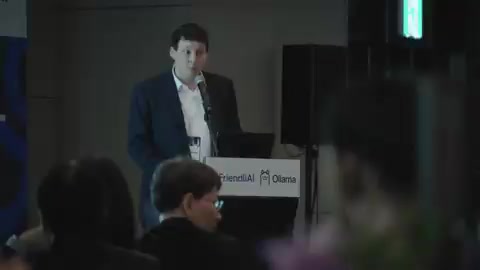
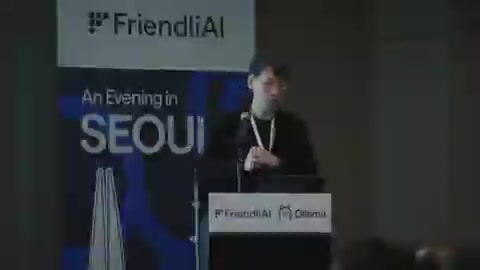
According to information shared by the organizers on social media, this Seoul dinner brought together over 100 decision-makers from Korea's tech industry. Although the specific topics were not disclosed publicly, peer gatherings of this scale are rare in Korea's AI circles. As a platform focused on inference optimization, FriendliAI's core business is highly relevant to the pain points of current AI application deployment.
Korea is home to tech giants such as Samsung, Naver, and Kakao, as well as a large number of AI startups. The willingness of these executives to gather in the evening indicates that issues such as inference efficiency, deployment costs, and model-as-a-service have become shared industry concerns.
Why Inference?
FriendliAI's primary focus is AI inference—that is, how to efficiently respond to user requests after model training is complete. As large models enter production environments, inference costs account for an increasingly large share of overall AI spending. According to common industry observations, the optimization potential for inference workloads is significantly greater than in the training phase, and most enterprises lack dedicated inference engineering teams.
The choice of Seoul as the event location also suggests that FriendliAI intends to deepen its presence in the Korean market. Korean enterprises adopt AI quickly, and competition in local cloud services and AI infrastructure is intense, making the demand for inference efficiency more urgent.
Core Technical Approaches to Inference Optimization
AI inference optimization is not a single technique but a collection of engineering methods. Common directions include: model quantization (compressing weights from FP16 to INT8/INT4 to reduce memory usage and computation), operator fusion and graph optimization (reducing kernel launch overhead), KV Cache management (avoiding repeated computation of attention key-values in autoregressive generation), continuous batching (dynamically merging different requests to improve GPU utilization), and speculative decoding (using a small model's draft to accelerate large model verification). When combined, these techniques can often increase throughput several-fold and reduce latency by more than half without significantly sacrificing accuracy. The value of inference platforms like FriendliAI lies precisely in engineering and productizing these scattered optimizations, enabling enterprises without dedicated teams to directly gain efficiency benefits.
Differences in Cost Structure Between Training and Inference
Training is a capital-intensive one-time investment, while inference is a continuous expense that grows linearly with user scale. When models enter production environments and daily active requests reach millions or even tens of millions, inference costs quickly exceed training costs and become the main component of AI bills. This is why, in industry estimates, the optimization potential for inference workloads is generally considered significantly greater than in the training phase—the marginal returns of training optimization are limited by the single task, while inference optimization can be continuously realized on every request.
Korea's Unique Position in the AI Ecosystem
Korea's position in the AI field is quite special: on the one hand, local giants invest heavily in developing their own large models; on the other hand, startups tend to seek opportunities in the application and infrastructure layers. The attendance of over 100 tech executives at an event hosted by an inference platform shows that attention to the infrastructure layer is rising.
Executive gatherings of this scale usually carry the intention of ecosystem building. FriendliAI may hope to use such events to establish closer partnerships with local Korean enterprises, transforming from a mere tool supplier into an ecosystem participant.
Korea's Domestic Large Models and AI Infrastructure Landscape
The main players in Korea's foundation model layer include Naver's HyperCLOVA X (focused on Korean language and local cultural context), Kakao's KoGPT series, and LG AI Research's EXAONE. These models are mostly optimized specifically for Korean language understanding and local compliance requirements, forming a differentiated positioning from English-dominant models. At the infrastructure layer, Naver Cloud, KT Cloud, and Samsung SDS provide local cloud services, while AWS, Azure, and Google Cloud also have regional nodes in Korea, creating intense competition. This landscape of "giants developing their own models plus multiple clouds coexisting" means there is a wide range of choices at the inference layer and sensitivity to cost-effectiveness, giving third-party inference optimization platforms an opportunity to enter. In addition, the Korean government has introduced AI industry support policies and computing subsidies in recent years, further stimulating enterprise demand for efficient inference solutions.
Signals from the Event
Based on public information, the event's communication approach was restrained and precise—only a brief summary was posted by the organizer on social media, with photos emphasizing atmosphere rather than agenda. This low-key handling actually conveys a signal: the event focused on relationship building and in-depth exchange rather than product launches or media exposure.
For observers following the AI infrastructure track, FriendliAI's moves in Korea are worth continued monitoring. Inference optimization is evolving from a technical topic into a business topic, and the Korean market may become an early sample for testing this trend.
One-line Summary
FriendliAI's private Seoul event attracted 100 Korean tech executives, reflecting AI's shift from training to inference deployment.
Paragraph Summary
FriendliAI hosted a private exchange event in Seoul, attracting over 100 executives from Korean tech companies—a scale rarely seen in Korea's AI circles. Although the specific agenda was not made public, the focus was on AI inference optimization and deployment efficiency. As large models enter production environments, inference costs continue to rise as a share of overall AI spending, while most enterprises lack dedicated inference engineering teams, highlighting the value of inference platforms. Korea has giants such as Samsung, Naver, and Kakao as well as numerous startups, with fast AI adoption and intense infrastructure competition, creating urgent demand for inference efficiency. The event's low-key and restrained communication suggests it focused on relationship building and ecosystem development rather than product launches. This move indicates that Korea's AI ecosystem is extending from the model layer to the infrastructure layer, and inference optimization is evolving from a technical topic into a business topic.
Related articles

Oral Pancreatic Cancer Drug Hailed as Biggest Breakthrough in Decades
An oral pancreatic cancer drug is called the biggest breakthrough in decades, sparking Hacker News debate. We analyze the real weight of this claim and the distance to clinical availability.

DevWorkflow 5.0: From Idea to Launch with the AI Five-Step Method
DevWorkflow 5.0 is a Claude Code plugin that uses a five-step process to take AI-assisted development from idea to launch. It asks you before every decision, preventing AI from adding tables and fields on its own, keeping docs and code consistent, and stopping merges before tests are written. Supports multiple platforms and languages, for individual developers and small teams.

How Do Hermes Agent's .md Files Work? A Breakdown of the Core Mechanism
Explaining Hermes Agent's .hermes directory mechanism: user.md stores personal info, memory.md records details worth remembering, soul.md defines the Agent's personality. Learn how these pure Markdown files keep the Agent consistent across sessions.