SEOYUN: A New Framework That Makes Exam Documents "Refuse" AI Glasses Snooping

SEOYUN uses reverse jailbreaking to make exam documents trigger VLM refusal, deterring AI glasses cheating.
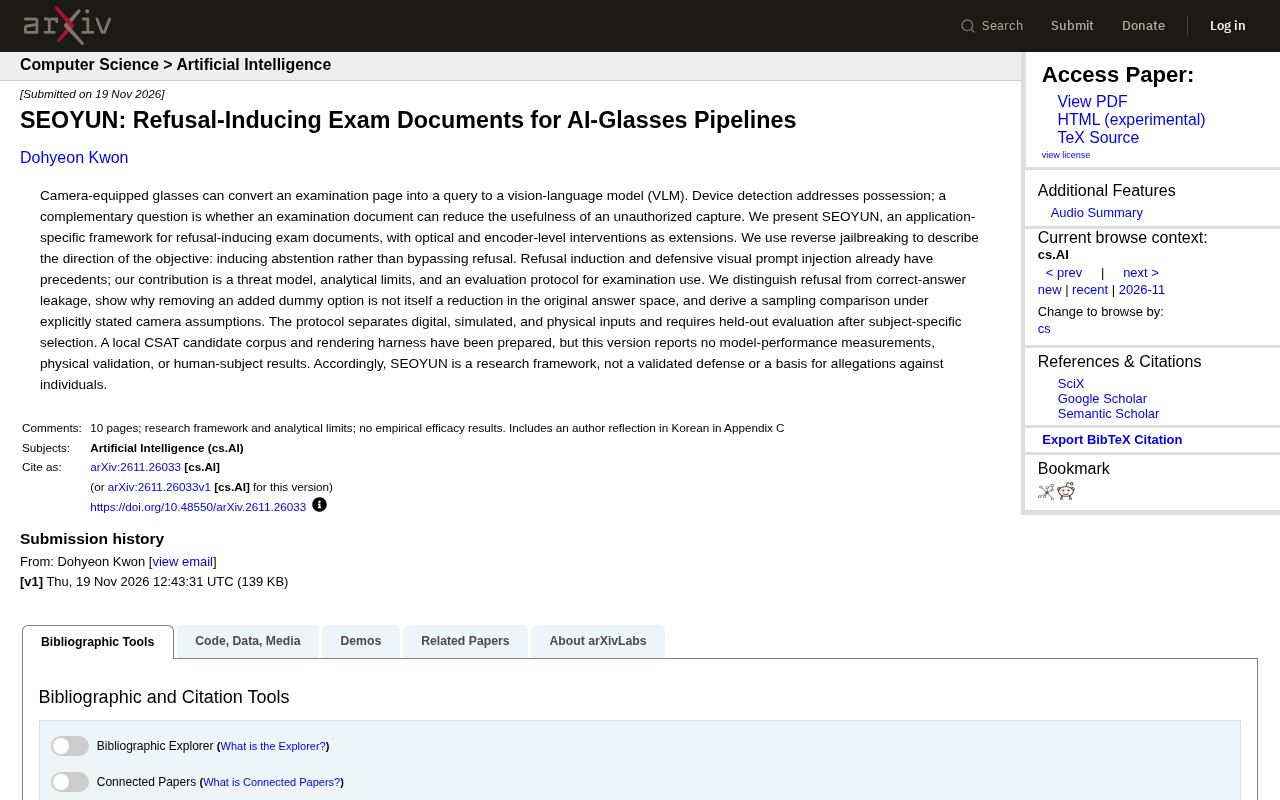
SEOYUN is a research framework against AI glasses exam cheating, centered on "refusal-inducing" exam documents: via reverse jailbreaking, it embeds visual interventions so VLMs refuse to answer when reading test images. It defines a threat model, distinguishes refusal from answer leakage, and proposes an evaluation protocol with digital, simulated, and physical inputs plus held-out evaluation. Currently only a local CSAT corpus and rendering toolchain exist; no model measurements, physical validation, or human subject results, so it remains a research framework, not a validated defense.
AI glasses cameras can easily convert exam pages into queries for vision-language models (VLMs), posing a new challenge to exam fairness. Traditionally, device detection has focused on "who is carrying the device," but a complementary question is: can the exam document itself reduce its usability for unauthorized photography? The SEOYUN framework is an application-specific study addressing exactly this question, proposing the concept of "refusal-inducing" exam documents and introducing optical and encoder-level interventions as extensions.
From "Bypassing Refusal" to "Inducing Refusal": The Reverse Jailbreaking Approach
The core idea of SEOYUN is reverse jailbreaking. Typical jailbreak attacks aim to bypass a model's safety restrictions, whereas reverse jailbreaking does the opposite: it attempts to induce the model to proactively decline to answer rather than provide an answer. In exam scenarios, this means making the VLM choose to "refuse to answer" rather than "give the answer" when receiving a specific document image.
Refusal induction and defensive visual prompt injection have precedents, but SEOYUN's contribution lies in defining a threat model for exam use, analyzing theoretical limits, and proposing an evaluation protocol. The framework distinguishes between "refusal" and "correct-answer leakage"—the former is the model refusing to answer, the latter is the model giving a wrong answer but leaking correct information. Additionally, the authors point out that removing an added dummy option does not itself reduce the original answer space, and they derive sampling comparisons based on explicit camera assumptions.
Vision-language models (VLMs) are multimodal large models capable of processing both image and text inputs, such as GPT-4V, LLaVA, etc. In exam scenarios, AI glasses cameras capture the test page, and the image is fed into the VLM, which can recognize the text and generate answers. VLMs are typically trained with safety alignment and will refuse certain sensitive requests, but refusal behavior is mainly aimed at harmful content rather than exam cheating. SEOYUN's "refusal induction" exploits this mechanism: by embedding specific visual patterns into the document, it causes the model to classify the test image as a request type that should be refused, thereby triggering a refusal.
"Jailbreaking" refers to bypassing a model's safety restrictions through carefully crafted prompts to make it output content that should be prohibited. Reverse jailbreaking reverses the goal: instead of making the model break through restrictions, it makes the model proactively enforce restrictions and deny service. This approach is a variant of "denial-of-service attacks" in adversarial attack research, and its difficulty lies in the induction pattern needing to remain robust against unknown models and shooting conditions.
Evaluation Protocol: Distinguishing Digital, Simulated, and Physical Inputs
SEOYUN's evaluation protocol divides inputs into three categories—digital, simulated, and physical—and requires held-out evaluation after topic-specific selection. This rigorous design aims to avoid overfitting and ensure that defenses work on unseen samples.
Currently, a local CSAT candidate corpus and rendering toolchain are ready, but this version has not reported any model performance measurements, physical validation, or human subject results. Therefore, SEOYUN is explicitly defined as a research framework, not a validated defense measure, and cannot be used as a basis for accusations against individuals.
Held-out evaluation is a standard experimental design in machine learning: the dataset is split into training, validation, and test sets; the model learns on the training set, tunes parameters on the validation set, and is finally evaluated on a test set that was never involved in training. SEOYUN's requirement for held-out evaluation after topic-specific selection means that the defense document design must not overfit to specific test questions but should remain effective on unseen questions of the same topic, thereby testing its generalization ability.
The three types of inputs—digital, simulated, and physical—correspond to different levels of realism: digital input is directly rendered document images, simulated input adds camera effects such as blur, tilt, and lighting variations, and physical input is a printed document photographed by an actual camera. Distinguishing these three types helps gradually approach real attack scenarios and avoid false defenses that only work on ideal digital images. Currently, the protocol has not reported model performance measurement results on any of the three input types.
Research Status and Limitations
SEOYUN is currently at the concept and protocol stage, lacking empirical data to support its effectiveness. The authors honestly point out that no model performance measurements, physical validation, or human subject experiments have been conducted. This means the framework's actual effectiveness remains to be verified, but the threat model and evaluation methods it proposes lay the foundation for future research.
Regarding the misuse of AI glasses in exams, SEOYUN offers a defense approach starting from document design. Compared to relying solely on device detection, this complementary method may increase the difficulty for attackers to exploit captured content. However, in the absence of empirical evidence, its practical value needs further exploration.
One-line Summary
SEOYUN proposes a reverse jailbreaking approach, using "refusal-inducing" exam documents to make AI glasses' VLMs proactively refuse to answer; still at the framework stage.
Paragraph Summary
SEOYUN is a research framework targeting AI glasses exam cheating, centered on "refusal-inducing" exam documents: through reverse jailbreaking, it embeds visual interventions in documents so that vision-language models (VLMs) proactively refuse to answer rather than provide answers when reading test images. The framework defines a threat model for exam scenarios, distinguishes "refusal" from "correct-answer leakage," analyzes theoretical limits, and proposes an evaluation protocol distinguishing digital, simulated, and physical inputs, requiring held-out evaluation to avoid overfitting. Currently, only a local CSAT candidate corpus and rendering toolchain have been completed; there are no model performance measurements, physical validation, or human subject results, so it is explicitly defined as a research framework rather than a validated defense measure.
Related articles

Michael Nielsen Takes Down His Classic Neural Network Textbook, Sparking Community Discussion
Michael Nielsen's classic free textbook Neural Networks and Deep Learning has been taken offline, sparking discussion on Hacker News about the reasons and impact.

Inside the AI Training Data Market: The Trade-off Between Exclusivity and Discounts
G2i founder Gabe Greenberg reveals the dual-track pricing of the AI training data market: labs pay a premium for exclusive data or accept discounts that allow others to buy it.

SessionGraph: Unifying All Coding Agent Sessions in One Interactive Graph
SessionGraph aggregates coding agent sessions into an interactive graph, helping developers review, debug, and manage AI coding workflows across sessions. This article examines its positioning, value, and open questions.