Sequoia Capital's Conversation with AI Expert: How the Von Neumann Architecture Shapes the Future of AI
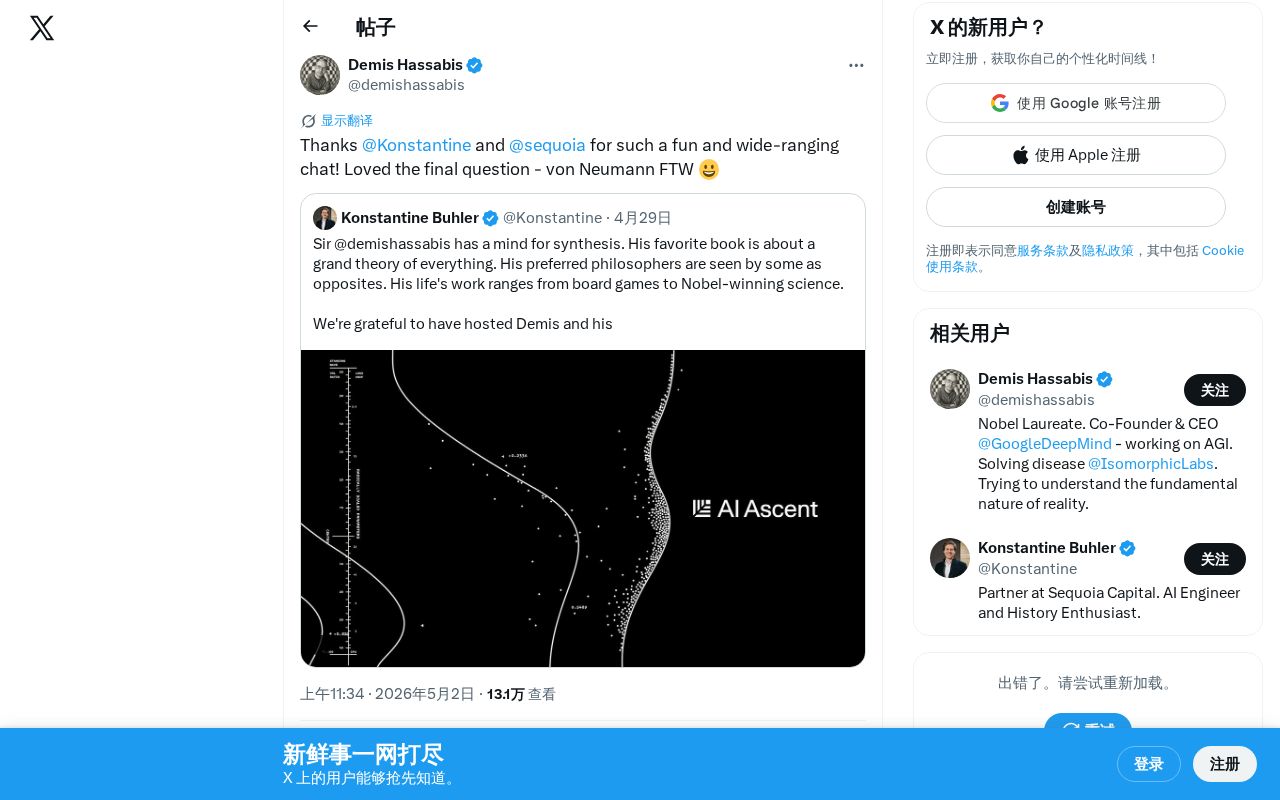
Sequoia Capital and an AI expert discuss how von Neumann's vision profoundly shapes AI's future.
Sequoia Capital engaged in a deep conversation with AI expert Konstantine, focusing on von Neumann's visionary insights and their relevance to modern AI. Von Neumann's stored-program architecture, self-reproducing automata theory, and universal computation vision respectively resonate across eras with today's compute infrastructure transformation, AI Agent autonomy, and AGI goals. The dialogue highlights the growing importance of foundational theory, interdisciplinary convergence, and long-term thinking for achieving AI breakthroughs.
Sequoia Capital's Deep Conversation with an AI Expert: Focusing on Von Neumann's Vision
Recently, Sequoia Capital, one of the world's leading venture capital firms, engaged in a wide-ranging and in-depth conversation with AI expert Konstantine, covering multiple frontier topics in artificial intelligence. The dialogue sparked considerable attention on social media, with many participants singling out the final question about von Neumann as the standout highlight of the entire session.
Although the full conversation has not yet been publicly released, feedback from participants suggests it was a discussion that combined both intellectual rigor and accessibility, touching on core issues in AI development.
Why Von Neumann Still Matters in the AI Era
Laying the Theoretical Foundation of Modern Computing
John von Neumann is widely recognized as one of the greatest mathematicians and scientists of the 20th century. His "von Neumann architecture" remains the core design paradigm for the vast majority of computing devices to this day, and he also made pioneering contributions to game theory, quantum mechanics, automata theory, and more.
The central idea of the von Neumann architecture is the "stored-program" concept—storing both program instructions and data in the same memory, with a central processing unit (CPU) sequentially reading and executing instructions from that memory. The architecture comprises five major components: the arithmetic logic unit, control unit, memory, input devices, and output devices. Before this, early computers like ENIAC required physical rewiring to change programs—an extremely inefficient process. The von Neumann architecture fundamentally transformed this situation, turning computers into truly general-purpose machines. However, the architecture also introduced the well-known "von Neumann bottleneck"—limited data transfer bandwidth between the CPU and memory, causing the processor to frequently sit idle while waiting for data. This bottleneck is particularly acute in the AI era, as deep learning demands massive parallel data processing—which is the fundamental reason behind the rise of GPUs and specialized AI chips.
In the field of artificial intelligence, von Neumann's ideas were remarkably prescient. As early as the 1950s, he began exploring the theoretical framework of self-reproducing automata, a concept that resonates across more than half a century with today's hotly debated topics of AI autonomy and AI Agents.
Von Neumann's theory of self-reproducing automata stemmed from a profound question: can a machine build another machine of equal or greater complexity than itself? Through rigorous mathematical proof, he provided an affirmative answer and identified the basic components required for self-reproduction: a universal constructor, a blueprint describing itself, and a mechanism for copying the blueprint. This theoretical framework was later found to bear a striking resemblance to the self-replication mechanism of DNA—the discovery of DNA's double helix structure came after von Neumann had formulated his theory. Today, the core aspirations of AI Agents—autonomous planning, autonomous execution, and even autonomous creation of sub-tasks and sub-Agents—echo self-reproducing automata at a deep conceptual level. When we discuss whether AI can autonomously write code or improve its own algorithms, we are essentially confronting the same fundamental question von Neumann posed seventy years ago.
His deep thinking about the nature of computation and intelligence laid an irreplaceable theoretical foundation for subsequent artificial intelligence research.
The Evolutionary Path from Von Neumann Architecture to Modern AI
The expression "von Neumann FTW" (von Neumann for the win) appeared in the conversation, suggesting the discussion likely touched on several key directions:
- Fundamental transformation of computing paradigms: From the classical von Neumann architecture to GPU clusters and neural network-specific chips, AI-era computing infrastructure is undergoing a profound transition
The traditional von Neumann architecture employs a serial execution model, processing one instruction at a time. But the core operations of modern deep learning—matrix multiplication and tensor operations—are naturally suited for massive parallel processing. GPUs (Graphics Processing Units), originally designed for graphics rendering, contain thousands of small computing cores capable of executing large numbers of simple operations simultaneously, which perfectly matches the needs of neural network training. NVIDIA's launch of the CUDA programming framework in 2007 transformed GPUs from graphics-specific devices into general-purpose parallel computing platforms, directly catalyzing the deep learning explosion. Since then, new architectures have continually emerged—Google's TPU (Tensor Processing Unit), various neural processing units (NPUs), and Processing-in-Memory designs—all attempting to fundamentally break through the von Neumann bottleneck. Current AI training clusters routinely employ tens of thousands of GPUs, with a single large model training run consuming computing resources worth tens of millions of dollars. The transformation of computing infrastructure has become one of the most critical physical constraints on AI development.
- The long-term pursuit of general intelligence: Von Neumann's vision of universal computation is directly aligned with the current research goal of AGI (Artificial General Intelligence)
AGI (Artificial General Intelligence) refers to AI systems possessing broad cognitive abilities equal to or surpassing those of humans—capable of demonstrating flexible understanding, learning, and reasoning across any intellectual task, rather than excelling only in specific domains. Current AI systems, including large language models like GPT-4 and Claude, while demonstrating remarkable performance in language understanding and code generation, still have significant limitations in causal reasoning, long-term planning, and physical world understanding, and are typically classified as "narrow AI" or "weak AI." There is enormous disagreement within the industry about when AGI will be achieved: optimists like OpenAI's Sam Altman suggest it could arrive within a few years, while more researchers believe it will take decades or longer. Von Neumann's vision of universal computation—a single machine that can complete any computational task through different programs—is precisely the theoretical origin of the AGI concept. The leap from "universal computation" to "universal intelligence" is the most ambitious goal of contemporary AI research.
- The unique value of interdisciplinary thinking: Von Neumann's research approach, spanning mathematics, physics, and computer science, is exactly the mode of thinking needed for AI breakthroughs today
Sequoia Capital's AI Investment Strategy and Technical Judgment
How Top VCs Understand AI Technology Trends
As one of the world's most influential venture capital firms, Sequoia Capital's investment strategy in AI has long served as an industry bellwether. From early seed rounds to growth-stage projects, Sequoia has deeply participated across multiple segments including AI infrastructure, large model development, and vertical applications.
Founded in 1972 and headquartered in Silicon Valley, Sequoia Capital manages over $85 billion in assets and has invested in numerous tech giants including Apple, Google, Oracle, Airbnb, and Stripe. In the AI wave, Sequoia's portfolio spans multiple layers of the industry stack: at the infrastructure layer, it covers chip and cloud computing companies; at the model layer, Sequoia is a significant investor in several large model companies; and at the application layer, it has broadly invested in AI-driven SaaS, developer tools, and vertical industry solutions. In 2023, Sequoia partner David Cahn published the widely discussed article "AI's $200 Billion Question," questioning whether the massive investments in AI infrastructure could generate commensurate commercial returns—demonstrating Sequoia's sober thinking about AI bubble risks. This attitude of active deployment combined with prudent skepticism is the hallmark strategy of top VCs during periods of technological transformation.
This type of public dialogue with technical experts reflects Sequoia Capital's continuous tracking and deep understanding of AI technology trends. For investment institutions, understanding the underlying logic of technology—including foundational theories like the von Neumann architecture—is a critical prerequisite for making sound investment decisions.
Three Key Takeaways from This Conversation for the AI Industry
The conversation between Sequoia Capital and the AI expert conveyed several noteworthy signals:
-
Foundational theory is returning to the spotlight: Amid the rapid commercialization of AI, returning to foundational theoretical thinking is becoming increasingly important—pure engineering optimization alone is insufficient to support the next round of breakthroughs
-
Cross-disciplinary convergence is the key to breakthroughs: The next major advances in AI will likely emerge from deep integration between foundational disciplines such as mathematics and physics with computer science
Multiple major breakthroughs in AI history have originated from interdisciplinary convergence. The core of deep learning—the backpropagation algorithm—has its mathematical foundation in the chain rule from calculus; the design of Convolutional Neural Networks (CNNs) was inspired by neuroscientists Hubel and Wiesel's research on cat visual cortex; and the attention mechanism in the Transformer architecture drew from cognitive science theories about human selective attention. In recent years, the intersection of physics and AI has been equally fruitful: Diffusion Models based on the diffusion process (originating from thermodynamics) have revolutionized image generation; energy-based models inspired by statistical physics have provided new perspectives for understanding neural networks; and the combination of quantum computing with machine learning (quantum machine learning) is seen as the next potential breakthrough direction. Von Neumann himself was the epitome of interdisciplinary research—freely traversing pure mathematics, applied mathematics, physics, economics, and computer science. This ability to break down disciplinary barriers is increasingly precious in AI research.
- A long-term perspective is indispensable: Top investment institutions are examining AI's developmental trajectory through a longer historical lens, rather than merely chasing short-term trends
Looking at AI's Future from Von Neumann's Shoulders
As we enthusiastically discuss frontier topics like large language models, multimodal AI, and AI Agents, looking back at the ideas of pioneers like von Neumann often yields unexpected insights. As this conversation demonstrated, the future of AI is not just about engineering implementation and raw compute accumulation—it's fundamentally about a deeper understanding of the nature of intelligence.
In an era of rapid technological iteration, maintaining reverence for and curiosity about foundational theory may well be the essential path toward true intellectual breakthroughs. We look forward to the full content of this conversation being made public, bringing new perspectives and inspiration to more AI practitioners and researchers.
Related articles
 Expert Opinions
Rethinking Scaling Laws: Parameters Are Not the Only Answer
Deep analysis of Scaling Law evolution from Kaplan to Chinchilla to the MoE era, exploring why blindly stacking parameters is a mistake, and how GLM-5.3 proves scaling has multiple knobs.
When AI Treats Humans as Subagents: Ro…
When AI Treats Humans as Subagents: Role Reversal and Hidden Risks in Human-AI Collaboration
Exploring the paradigm shift where humans become "subagents" in AI Agent architectures. Analyzes human node design in LangChain and AutoGen, and the risks of ceding control and cognitive atrophy.
 Expert Opinions
The Lazy Person's Productivity Theory: Why Being 'Lazy' Actually Drives Peak Performance
Explore the engineering philosophy behind 'lazy people are most productive': how constructive laziness drives automation, AI tools amplify efficiency, and systems thinking eliminates wasted effort.