SereneDB: The Open-Source Database Built for Agentic AI That Unifies Search and Analytics

SereneDB unifies full-text search and analytics in a single Postgres/Elasticsearch-compatible open-source engine built for Agentic AI.
SereneDB is an open-source database engine claimed to be 12 years in the making, with a core proposition of unifying full-text search and analytical queries in a single system — eliminating the need to maintain both Elasticsearch and ClickHouse alongside the ETL pipelines between them. It supports both Postgres and Elasticsearch protocols, allowing developers to migrate existing workloads without rewriting application logic. Public benchmarks show it indexes 1 billion logs in under 8 minutes with roughly one-tenth the disk footprint of comparable systems, and it is licensed under Apache 2.0. The project also emphasizes readiness for Agentic AI workloads. Teams considering adoption are advised to validate performance against their own real-world workloads before committing.
SereneDB recently topped the Open Source category on Product Hunt with an ambitious pitch that caught the developer community's attention: a single open-source database engine capable of handling both ultra-fast full-text search and rapid analytics. The project claims 12 years of development, compatibility with Postgres and Elasticsearch, and publicly available benchmarks that outperform Elasticsearch, ClickHouse, and Postgres search extensions.
One Engine, Two Problems Solved
For years, organizations have typically maintained two separate systems for data workloads: one for full-text search (like Elasticsearch) and another for analytical queries (like ClickHouse or other columnar databases). Keeping these systems in sync usually requires complex ETL pipelines, which add operational overhead along with data consistency and latency issues.
SereneDB's core value proposition is breaking this pattern — unifying full-text search and fast analytics into a single engine. In the project's own words, you can "keep your SQL, your drivers, your Elastic clients, and cut the second system along with the ETL between them." This "two-in-one" approach holds genuine appeal for teams looking to simplify their data infrastructure.
Compatibility Is the Key to Adoption
What truly sets this project apart from countless "reinvent the wheel" databases is its respect for existing ecosystems. SereneDB supports both Postgres and Elastic protocols, meaning developers can theoretically migrate their existing queries, drivers, and clients without rewriting application logic. This promise of painless migration often determines whether a new database actually gets adopted — no matter how advanced the technology, if migration costs are too high, production adoption rarely happens.
ETL (Extract, Transform, Load) pipelines are a foundational concept in data engineering — the process of extracting data from one system, transforming it, and loading it into another. In a dual-system architecture, ETL doesn't just mean extra infrastructure costs; it introduces data latency. Data written to Elasticsearch may take minutes or even hours to appear in ClickHouse. This delay is particularly problematic in AI Agent scenarios that require real-time decision-making. The deeper issue is data consistency: if synchronization between the two systems fails or drifts, search results and analytical results on the same dataset can contradict each other. Diagnosing such issues often costs far more than maintaining the systems themselves.
Benchmark Highlights
Performance is SereneDB's other major selling point. According to publicly available benchmarks from the project, key highlights include:
- Outperforms Elasticsearch, ClickHouse, and Postgres search extensions in both full-text search and analytics scenarios;
- Indexes 1 billion log entries in under 8 minutes;
- Disk footprint roughly one-tenth that of comparable systems.
To their credit, the team has made their benchmarking methodology and raw results fully public — a relatively responsible approach in an industry where performance claims tend to be heavily curated. That said, any vendor-run benchmark warrants healthy skepticism. Different data distributions, query patterns, and hardware configurations can significantly impact results. For developers, the safest approach is always to validate against your own workloads.
The claim of roughly one-tenth the disk footprint typically points to differences in storage format design. Elasticsearch maintains large inverted indexes and segment files to support real-time search, while ClickHouse uses columnar compressed storage. An engine optimized for both use cases simultaneously could theoretically share underlying storage structures, avoiding the space waste of indexing the same data twice. However, reduced disk usage sometimes comes with trade-offs in write speed or query flexibility — context matters when evaluating this metric.
Positioned for Agentic AI
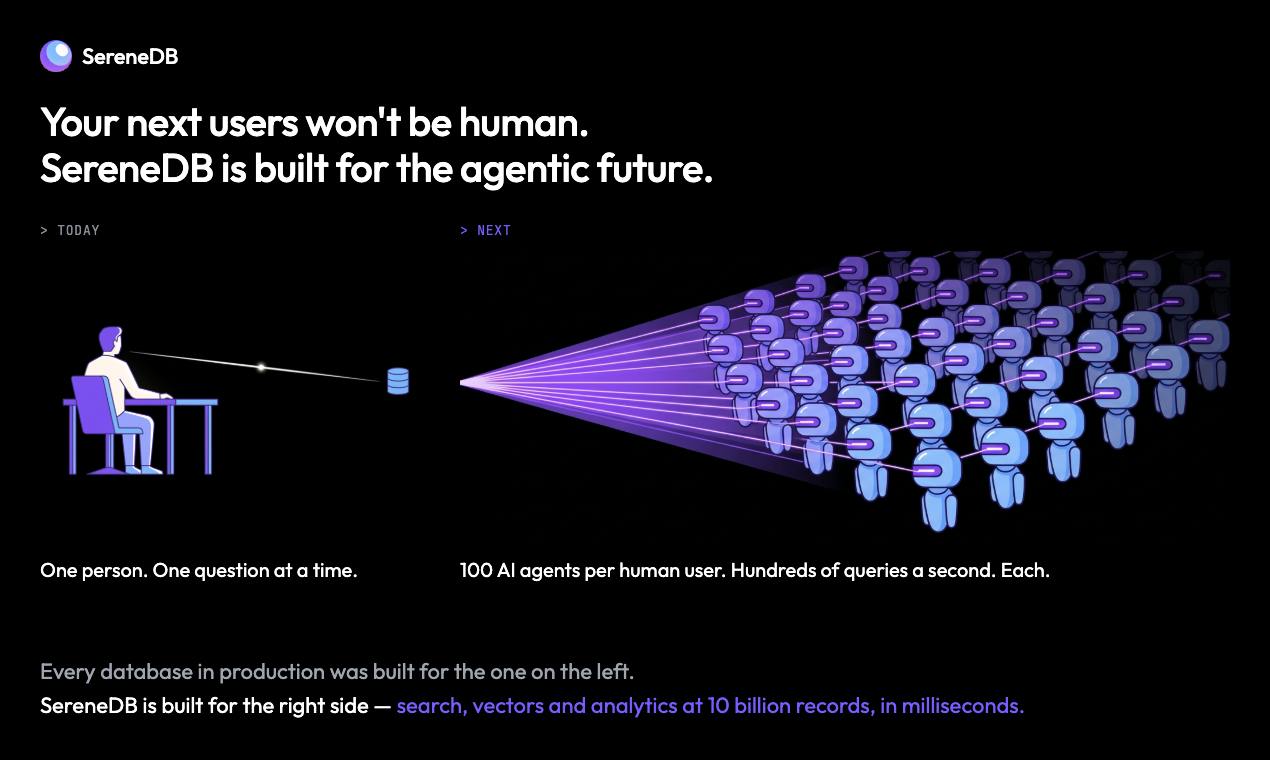
SereneDB's tagline explicitly emphasizes "Agentic AI ready." As AI Agents become an increasingly mainstream application development paradigm, this positioning isn't just empty marketing. Agent systems typically need to frequently search through large volumes of unstructured text (logs, documents, knowledge bases) while simultaneously running real-time analytics and aggregations on that data. A unified engine that handles both fast full-text search and analytical queries fits this workload profile naturally.
In other words, SereneDB is aiming to be the data backend for AI Agents — letting an agent accomplish both "search fast" and "compute fast" within a single system, without shuttling data between multiple stores.
Agentic AI refers to AI systems capable of autonomously planning, invoking tools, and iteratively executing multi-step tasks — fundamentally different from traditional single-turn question-answering AI. A typical Agent workflow involves: retrieving relevant context from a knowledge base or logs (requiring full-text search), performing statistical analysis or anomaly detection on retrieved results (requiring analytical queries), and feeding those results back to the model for the next reasoning step. This pattern demands a data layer that can handle both semantic/keyword search over unstructured text and efficient aggregation and filtering operations. The traditional approach involves pulling from separate vector databases (for semantic retrieval), Elasticsearch (for full-text search), and analytical databases — and the value of a unified engine lies in reducing cross-system network round-trips and serialization overhead, which is critical in Agent scenarios where response latency requirements are extremely tight.
Open Source and Community
SereneDB is open-sourced under the Apache 2.0 license — an important signal for enterprise adoption. A permissive license means lower compliance risk and greater customization flexibility. The project earned 105 upvotes and a #5 ranking on Product Hunt, with categories spanning Open Source, Developer Tools, GitHub, and Database, reflecting sustained community interest in open-source database tooling.
The project was built by a team including Andrey Abramov. For a project claiming 12 years of development, the accumulated technical depth is worth noting — though the real test will come from broader production adoption and independent third-party evaluations.
Promising, But Deserves Careful Evaluation
SereneDB paints an appealing picture: one engine, dual capabilities, compatibility with mainstream ecosystems, open source, and optimized for AI Agents. If these promises hold up in real-world scenarios, it has the potential to become a compelling option for simplifying data infrastructure.
That said, databases are foundational software where stability and long-term reliability matter enormously — earning trust takes time for any new project. Teams interested in exploring SereneDB are well-advised to start with a small-scale pilot on non-critical workloads, validate the official benchmarks against their own data and query patterns, and then decide whether deeper adoption makes sense. For teams building data backends for AI Agents, or struggling to maintain parallel search and analytics systems, SereneDB is at least a new option worth adding to the evaluation shortlist.
Related articles

Chain of Thought Isn't Just for AI: How Humans Can Use CoT to Improve Thinking Quality
Chain of Thought isn't just a prompt trick for large models. Starting from a Hacker News discussion, this article analyzes why CoT works for human thinking too, breaks down actionable ways to transfer it, and highlights the key differences between human CoT and machine CoT.
Cloudflare Teams Up with OpenAI: Closi…
Cloudflare Teams Up with OpenAI: Closing the Loop from Vulnerability Discovery to Defense with AI
Cloudflare uses OpenAI Daybreak to investigate security vulnerabilities and generate reviewable remediation plans, while developers use Codex to boost coding efficiency and quality.

Orca Multi-Agent Orchestration in Practice: A Guide to Parallel Collaboration with Claude and Codex
Orca is Stable AI's free open-source agent workbench supporting 34 agents like Claude Code and Codex in parallel. Learn its Git worktree isolation, multi-model orchestration, and mobile management.