Seven Key Questions Startups Must Consider Before Launching an AI Product
Before launching an AI product, validate the real problem, calculate costs clearly, and use an MVP to control risk.
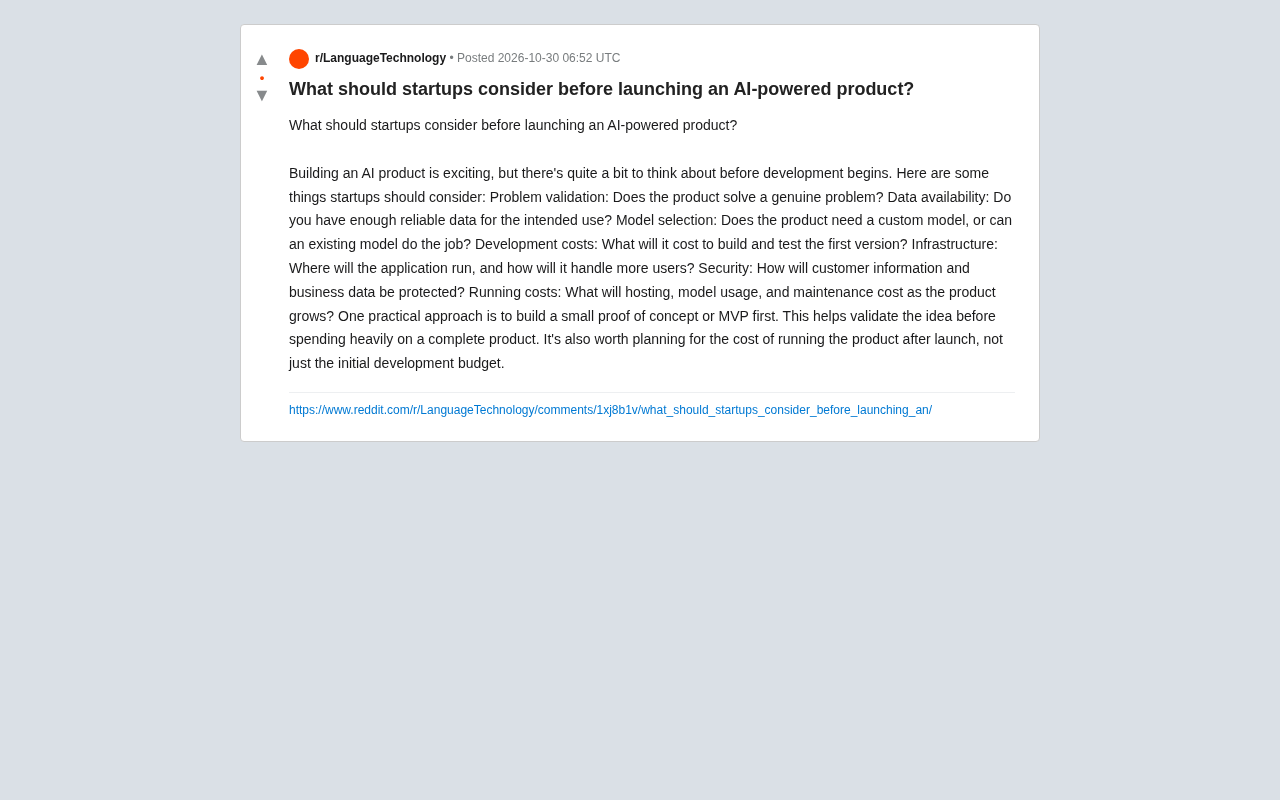
Based on a Reddit developer's question, this article lays out a decision chain from requirements to launch: validate the real user problem instead of being led by model capabilities; assess data availability by volume, quality, and compliance; treat model selection as a cost decision; calculate development and operating costs separately; and address infrastructure and security before launch. Finally, use an MVP to turn abstract judgments into executable validation at the lowest cost.
The AI product startup boom shows no signs of slowing, but turning a demo into a profitable product requires far more than lines of code. A developer's question on Reddit—what should startups consider before launching an AI product—drew plenty of pragmatic discussion. Rather than piling on buzzwords, the original thread's answers brought the focus back to fundamentals: product validation, data, cost, and operations.
1. Ask First: Is This a Real Problem You're Solving?
The original post puts problem validation first, and not by accident. AI capabilities are expanding rapidly—more and more things become possible—but there's a wide gap between "can do" and "worth doing." The most common mistake startups make is being drawn in by model capabilities, thinking "what can I do with AI" first and then hunting for a use case.
The safer order is the reverse: first confirm that target users have a painful, frequent enough problem, then judge whether AI is the optimal path to solving it. Some scenarios can be handled with rule engines or traditional software; forcing a model in only adds cost and uncertainty. The original post stresses answering this question before development begins—not validating it later through user churn data after launch.
2. Whether You Have Enough Data Determines Whether the Product Can Stand
Data availability is the second consideration on the original list. "Available" here means at least three things: whether the data volume is sufficient for the intended purpose, whether data quality is reliable, and whether the data acquisition method is compliant.
Many startups use public datasets or manually curated samples during the demo phase, only to discover in real business environments that the data distribution is completely different. Another commonly underestimated issue is the data loop—whether feedback data can be continuously collected after launch to improve the model. The original post doesn't expand on this, but from a long-term product operations perspective, AI products lacking a data feedback mechanism will see noticeably constrained iteration speed.
3. Build Your Own Model or Use an Off-the-Shelf One? This Is a Cost Decision
The original post frames model selection as a binary choice: does the product need a custom model, or can an existing model do the job? This judgment directly determines the magnitude of R&D investment.
For most startups, a general-purpose model plus light fine-tuning or prompt engineering is enough for a substantial range of scenarios. Scenarios that genuinely require training a model from scratch typically involve exclusive data requirements or special constraints on latency, cost, or deployment environment. Choosing the wrong direction is expensive: building your own model means longer development cycles, higher compute investment, and a more specialized team. The original post's reminder is simple—figure out the requirements first, then decide the technical path.
Fine-tuning refers to continuing to train a pretrained large model with labeled data from a specific domain so the model better fits the business scenario. Compared with training from scratch, fine-tuning requires far less compute and data—usually a few hundred to a few thousand high-quality samples can produce results—making it the most common customization path for startups.
Prompt Engineering guides a general-purpose model to complete tasks by designing input instructions, examples, and output formats without modifying model parameters. It has the lowest iteration cost and suits early stages where requirements are not yet stable.
A common evolution path in practice is: first use prompt engineering for quick validation, introduce fine-tuning when results fall short, and only consider building your own model or distilling a smaller one when neither suffices. This path lets startups get the most information for the least investment at each stage.
4. Do the Math on Two Accounts: Development Cost and Operating Cost
The original post lists development cost and operating cost separately, and this deserves special attention. When budgeting, startups often focus on the development and testing costs of the first version while ignoring the ongoing expenses after launch.
Operating costs include hosting fees, model invocation fees, and routine maintenance—and these costs scale with user growth. Under pay-per-use model invocation pricing, doubling users may mean doubling costs; if the product involves heavy inference requests, this account must be calculated clearly early on. The original post recommends incorporating post-launch operating costs into planning before release, rather than fixating only on the development budget.
Among AI product operating costs, model invocation fees are typically billed by token (the basic unit of text processing by a model, roughly equivalent to a word), with input and output priced separately. This means costs are directly tied to the number of conversation turns, context length, and output length—not simply linear with user count. Heavy users with long contexts and high-frequency interactions may have unit costs far above average.
In addition, inference cost is affected by model size: for the same task, the per-call price of a large-parameter model can be an order of magnitude higher than a small model. When estimating, beyond total volume, pay attention to the distribution of user costs and reserve room for optimization such as model price reductions, cache reuse, and routing requests to smaller models.
5. Infrastructure and Security Can't Wait Until After Launch
On infrastructure, the original post asks: where does the application run, and how do you handle user growth? This looks like a routine technical architecture question, but AI products have their own particularities—elastic demand for inference load, compatibility when switching model versions, and data residency requirements in different regions all affect architecture choices.
Security involves protecting customer information and business data. AI products typically need access to user data to deliver personalized results, and the exposure surface during transmission, storage, and inference is broader than for traditional applications. The original post doesn't offer specific security solutions, but listing security as a must-answer question before launch is the right direction.
6. MVP Is the Most Pragmatic Risk Control Measure
After listing all the considerations, the original post gives one concrete recommendation: build a small proof of concept or MVP first, validate the idea, and then invest resources in developing the full product.
The value of this advice is that it turns all the abstract questions above into executable steps. An MVP can simultaneously validate whether the problem is real, whether data is sufficient, whether model performance meets the bar, and whether costs are controllable. Compared with betting directly on a full product, the cost of trial and error at the MVP stage is far lower. The original post also reminds us that an MVP is not just feature validation but also cost validation—running with real traffic for a period produces operating cost data more convincing than any estimate.
MVP (Minimum Viable Product) was introduced by Eric Ries in the lean startup methodology. It refers to a product version built with the minimum feature investment that can be delivered to real users, with the goal of obtaining validating feedback about whether the demand holds at the lowest cost—not delivering a product with incomplete features.
For AI products, the special thing about an MVP is that it validates not a single assumption but several coupled assumptions: demand authenticity, data sufficiency, model effectiveness, and unit economics. A commonly used complementary approach in the industry is proof of concept (PoC): before formal project approval, use offline data or a small group of users to prove technical feasibility, forming a two-stage validation with the MVP—"can it be built technically" and "will users use it."
7. String These Considerations into a Decision Chain
Taken individually, the seven questions in the original post are nothing new, but their relationships deserve serious attention from startups. Problem validation determines whether to do it, data availability determines whether it can be done, model selection determines how to do it, cost and security determine whether it's affordable and sustainable, and the MVP is the validation method that puts judgment into practice.
If any link in this decision chain goes wrong, it may surface later at a higher cost. For resource-constrained startups, spending more time on these foundational questions before launch may be more valuable than writing thousands more lines of code.
One-line Summary
Before launching an AI product, validate the real problem, calculate costs clearly, and use an MVP to control risk.
Paragraph Summary
The article centers on a Reddit developer's question—what should startups consider before launching an AI product—and lays out a decision chain from requirements to launch. The author emphasizes validating whether a user problem truly exists rather than being led by model capabilities to find a scenario; data availability must be assessed for volume, quality, and compliance, with a post-launch data feedback mechanism established; model selection is fundamentally a cost decision, and general models plus fine-tuning or prompt engineering are often sufficient; development and operating costs must be calculated separately, since model invocation fees scale with user growth; and infrastructure and data security cannot be deferred until after launch. Finally, the article advocates using an MVP to turn these abstract judgments into executable validation, testing demand, data, effectiveness, and cost simultaneously at the lowest cost.
Related articles

After Affirmative Action Ends: Sharp Drop in Black Enrollment and the Rise of HBCUs
After the Supreme Court ended race-conscious admissions, Black freshman enrollment at the top 50 most selective universities fell 27%, with Harvard dropping from 18% to 11.5% and Yale from 9.5% to 8%, as more Black students turn to HBCUs.

Claude Rolls Out Watermarking Across the Board: Paid Users Can't Opt Out, But Only a Select Few Can Detect It
Anthropic extends Claude's invisible text watermark to Mythos 5, Opus 4.7 and more, globally and with no paid opt-out. Even proofreading and translation get marked, yet detection is limited to regulators and enterprises.
Apple AI Finally Enters China: iOS 27.3 Brings Apple Intelligence to the Chinese Market
Apple announces Apple Intelligence will enter China with iOS 27.3, beta on November 4, official release in December. This article analyzes the feature trade-offs, localization logic, and the practical impact on users and developers.