Seven Multi-Agent Orchestration Patterns Illustrated with Framework Support Comparison

Seven multi-agent orchestration patterns compared with mainstream framework support to guide architecture selection.
This article catalogues seven multi-agent orchestration patterns—sequential chain, router, parallel fan-out, supervisor, hierarchical, group chat/debate, and handoff—and annotates native support from OpenAI Agents SDK, LangGraph, Mastra, AI SDK, ADK, CrewAI, and the A2A v1.0 protocol. It argues that orchestration patterns matter more than framework selection because patterns set the system's ceiling. Each pattern has clear scenarios and costs: sequential chains are simple but fragile; group chat improves quality but consumes more tokens. LangGraph covers the most ground, OpenAI Agents SDK excels at handoff, CrewAI aligns with supervisor and group chat semantics, and A2A is a cross-system protocol rather than an in-process tool. Selection should weigh flow determinism, quality tolerance, and system scale, plus debugging and observability costs. Real systems often combine multiple patterns, and a framework's value lies in expressing those compositions naturally.
Title
Seven Multi-Agent Orchestration Patterns Illustrated with Framework Support Comparison
Meta Description
Illustrating seven multi-agent orchestration patterns: sequential chain, router, parallel, supervisor, hierarchical, group chat, and handoff, with a comparison of native support across OpenAI Agents SDK, LangGraph, Mastra, AI SDK, ADK, CrewAI, and A2A v1.0 to help developers choose patterns and frameworks by scenario.
Article Content
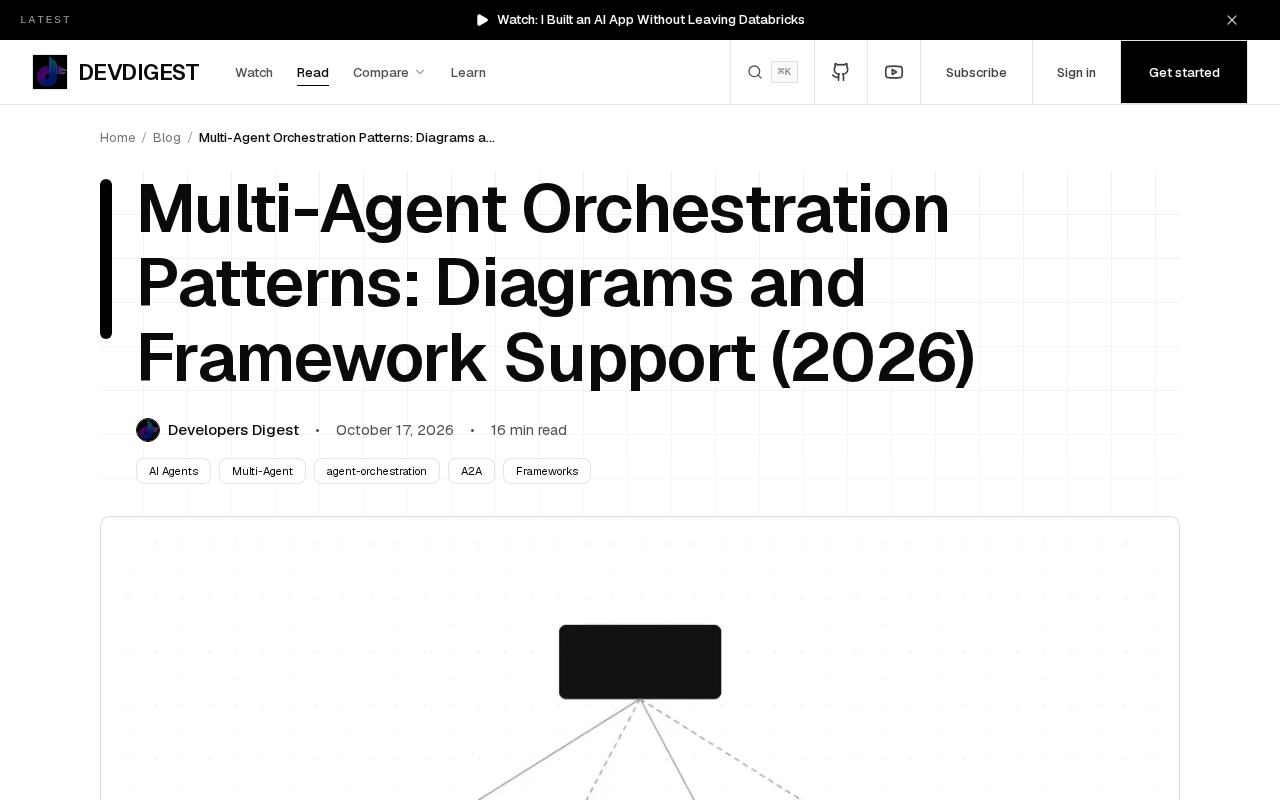
Multi-agent systems are moving from experimentation to production, but how to choose the right orchestration pattern and framework remains a real challenge for developers. A recent technical analysis catalogued seven multi-agent orchestration patterns, pairing each with an architecture diagram and noting native support across major frameworks—including OpenAI Agents SDK, LangGraph, Mastra, AI SDK, ADK, CrewAI, and the A2A v1.0 protocol. The value of this material lies in mapping abstract patterns to concrete toolchains, giving architecture decisions a reference point.
Why Orchestration Patterns Matter More Than Framework Selection
When teams start a multi-agent project, their first instinct is often to pick a framework. But a framework is only an implementation vehicle—what truly determines a system's ceiling is the orchestration pattern: how agents divide work, communicate, and arbitrate conflicts. Choose the wrong pattern and even the most powerful framework can't save you; choose the right one and even a lightweight framework can build a robust system.
These seven patterns span a spectrum from simple serial execution to complex negotiation. Understanding their applicable boundaries has more long-term value than memorizing the usage of a particular API.
Orchestration Pattern refers to the interaction structure and control-flow rules that multiple agents follow when collaborating to complete a task. It specifies who invokes whom at what moment, how information flows, and how conflicts are adjudicated. The distinction from framework selection is that a pattern is an architectural design decision independent of any specific implementation, while a framework is the toolkit that realizes these patterns. The same pattern can be implemented by different frameworks, and the same framework can implement multiple patterns. The value of understanding patterns is that it abstracts the complexity of multi-agent systems into comparable, composable structural units, enabling architecture decisions to outlive the lifecycle of any specific API.
Core Characteristics of the Seven Orchestration Patterns
According to the original analysis, each of the seven patterns has clear applicable scenarios:
- Sequential Chain: Agents execute in a fixed order, with each one's output feeding the next as input. Suited to tasks with a determined flow and clear dependencies, such as document processing pipelines.
- Router: A dispatcher agent routes tasks to different specialized agents based on input characteristics. Suited to scenarios with clear intent classification and many branches.
- Parallel Fan-Out: Multiple agents process different aspects of the same task simultaneously, with results aggregated into an output. Suited to independently splittable subtasks, such as multi-dimensional analysis.
- Supervisor: A manager agent dynamically assigns tasks and checks subordinates' output, requesting rework when necessary. Suited to scenarios with high quality requirements that need iterative correction.
- Hierarchical: Supervisors above supervisors, forming a multi-layer management structure. Suited to large-scale, multi-domain complex systems.
- Group Chat / Debate: Multiple agents exchange viewpoints on the same question and converge on an answer through discussion. Suited to decision tasks requiring multi-perspective trade-offs.
- Handoff: An agent actively transfers control to another agent during execution. Suited to scenarios with frequent role switching in conversational flows, such as customer service escalation.
Each pattern has its costs: the sequential chain is simple but fragile—one failure halts the whole chain; parallel fan-out is fast but the aggregation logic easily becomes a bottleneck; group chat can improve answer quality, but token consumption and latency rise significantly.
Supervisor mode and Hierarchical mode are often conflated, but the key difference lies in the depth of the control-flow hierarchy. Supervisor mode has only one layer of management: a single supervisor agent directly dispatches several executor agents and quality-checks their output. Hierarchical mode introduces multiple levels of supervisors, each reporting upward and dispatching downward, forming a tree-like management structure. The former suits scenarios with relatively concentrated task domains and a limited number of agents; the latter is used for large-scale systems, reducing the cognitive load on any single supervisor through layering. The cost of hierarchical mode is that communication overhead rises with each added layer, and the decision latency of upper-level supervisors propagates to the entire subtree.
Comparison of Native Framework Support
The original analysis annotated each framework's native support for the above patterns, which directly affects development cost:
- OpenAI Agents SDK provides out-of-the-box abstractions for handoff and routing, suited to applications centered on conversational flow.
- LangGraph models with a graph structure and has strong native expressiveness for sequential chains, parallel fan-out, supervisor, and hierarchical patterns, making it a broadly covering choice.
- Mastra and AI SDK lean toward lightweight orchestration, with direct support for simple chains and routing, while complex patterns require custom composition.
- ADK (Agent Development Kit) has dedicated designs for hierarchical and supervisor patterns, suited to building structured multi-agent systems.
- CrewAI's role-based abstraction naturally aligns with supervisor and group chat patterns, with clear team-collaboration semantics.
- A2A v1.0, as an inter-agent communication protocol, addresses cross-system interoperability rather than in-process orchestration, placing it at a different layer from the other frameworks.
You may not have noticed that "native support" does not mean "usable only for that pattern." Most frameworks can implement any pattern through composition—the difference lies in how much glue code is required and whether the abstractions feel natural.
A2A (Agent-to-Agent) protocol v1.0 is a communication standard for interoperability between heterogeneous agent systems, defining how agents discover each other, negotiate capabilities, and exchange tasks and results. It focuses not on how to orchestrate multiple agents within a single process, but on how agents collaborate across processes, organizations, and technology stacks. By contrast, frameworks like LangGraph and CrewAI solve orchestration problems within the same application. In real architectures, A2A typically sits above or between orchestration frameworks: each organization completes local orchestration internally with a framework, then interfaces with agents in other systems via A2A. Therefore, comparing A2A side by side with orchestration frameworks is inappropriate—it plays a role closer to the transport and protocol layer.
How to Choose Patterns and Frameworks for Your Scenario
The selection path boils down to three questions: Is the task flow deterministic? How much tolerance is there for output quality? Will the system scale continue to expand?
If the flow is deterministic and the scale is small, a sequential chain with a lightweight framework suffices; if quality requirements are high and repeated refinement is needed, supervisor mode paired with LangGraph or CrewAI is more suitable; if cross-organization, cross-system collaboration is needed, the A2A protocol should be part of the architecture rather than fixating solely on single-machine orchestration frameworks.
Another easily overlooked dimension is debugging cost. Hierarchical and group chat patterns are expressive, but their execution paths are non-deterministic, making issues far harder to trace than with sequential chains. In production, without robust logging and observability, complex patterns can actually slow down iteration.
Observability in multi-agent systems refers to the ability to record, trace, and replay inter-agent call chains, decision paths, state transitions, and token consumption. Unlike single-agent applications, multi-agent systems often have non-deterministic execution paths: supervisors may repeatedly request rework, and group chats may produce multiple rounds of divergent discussion. Without observability, the debugging cost of complex orchestration patterns rises sharply, because developers struggle to reproduce the specific path of a given failure. Production environments typically require distributed tracing (such as OpenTelemetry), structured logging, and call-graph visualization to support this. This is why, when selecting a pattern, in addition to functional fit, you should assess whether your team's existing observability infrastructure can cover the execution complexity of the chosen pattern.
Pattern Composition Is the Norm
Real systems rarely use just one pattern. A common approach is to use a supervisor at the outer layer for task dispatch, a sequential chain at the inner layer for specific sub-flows, and embed group chat where multi-party evaluation is needed. The value of a framework lies in whether it lets these compositions be expressed naturally, rather than forcing you to choose one or the other.
The original illustrated material provides a clear starting point: recognize the patterns first, then match the framework, and finally validate under real load. The complexity of multi-agent systems doesn't disappear through framework encapsulation—it only shifts. Choosing the right orchestration structure means putting complexity in a controllable place.
One-line Summary
Seven multi-agent orchestration patterns compared with mainstream framework support to guide architecture selection.
Paragraph Summary
This article catalogues seven multi-agent orchestration patterns—sequential chain, router, parallel fan-out, supervisor, hierarchical, group chat/debate, and handoff—and annotates the native support each receives from OpenAI Agents SDK, LangGraph, Mastra, AI SDK, ADK, CrewAI, and the A2A v1.0 protocol. The article emphasizes that orchestration patterns matter more than framework selection, because patterns determine a system's ceiling while frameworks are only implementation vehicles. Each pattern has clear applicable scenarios and costs—for example, sequential chains are simple but fragile, while group chat yields high quality but consumes many tokens. On the framework side, LangGraph covers the most ground, OpenAI Agents SDK excels at handoff, CrewAI aligns with supervisor and group chat semantics, and A2A is a cross-system communication protocol rather than an in-process orchestration tool. Selection should be based on three questions—flow determinism, quality tolerance, and system scale—and should account for debugging and observability costs. Real systems often combine multiple patterns, and a framework's value lies in whether it can express those compositions naturally.
Related articles

Gemini 4 Argon Hands-On: AI Builds Board Games, Constructs Temples, and Trains Robots Autonomously
Gemini 4 Argon hands-on roundup: AI autonomously builds a desk racetrack and temple in Blender, writes a ray tracing engine, trains a humanoid robot to sink 7 shots, plus API pricing and developer access.

The Magic Octagonal Coin: Why Only 9% of People Can Predict Its Flip?
Only 9% of people can correctly predict the Magic Octagon coin flip. This article explains its spatial rotation mechanism, common cognitive pitfalls, and a new hypothesis based on Relevance Theory, exploring the limits of human spatial reasoning.

Sam Altman: AI Is Entering the Era of Scientific Discovery — Math Breakthroughs Will Replicate in Biology and Energy
Sam Altman says AI is entering the era of scientific discovery — math breakthroughs will replicate in biology, materials science, and energy to help develop new drugs and energy sources.