SFO Airport in the Browser: A Real-Time Miniature Replica Project

A developer spent weeks building a real-time browser replica of SFO with live flights, ATC, and easter eggs.
A Bay Area-raised developer built "tiny live replica of SFO" in the browser over a few weeks, recreating San Francisco International Airport in miniature. The project includes live aircraft movements, real air traffic control audio, custom airline liveries, AirTrain and BART rail systems, and numerous easter eggs. It earned 258 points and 96 comments on Hacker News's Show HN. The article analyzes the technical challenges of real-time data streams and ATC audio synchronization, notes how easter eggs and local elements give the project strong emotional and playful appeal, and discusses what such personal projects mean for the browser as a creative medium.
A developer spent a few weeks recreating San Francisco International Airport (SFO) in the browser, complete with live planes, real ATC, custom liveries, AirTrain and BART, plus plenty of easter eggs. The project earned 258 points and 96 comments on Hacker News, and this article breaks down its technical highlights and local emotional resonance.
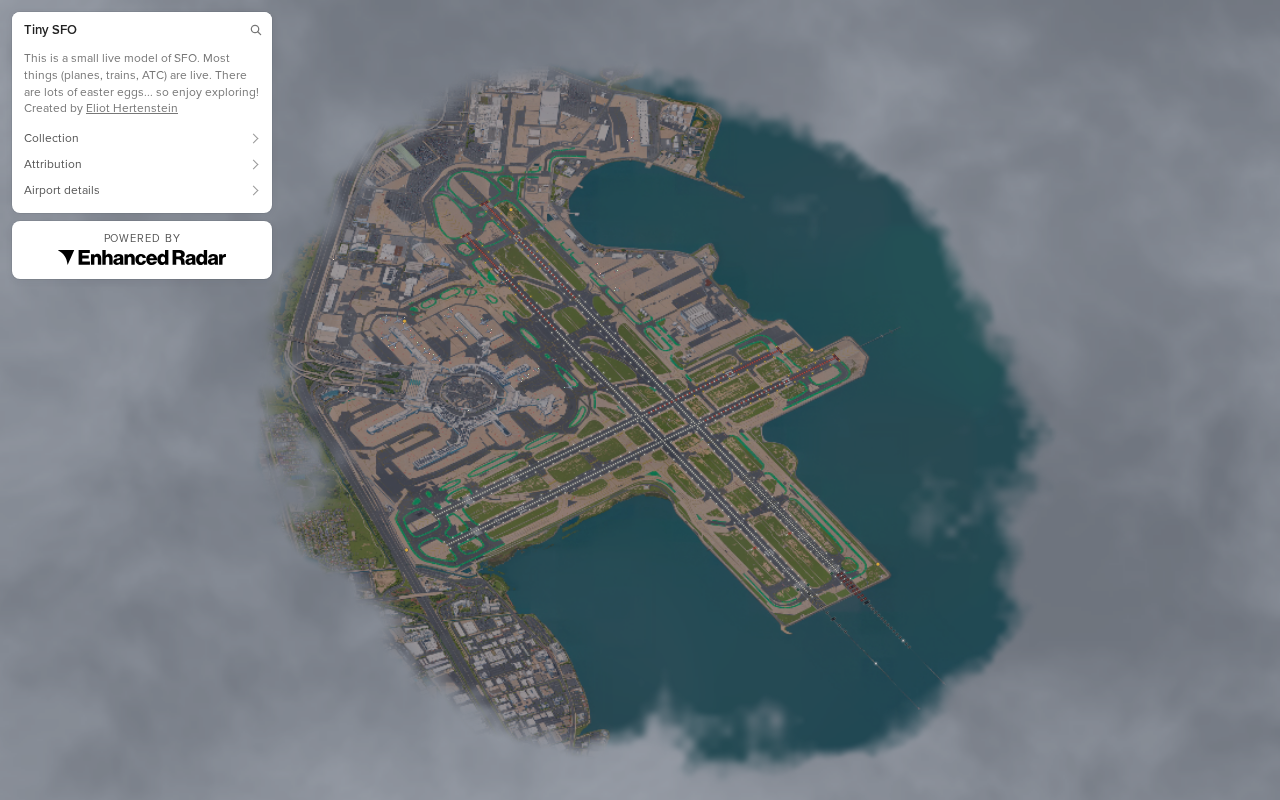
A developer who grew up in the San Francisco Bay Area spent a few weeks building a "miniature version of San Francisco International Airport (SFO)" in the browser. The project, titled "tiny live replica of SFO," received 258 points and 96 comments after being posted on Hacker News. It's not just a static map — it packs live flights, real air traffic control (ATC), custom liveries, AirTrain and BART into a single webpage, along with a ton of easter eggs.
What the project is: bringing the airport into the browser
According to the author's description in the Show HN post, the core of this SFO replica is "live" and "tiny." It runs in the browser, and users can see the airport in action the moment they open the page: planes are moving, controllers are talking, and rail transit is running. The author didn't disclose the specific tech stack, but "runs in the browser" and "live planes" suggest that front-end rendering and real-time data streams are the two key pillars of the project.
The modules included in the project are:
- Live planes: displaying flight activity inside and around the airport;
- Real ATC: tapping into real air traffic control communications;
- Custom liveries: giving planes different airline paint schemes;
- AirTrain and BART: replicating the airport's internal people mover and the Bay Area Rapid Transit system;
- A ton of easter eggs: fun details the author hid for users to discover.
The author wrote in the post: "I grew up in the Bay Area and spent a lot of time at this airport, so this is something of a tribute to a place that's almost like a second home." That personal connection is the source of the project's character — it's not a cold data visualization, but an interactive piece with the warmth of memory.
Real-time data and real ATC: behind the technical highlights
The most compelling aspect of this project is how it brings real-world live signals into the browser. Live aircraft positions and real ATC communications mean the project needs to handle continuously updating data streams and map them onto a miniature 3D or 2D scene. For front-end developers, the challenge isn't drawing the airport — it's making the scene come alive: data latency, update frequency, coordinate system transformations, and performance overhead can each become a bottleneck.
The introduction of real ATC is particularly noteworthy. Air traffic control communications are public, but presenting them in sync with aircraft positions requires solving a time-alignment problem — what you hear needs to correspond to what you see the plane doing, or the experience feels disjointed. The author didn't elaborate on the technical details in the post, but the phrase "real ATC" suggests the project at least implements a linked display of control audio and flight status.
Another easily overlooked detail is the "custom liveries." This implies the project treats aircraft models as configurable, so planes from different airlines can appear with different looks. It's not just visual richness — it also hints that the project has its own approach to asset management.
ADS-B and the source of live flight data
Live aircraft position data typically comes from ADS-B (Automatic Dependent Surveillance–Broadcast) systems. Commercial airliners and some general aviation aircraft broadcast their position, altitude, speed, and identification code via onboard transponders, and ground receivers or crowdsourced networks (such as OpenSky Network and ADS-B Exchange) aggregate these signals into queryable data streams. After connecting to such public data, developers need to poll or subscribe to updates at a certain frequency, then map latitude, longitude, and altitude into the local coordinate system of the miniature scene. This explains why "live planes" is technically feasible: the data itself is public, and the challenge lies in coordinate conversion, interpolation smoothing, and managing rendering performance in the browser.
The public nature of ATC audio and the synchronization challenge
Air traffic control communications are broadcast over VHF bands, and anyone with the appropriate receiving equipment can listen in, which means there's no legal barrier to obtaining "real ATC" data. Platforms like LiveATC.net have long provided live streams of control channels at major airports worldwide. Embedding audio into a webpage isn't complicated; the real engineering challenge is time alignment: the audio stream has its own buffering delay, and aircraft position data has its own update interval. If the two aren't synchronized, users will hear instructions but won't see the corresponding actions. A common approach is to introduce adjustable delays or timestamp alignment mechanisms so that audio and flight status match as closely as possible at the presentation layer.
Easter eggs and local flavor: why Bay Area residents will resonate
The author emphasizes that the project contains "a TON of easter eggs." Easter eggs are the soul of this kind of personal project — they don't serve functionality, they serve emotion and fun. For someone who grew up in the Bay Area and considers SFO a second home, an easter egg might be a detail of a specific terminal, a view from a particular runway, or a scene only regulars would recognize.
The recreation of AirTrain and BART also carries strong regional identity. For non-local users, they're just airport transit systems; but for Bay Area residents, BART's lines and stations are part of daily life. Putting these two systems into the miniature scene connects the airport to the city, extending the replica beyond the airport's fences.
Judging from the Hacker News response, 258 points and 96 comments show that the project struck a chord with quite a few people. High engagement on Show HN usually means two things: the project itself is well-executed, and it sparks discussion. The specific content of the comments wasn't detailed in the original material, but it's reasonable to infer that technical implementation, data sources, and easter egg discoveries were the main topics of discussion.
The role of BART and AirTrain in the Bay Area context
BART (Bay Area Rapid Transit) is the primary rail transit system in the San Francisco Bay Area, connecting downtown San Francisco, the East Bay, and the Peninsula, with one line running directly to SFO's international terminal. AirTrain, meanwhile, is SFO's internal automated people mover, looping between terminals, parking garages, and the BART station. For Bay Area residents, BART is part of the daily commute, and AirTrain is a fixed part of getting in and out of the airport; recreating both in the miniature scene effectively establishes spatial continuity between the airport and the city, pushing the work beyond the category of an "airport model" and giving it a stronger imprint of local life.
The significance of personal projects on Show HN
This project is a typical Show HN creation: one person, a few weeks, and a small goal driven by personal emotion. It has no business plan and doesn't solve grand problems, but it demonstrates a possibility — using browser technology to replicate a corner of the real world in real time, infused with personal memory.
For developers, the value of such projects is that they force you to deal with real data, real performance, and real experience. The live flight data isn't mocked, the ATC audio isn't synthesized, and the BART lines aren't drawn arbitrarily. Every "real" element means additional engineering cost, and the author chose to include them all.
For ordinary users, the project offers a lightweight entry point: open the webpage, watch planes take off and land, listen to control communications, and hunt for easter eggs. No installation, no registration, and no aviation knowledge required. That low-barrier fun is exactly the advantage of the browser as a creative medium.
If you're interested in aviation, real-time data visualization, or browser-based 3D, this project is worth a few minutes of exploration. The author wrote at the end of the post: "I welcome feedback and hope you enjoy exploring." For a project that pays tribute to a second home in just a few weeks, that line is probably its most genuine footnote.
Related articles

Inside the Optimization of Rust Compiler's New Trait Solver
An in-depth look at the optimization of the Rust compiler's next-generation trait solver, covering architecture evolution, community discussion, and impact on developers.

AI Role-Play in a Barbershop: How Veda Builds Immersion Through Dialogue
From a Bilibili Veda barbershop video, explore how AI role-play builds immersion through task dialogue, relationship maintenance, and improvisation.

Why Does Python Endure? A 20-Year Developer's Firsthand Account
A senior developer shares his journey from C, Java, and other languages to Python: convinced by its concise code in 2006, he asks himself every year whether to keep using Python, and the answer is always yes. Python's flexibility and versatility are the key to its enduring popularity.