SGD Dynamics Decomposition: How Orthogonal Subspaces Harm Generalization

SGD training induces spectral spikes in orthogonal complement directions, amplifying variance and harming generalization; freezing them is better.
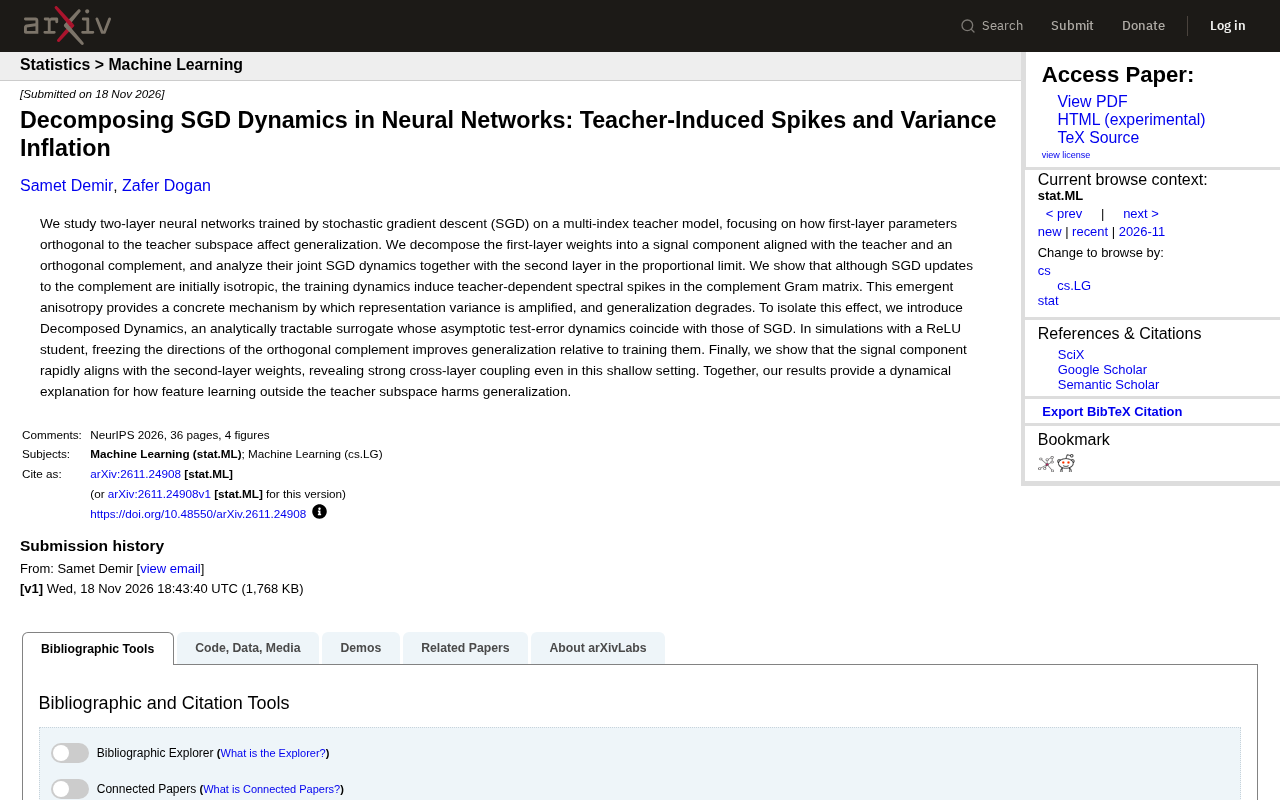
This study decomposes first-layer weights in a two-layer network trained with SGD on a multi-index teacher model into a signal component aligned with the teacher subspace and an orthogonal complement component, making joint dynamics analytically tractable. It finds that SGD updates to the orthogonal complement are initially isotropic but training induces teacher-dependent spectral spikes, wasting capacity on task-irrelevant directions and inflating representation variance, thus harming generalization. Decomposed Dynamics serves as a surrogate model matching SGD's asymptotic test error; simulations show freezing orthogonal complement directions generalizes better, supporting the claim that feature learning outside the teacher subspace is harmful. The signal component also rapidly aligns with second-layer weights, indicating strong cross-layer coupling.
The generalization behavior of two-layer neural networks under SGD training is often simplified into a black-box process of "parameter updates." But a study on multi-index teacher models decomposes the first-layer weights into a part aligned with the teacher signal and an orthogonal complement part, revealing a counterintuitive mechanism: training in the orthogonal complement directions is not only unhelpful, but actually amplifies representation variance due to teacher-induced spectral spikes, dragging down generalization.
A Decomposition Framework for Signal and Orthogonal Complement
The study considers a two-layer network trained with SGD on a multi-index teacher model in the proportional limit. The authors decompose the first-layer weights into two components: a signal component aligned with the teacher subspace, and a complement component orthogonal to the teacher subspace. This decomposition makes the joint dynamics of SGD — including the second-layer weights — analytically tractable.
The key observation is that SGD's updates to the orthogonal complement are initially isotropic, but the training process itself introduces a teacher-dependent spectral structure. In other words, the teacher signal in the data "leaks" into directions that should be irrelevant, forming spectral spikes.
Multi-index teacher model is a data-generation setup commonly used in theoretical analysis: the teacher network's output is formed by combining projections of the input onto several fixed directions (i.e., "indices" or the teacher subspace) through a nonlinear function. The student network must recover these directions and their combination rules from data. Compared to single-index models, the multi-index setting allows multiple correlated feature directions, which is closer to real tasks where features are not confined to a single dimension, while still retaining sufficient analytical tractability. The proportional limit refers to the thermodynamic limit in which network width, sample count, and teacher dimension all tend to infinity at fixed ratios; in this limit, empirical risk and generalization error can be characterized by deterministic equivalent equations, avoiding the analytical difficulties caused by finite-size fluctuations.
Teacher-Induced Spectral Spikes and Variance Inflation
This emergent anisotropy is precisely the concrete mechanism by which representation variance is amplified. The spikes that appear in the Gram matrix of the orthogonal complement mean that the network wastes capacity on task-irrelevant directions, and the variance inflation in these directions directly harms generalization.
To isolate this effect, the authors propose "Decomposed Dynamics" as an analytically tractable surrogate model whose asymptotic test-error dynamics match those of SGD. This provides a controllable sandbox for theoretical analysis.
Spectral spike refers to an isolated large eigenvalue that appears in the empirical spectral distribution of a matrix outside the otherwise continuous bulk spectrum. In random matrix theory, when the mean part of a matrix has low rank but the signal strength exceeds a certain threshold (the BBP phase transition point), the corresponding eigenvector aligns with the signal direction. Here, the Gram matrix of the orthogonal complement should contain only a noise bulk spectrum, but the teacher signal "leaks" in through SGD's finite-step updates, forming a low-rank mean component that causes a spike to emerge beyond the spectral edge. The eigenvector associated with this spike concentrates network capacity on task-irrelevant directions, significantly amplifying representation variance in those directions — equivalent to reducing the effective sample size and ultimately raising test error.
Freezing Orthogonal Directions Is Actually Better
In simulations with a ReLU student, a notable result is that freezing the orthogonal complement directions (i.e., not training them) yields better generalization than training them. This directly supports the argument that "feature learning outside the teacher subspace is harmful" — at least in this shallow setting.
This finding offers insight into overparameterization in deep networks: not all trainable parameters are worth training, especially those in directions orthogonal to the task structure.
Freezing here means fixing the projection of the first-layer weights onto the orthogonal complement subspace to zero (or to its initial value) during training, updating only the signal component and the second-layer weights. This operation is equivalent to adding a hard projection constraint to the optimization process, restricting the hypothesis space to the teacher subspace. In contrast, standard SGD updates both components simultaneously, and updates in the orthogonal complement indirectly affect the learning trajectory of the signal component through nonlinear activation and coupling with the second layer. The freezing experiment is diagnostically valuable because it cuts off the "orthogonal complement variance inflation" channel; if generalization improves as a result, this can be attributed to the negative effect of that channel rather than other optimization details.
Fast Cross-Layer Alignment via Coupling
The study also finds that the signal component rapidly aligns with the second-layer weights, indicating that even in this shallow setting, cross-layer coupling is very strong. This means that signal learning in the first layer does not proceed in isolation but co-evolves with the readout in the second layer.
Taken together, this work provides a dynamical explanation for "how feature learning outside the teacher subspace harms generalization": SGD does not neutrally explore all directions; the teacher signal induces spectral spikes, amplifies variance, and ultimately degrades test performance. For readers working in representation learning or theoretical analysis, this offers a perspective worth attention.
One-line Summary
When SGD trains a two-layer network, teacher signals induce spectral spikes in the orthogonal complement directions, amplifying variance and harming generalization — freezing them is actually better.
Paragraph Summary
This study considers SGD training of a two-layer network on a multi-index teacher model in the proportional limit, decomposing the first-layer weights into a signal component aligned with the teacher subspace and an orthogonal complement component, making the joint dynamics (including the second layer) analytically tractable. The core finding is that SGD's updates to the orthogonal complement are initially isotropic, but training induces teacher-dependent spectral spikes, wasting capacity on task-irrelevant directions and inflating representation variance, thereby dragging down generalization. The authors propose "Decomposed Dynamics" as a surrogate model whose asymptotic test error matches SGD; in ReLU student simulations, freezing the orthogonal complement directions generalizes better than training them, supporting the claim that "feature learning outside the teacher subspace is harmful." The signal component also rapidly aligns with the second-layer weights, showing strong cross-layer coupling in shallow networks.
Related articles

From Gobbler to Sloppy Joe: The Hit-Making Playbook of a New Jersey Deli Institution
NYT Cooking visits Milburn Deli in New Jersey to break down the hit logic behind the Gobbler turkey sandwich and the local Sloppy Joe: bread sliced to order, house-made sauces, a group shout culture, and customer co-creation behind six locations.
In the Age of AI Programming, When Do You Still Need to Write Code by Hand?
Is handwritten code still valuable once AI programming agents are widespread? This article outlines three scenarios where handwriting is essential—learning, style development, and prototype validation—and provides a division-of-labor framework between AI and humans to help developers balance efficiency and skill growth.

AI Data Center Construction Hits Roadblocks: The Neoclouds Winter and Nvidia's New Bar
Nvidia says it won't support unfinished AI data centers, leaving neoclouds squeezed by construction delays and rising debt costs. We analyze what this means for AI infrastructure.