SGLang-Diffusion: A High-Performance Serving Framework for Diffusion Models

SGLang team unveils SGLang-Diffusion, a high-performance serving framework for diffusion models, set to debut at PyTorch Conference 2026.
SGLang-Diffusion is a high-performance inference engine and serving stack for diffusion models, developed by SGLang team members Yihao Wang and Kevin Mee. It aims to fill the gap in diffusion model deployment tooling by supporting both offline batch processing and real-time serving workloads. Building on SGLang's LLM serving expertise, it focuses on parallelization strategies (tensor parallelism, pipeline parallelism, etc.) and execution path optimizations tailored to multi-step denoising computation. Full technical details will be revealed at PyTorch Conference in October 2026.
An Inference Engine Built for Diffusion Models
In the era of generative AI, diffusion models have become the dominant technical approach for image and video generation tasks. Yet compared to the mature inference-serving ecosystem built around large language models, diffusion model deployment and serving optimization have long lacked dedicated tooling. SGLang-Diffusion, announced by Yihao Wang and Kevin Mee — members of the Riddick Stark / SGLang team — is designed to address exactly this gap: a high-performance inference engine and serving stack purpose-built for diffusion models.

According to the authors, SGLang-Diffusion is more than just an inference engine — it is a complete serving stack. This means it goes beyond optimizing single-inference latency to cover the full pipeline, from request scheduling to parallelized model execution, with the goal of delivering stable, efficient diffusion model services in production environments.
SGLang (Structured Generation Language) was originally developed as a high-performance inference and serving framework for large language models, driven by a collaboration between academia and industry. One of its core innovations is RadixAttention — a KV cache reuse technique based on a Radix Tree that automatically identifies and shares prompt prefix caches across multiple requests, significantly reducing redundant computation and improving throughput. SGLang also provides an efficient continuous batching scheduler, making it a strong performer in LLM serving benchmarks. Built on this engineering foundation, SGLang has established a strong reputation in the LLM inference space. Extending these capabilities to diffusion models is the central motivation behind SGLang-Diffusion.
Supporting Both Offline and Real-Time Workloads
A key design decision in SGLang-Diffusion is its support for both offline and real-time workloads. These two scenarios place very different demands on a serving framework: offline batch processing prioritizes maximizing throughput, often at the expense of per-request latency; real-time serving, on the other hand, requires strict latency control to ensure a smooth user experience.

Building a single framework that handles both modes gracefully is non-trivial — it requires sufficient flexibility in scheduling policy, resource allocation, and execution path design. Based on what the authors have shared, SGLang-Diffusion is engineered around exactly this dual-scenario requirement.
Serving Optimizations: Parallelization and Execution Paths
The authors highlighted several key technical directions in their preview: serving optimizations for different parallelization schemes, execution path design, and how to serve frontier diffusion models on top of SGLang.
Diffusion model inference involves multi-step denoising iterations that are computationally intensive and memory-hungry. Applying the right parallelization strategy — such as tensor parallelism, pipeline parallelism, or specialized partitioning schemes tailored to diffusion model characteristics — can significantly improve throughput and reduce latency in multi-GPU environments. Execution path optimization, meanwhile, focuses on eliminating redundant computation and improving operator scheduling so that each denoising step runs as efficiently as possible.

These optimizations are particularly noteworthy because SGLang has already built a strong reputation in LLM serving through techniques like RadixAttention. Porting and extending this engineering expertise to diffusion models holds the promise of bringing the scheduling and parallelism know-how accumulated in LLM serving directly into visual generation workloads.
Diffusion model inference is fundamentally different from LLM inference, and that difference is precisely what makes specialized optimization necessary. LLM inference is autoregressive token-by-token generation, where the bottleneck lies in memory bandwidth and KV cache management. Diffusion models, by contrast, require tens to hundreds of denoising iterations over the same UNet or Transformer architecture (such as DiT, the Diffusion Transformer) — with each step being a full forward pass, carrying far greater computational cost than a single token generation step. Common parallelization strategies include: Tensor Parallelism, which shards individual weight matrices across multiple GPUs for synchronized computation; Pipeline Parallelism, which splits the model layer-by-layer across devices to form a pipeline; and more recently proposed sequence-level or step-level parallelism approaches that exploit the dependency structure between adjacent denoising steps to enable asynchronous scheduling. Choosing the right parallelization strategy is critical for balancing inference latency and GPU memory utilization in multi-card cluster deployments.
Debut at PyTorch Conference
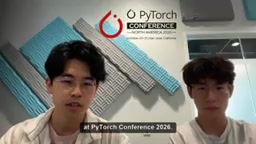
Yihao Wang and Kevin Mee are scheduled to present the technical details of SGLang-Diffusion at the PyTorch Conference, taking place October 20–21, 2026, in San Jose, California. They will provide an in-depth look at serving optimizations, parallelization strategies, and deployment practices for frontier diffusion models.
For developers and teams looking for efficient deployment solutions for diffusion models, this is a project worth following closely. As image and video generation applications continue to scale, specialized serving frameworks will become critical infrastructure for reducing costs and improving user experience.
Summary
Public information about SGLang-Diffusion remains limited for now, with further technical details expected at the conference. But from a positioning standpoint, it fills a clear gap in the diffusion model serving toolchain: systematically bringing mature, high-performance serving principles into the diffusion model domain, while addressing both offline batch processing and real-time interactive workloads. Those interested can keep an eye on the PyTorch Conference schedule for first-hand details.
Related articles

ChatGPT Space Launches: Team Collaboration and New Pages Features Explained
ChatGPT Space is OpenAI's new team collaboration feature with Pages, real-time collaboration, and Slack/Google Drive sync. We break down its privacy design, multi-platform integration, and the full workflow from conversation to document.

Migrating Apache Spark UDFs to GPU Acceleration with AI Agents
NVIDIA developer blog explains how AI Agents rewrite Apache Spark UDFs for GPU acceleration, covering migration criteria, agent rewriting and verification workflows, plus pitfalls like result consistency and CPU-GPU transfer overhead.

Zed Editor v0.40.4-rc2 Released: Usage Credits Now Available Without Upgrading
Zed editor releases v0.40.4-rc2, allowing users to use usage credits for AI features without upgrading to a paid plan, lowering the trial barrier.