SGLang v0.5.19 Released: Core Upgrades to the High-Performance LLM Inference Engine Explained
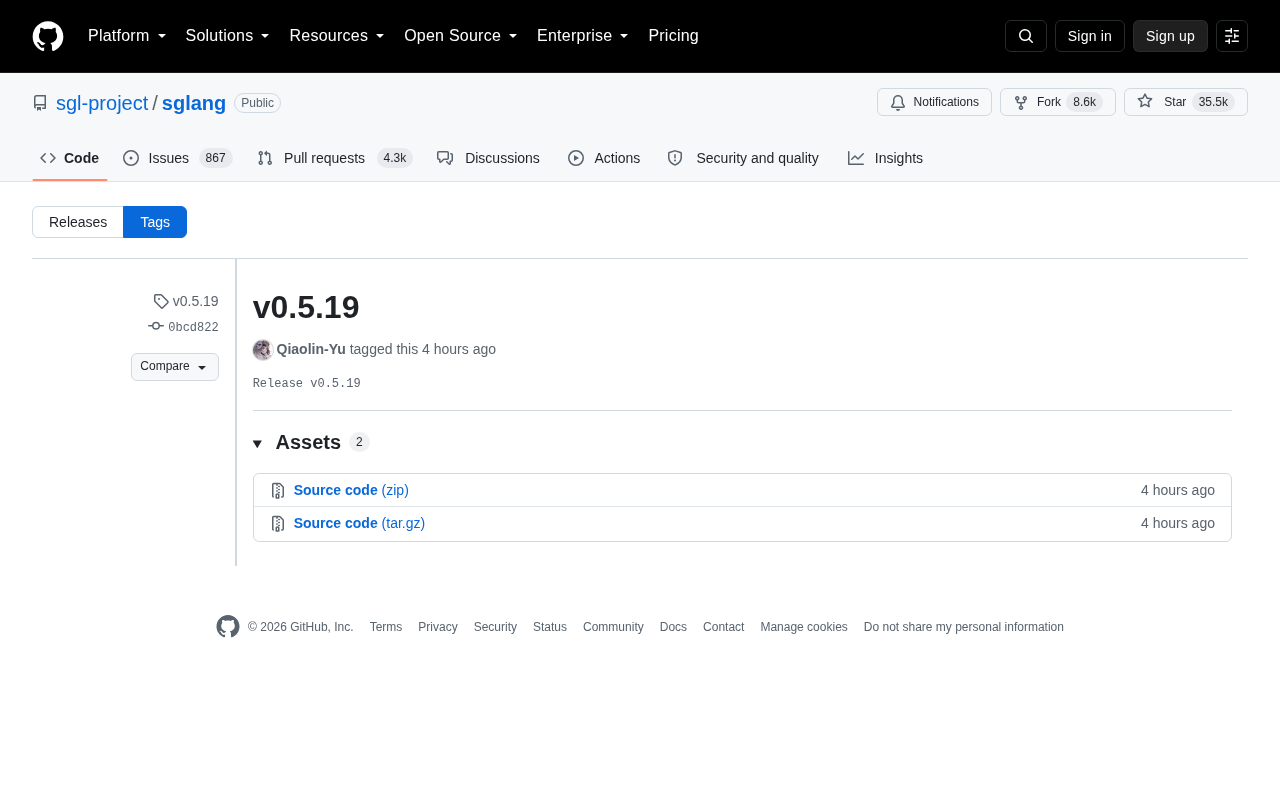
SGLang v0.5.19 released with continued improvements to its high-performance LLM inference engine.
SGLang v0.5.19 has been officially released, continuing the rapid iteration of this high-performance LLM inference framework with 35.5k GitHub stars. The article provides an in-depth analysis of SGLang's core innovations — RadixAttention prefix caching and structured output — along with technical context on KV Cache, MoE architectures, and quantization, plus practical upgrade guidance for production deployments.
SGLang Gets the v0.5.19 Update
SGLang, one of the most closely watched large language model (LLM) inference and serving frameworks today, has officially released version v0.5.19. Maintained by the sgl-project team, the project has accumulated 35.5k Stars and 8.6k Forks on GitHub, a testament to its activity and influence within the open-source community. This release was tagged by contributor Qiaolin-Yu on September 4th (commit 0bcd822), continuing SGLang's characteristically rapid iteration cadence.
For engineers and researchers working on LLM deployment and inference optimization, every SGLang version update is worth paying attention to, as it typically brings substantive improvements in inference throughput, latency, or compatibility.
SGLang's Core Positioning: More Than Just Another LLM Inference Framework
To understand the significance of v0.5.19, it's important to first understand SGLang's positioning. SGLang (Structured Generation Language) is a high-performance serving framework for large language models and vision-language models. Its core design goal is to make complex LLM applications run faster and more efficiently.
Compared to traditional inference frameworks, SGLang features two major technical innovations:
RadixAttention Prefix Caching Mechanism
SGLang's RadixAttention technology automatically reuses KV Cache (key-value cache) across multiple requests. In practice, many requests share identical system prompts or conversation prefixes. RadixAttention uses a Radix Tree structure to intelligently manage these shared prefixes, dramatically reducing redundant computation and significantly boosting inference throughput.
Technical Background on KV Cache: KV Cache is one of the most critical acceleration techniques in Transformer inference. During autoregressive generation, each time the model generates a new token, it needs to compute attention with all previous tokens. Without caching, every step would require recomputing the Key and Value vectors for all historical tokens, causing computational cost to grow quadratically with sequence length. KV Cache stores previously computed Key and Value vectors in GPU memory, so each generation step only needs to compute the new token's Key/Value and concatenate it with the cache, reducing the incremental computation complexity to linear. However, the memory footprint of KV Cache is substantial — for LLaMA-70B, for example, the KV Cache for a single request at a 4096 context length can consume several GB of GPU memory, making it the primary bottleneck limiting batch size and concurrency.
Data Structure Advantages of Radix Trees: A Radix Tree, also known as a compressed prefix tree (Patricia Trie), is a space-optimized trie structure. Unlike a standard Trie, a Radix Tree compresses paths with only a single child node into a single node, significantly reducing storage overhead. In SGLang's RadixAttention, the Radix Tree manages KV Cache sharing across different requests: each path in the tree represents a token sequence, and if multiple requests share the same prefix (such as a system prompt), they share the same nodes along that path, with the corresponding KV Cache stored only once. This design supports efficient Longest Prefix Match (LPM) lookups, determining in O(n) time how much existing cache a new request can reuse.
Structured Output and the Frontend Programming Language
SGLang provides a flexible frontend programming language that allows developers to easily write complex generation programs involving multi-turn conversations, control flow, parallel calls, and external interactions. Combined with the efficient backend runtime, this makes SGLang particularly well-suited for Agent and structured data extraction scenarios.
Structured Output has immense technical significance in production environments — when LLM outputs need to be parsed and processed by downstream programs, free-form text output frequently leads to parsing failures. The mainstream technical approach for implementing structured output is constrained decoding, which applies constraint masks to token logits during the decoding phase using Finite State Machines (FSM) or Context-Free Grammars (CFG), only allowing tokens that conform to grammatical rules to be sampled. SGLang integrates an efficient constrained decoding engine and co-optimizes it with RadixAttention's caching mechanism, ensuring that structured output does not significantly degrade inference throughput. This has direct commercial value in Agent tool calling, API response generation, data extraction, and similar scenarios.
The Engineering Logic Behind Rapid Iteration
SGLang employs a fairly dense release strategy — the version number v0.5.19 alone reveals how frequently minor versions are updated. This rapid iteration model is not uncommon in the high-performance inference framework space — both vLLM and TensorRT-LLM maintain a similar update cadence.
Technical Background on Competing Frameworks: vLLM, developed by a team at UC Berkeley, is renowned for its PagedAttention technology — a technique that borrows from operating system virtual memory paging to manage KV Cache in fixed-size blocks, virtually eliminating memory fragmentation and dramatically improving batching efficiency. TensorRT-LLM is NVIDIA's enterprise-grade inference optimization solution, deeply integrating the TensorRT compiler with NVIDIA hardware features (such as FP8 and Transformer Engine), typically achieving peak single-GPU inference performance on NVIDIA GPUs. SGLang differentiates itself through RadixAttention and its structured generation language, demonstrating unique advantages in prefix-sharing scenarios and complex generation tasks. Each framework has its own focus, but they continue to converge on core inference performance.
The underlying reason is that LLM inference optimization is a field that heavily depends on hardware adaptation and algorithmic innovation. New model architectures (such as MoE — Mixture of Experts), new quantization schemes, new attention mechanisms, and constantly evolving GPU hardware all demand that inference frameworks keep pace.
Challenges MoE Architectures Pose for Inference: Mixture of Experts (MoE) is a sparsely activated model architecture. Its core idea is to place multiple parallel "expert" sub-networks within the Transformer's feed-forward layers, with each token activating only a small subset of experts during inference (typically 2–4), dynamically routed by a gating network (Router/Gate). This design allows models to have extremely large total parameter counts (e.g., Mixtral 8x7B has approximately 47B parameters), while the actual compute per inference step is equivalent to a much smaller dense model (approximately 13B active parameters). MoE architectures pose unique challenges for inference frameworks: the dynamic routing of experts creates irregular computation patterns and makes load balancing difficult; meanwhile, the large number of inactive parameters still need to be loaded into memory, placing higher demands on memory management and communication efficiency. Recent popular models like DeepSeek-V2/V3 and Qwen2-MoE all employ the MoE architecture.
The Ongoing Evolution of Quantization: Quantization is one of the core techniques for reducing model inference costs. It works by converting model weights and/or activation values from high-precision floating-point numbers (such as FP16/BF16) to lower-precision representations (such as INT8, INT4, or even lower). Common quantization methods include: GPTQ (layer-wise quantization based on second-order information), AWQ (Activation-Aware Weight Quantization, which protects important weight channels based on activation distributions), and FP8 quantization (natively supported in hardware on Hopper architecture GPUs). The benefits of quantization are multifaceted: reduced memory footprint allows larger models to run on limited hardware, lower memory bandwidth requirements improve throughput (LLM inference is typically memory bandwidth-bound rather than compute-bound), and computational cost is reduced. Inference frameworks need to continuously adapt to various new quantization formats and algorithms, making this another key driver of rapid iteration.
Each minor version update typically includes support for new models, performance patches, bug fixes, and inference kernel-level optimizations.
For users in production environments, this rapid iteration is both an opportunity and a challenge: on one hand, you can benefit from performance gains immediately; on the other, you need to establish robust version validation processes to ensure upgrades don't introduce regressions.
Version Upgrade Guide and Considerations
For users looking to adopt v0.5.19, you can typically install or upgrade to the latest version directly via pip. Before upgrading, it's recommended to carefully review the change notes in the official Release Notes, with particular attention to the following:
- API Compatibility Changes: Whether any interface adjustments might affect existing code;
- Newly Supported Models: Whether the models you're currently using are covered;
- Performance-Related Improvements: Changes in inference throughput, memory usage, and other metrics;
- Dependency Requirements: Version requirements for underlying dependencies like CUDA and PyTorch.
It's worth noting that since the original release information for this version is relatively brief, developers are advised to refer to the GitHub repository's official Release page and complete changelog for detailed update information.
The Continued Flourishing of the Open-Source LLM Inference Ecosystem
The release of SGLang v0.5.19 is a microcosm of the continued flourishing of the open-source LLM inference ecosystem. At a time when deploying large models into production has become an industry focal point, inference efficiency directly impacts deployment costs and user experience. With innovative technologies like RadixAttention, SGLang has become an important choice for many enterprises and research institutions deploying large models.
With ongoing contributions from the open-source community, SGLang is poised to deliver even more performance breakthroughs and feature enhancements in future releases. For practitioners focused on LLM engineering, continuously tracking the evolution of core inference infrastructure like this is essential for maintaining a competitive technical edge.
Key Takeaways
Related articles

Type.com Review: A Deep Dive into the Team AI Collaboration Shared Workspace
Type.com integrates Claude, Codex, and other AI models into a team collaboration platform with shared knowledge, automation, and custom apps. Read our in-depth review of its features, use cases, and competitive edge.

OTP.com Review: One API to Unify SMS, WhatsApp, Email, and Telegram OTP Delivery
In-depth review of OTP.com: a single API unifying SMS, WhatsApp, Email, and Telegram OTP channels to cut integration costs and boost delivery rates for developers.

Pluno Review: An AI Chrome Extension That Proactively Discovers Automation Opportunities
Pluno is an AI Chrome extension that proactively discovers and executes automation tasks. No manual workflow setup needed — it observes user behavior, identifies repetitive tasks, and proposes automation solutions.