shadcn/improve: Audit Your Codebase with the Strongest Model, Let Cheap Models Execute the Plan

shadcn/improve uses a strong model to audit and write a plan, and cheap models to execute it, reducing AI coding costs.
The article introduces the core idea of the GitHub open-source project shadcn/improve: splitting the AI coding workflow into two stages—"strong model audit" and "cheap model execution." A strong model (like Claude Opus) reads through the codebase, identifies problems, and outputs a structured, executable plan; a cheap model (like Claude Haiku) then modifies the code item by item according to the plan. This division of labor resembles architects writing design documents and engineers implementing them—retaining high-quality decisions while dramatically reducing token costs. The article also analyzes the implications for team collaboration: the plan itself can serve as a PR description or technical debt list, marginal costs in the execution stage are low, and cheap models, not needing to understand the whole picture, reduce the risk of fabrication. It also notes that it depends on plan quality, recommending a quick human review of the plan after the audit before execution. The project has surpassed 10,000 stars and suits refactoring and technical debt cleanup for medium-to-large codebases.
Why We Need the "Strong Model Audits + Cheap Model Executes" Division of Labor
As AI coding tools become widespread, a real contradiction is becoming increasingly prominent: the smartest models (like Claude Opus, GPT-4 level) can deeply understand a codebase and produce high-quality refactoring plans, but they're expensive; while cheap models (like Haiku, GPT-3.5 level) can handle simple tasks but struggle to independently complete complex analysis.
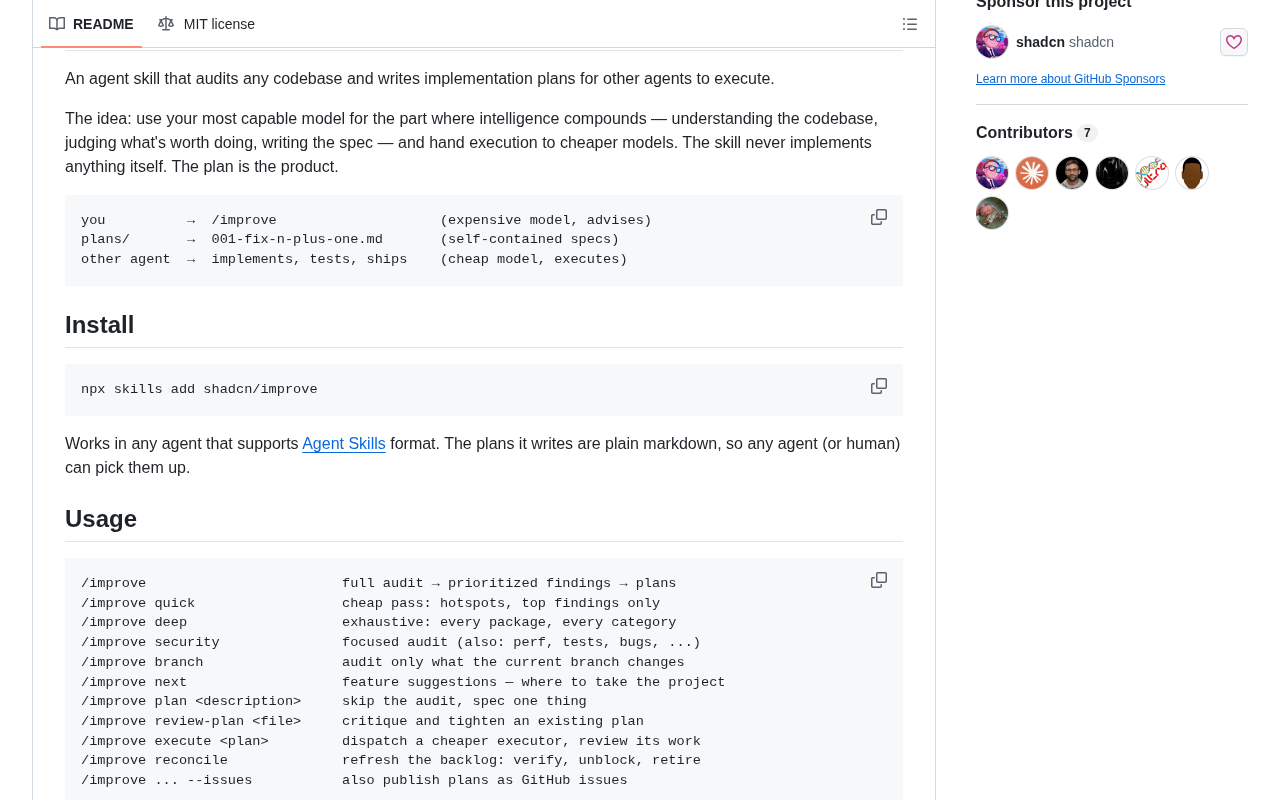
The open-source project shadcn/improve on GitHub proposes an elegant solution: let the most powerful model audit the codebase and write an execution plan, then hand it to cheaper models to implement item by item. This project has already gained over 10,000 stars on GitHub, with 333 new stars in a single day, showing it has hit a real pain point for developers.
Core Idea: Separate "Thinking" from "Execution"
In traditional usage, developers often directly ask a mid-tier model to complete the entire "analyze + modify" workflow, resulting in either poor quality or heavy token consumption from repeated debugging. shadcn/improve splits the process into two stages:
- Audit stage: Use your strongest model (like Claude Opus) to read through the codebase, identify problems, propose improvement directions, and output a structured, executable plan file.
- Execution stage: Hand the plan to a lower-cost model (like Claude Haiku or other lightweight models) to complete the code modifications step by step.
This division of labor is similar to "architects write design documents, engineers implement according to the documents" in software engineering. The strong model handles high-value judgment and planning, while the cheap model handles mechanical execution, significantly reducing overall costs while retaining high-quality decision-making.
Model Cascading is the theoretical foundation of this division of labor: layer tasks by difficulty, assigning high-difficulty parts to large models and low-difficulty parts to small models, thereby compressing inference costs while ensuring quality. Unlike Model Routing, which dynamically selects models based on input content, cascading emphasizes the sequential dependency of task stages—the output of the previous stage (the plan) becomes the input of the next stage (execution constraints). Common variants in practice include: using a strong model in the audit stage to generate a plan with acceptance criteria, having a small model complete items one by one in the execution stage, and then a lightweight validation step (which can use rule scripts or a small model) to check compliance with the plan. The effectiveness of cascading depends on whether stage boundaries are clear and whether the plan is specific enough; otherwise, small models easily deviate under vague instructions.
Project Features and Usage
shadcn/improve is released as open source, with a language stack consistent with the shadcn ecosystem. From the repository description, it's not a complex framework but a reusable set of workflows and prompt collections that help you connect "audit—plan—execute" together.
A typical usage flow includes:
- Run the audit command in the project root directory and select the strongest model currently available to you;
- The model generates one or more improvement plans describing specifically what to change, why, and how to verify;
- Switch to a cheap model, execute item by item according to the plan, and commit in batches.
Since the project was just released, it's recommended to check the repository README directly for specific CLI parameters and integration methods. But from the design philosophy alone, it already provides a practical paradigm for "AI coding cost optimization."
Structured plan files usually refer to task lists described in Markdown or YAML form, each containing: target file/function location, problem description, modification intent, and acceptance method (such as test commands, expected behavior). The value of this format lies in converting "natural language suggestions" into "executable specifications," enabling cheap models to operate item by item without understanding the global architecture, and also facilitating human review and version management. It's recommended to control the granularity of plan files so that each item can be independently verified, avoiding a single plan item covering multiple files that makes it difficult to locate failure causes during execution. At the same time, the plan should explicitly list changes outside the current scope to prevent the executing model from expanding the modification scope on its own.
Practical Impact on Development Workflows
This model offers several insights for team collaboration:
The plan is the documentation. The plans produced by strong models are highly readable and can serve as PR descriptions or technical debt lists, making human review easier.
Costs are controllable. The audit stage consumes many tokens but only runs once; the execution stage is highly repetitive and processed in batches with cheap models, dramatically reducing marginal costs.
A quality floor is guaranteed. Cheap models don't need to "understand the whole picture"—they just follow steps, reducing the risk of fabrication.
Of course, this division of labor also depends on the quality of the plan—if the strong model misses key context, the execution stage may go off track. Therefore, it's recommended to have a human quickly review the plan after the audit before handing it to the cheap model for execution.
Technical debt refers to the long-term maintenance costs accumulated from suboptimal design choices made for short-term speed, such as duplicate code, missing tests, inconsistent naming and style, and outdated dependencies. Technical debt is characterized by being scattered and large in quantity, with high manual per-item processing costs, making it perfectly suited for the "strong model one-time identification + cheap model batch repair" model. In the audit stage, technical debt can be sorted by impact scope and repair difficulty to form a priority queue; in the execution stage, low-risk items are processed in batches, while high-risk items are left for human intervention. This layered approach prevents cheap models from making wrong judgments on changes involving architectural adjustments.
Who It's For
If you frequently use AI to assist with refactoring, clean up technical debt, unify code style, or maintain a medium-to-large codebase, shadcn/improve's approach is worth learning from. It's not tied to a specific model vendor—you can flexibly choose the combination of "audit model" and "execution model" based on your budget.
The project has now surpassed 10,000 stars with high community attention, and it's likely to spawn more tool integrations in the future. For developers concerned with AI coding efficiency and cost, this is an open-source project worth following.
Related articles

Prompt Engineering for Beginners: From Writing Prompts to Engineering Thinking
Starting from the essence and four functions of prompts, this article systematically explains the six-step process, four success criteria, learning value, and practical limitations of prompt engineering to help you build a complete understanding.

Anthropic Launches Nasdaq IPO: AI Giant's Listing and Risk Disclosures
Anthropic officially launches its Nasdaq IPO under ticker ANT, with market valuation expected to potentially exceed SpaceX's record. The prospectus devotes nearly 100 pages to AI risks, while first-half revenue grew over 14x but net losses widened sharply, reigniting the AI bubble debate.

Rust cURL Clone Uses 4,832 unsafe Blocks—Is the Memory Safety Myth Broken?
A Rust cURL clone uses 4,832 unsafe keywords, challenging Rust's memory safety narrative. We analyze what unsafe really means, compare Fil-C, and examine rewrite motives.