Shadow AI Agents Are Reading Customer Data: A Fintech Practitioner's Governance Dilemma

Fintech security team discovers shadow AI Agents reading customer data, exposing a structural AI governance gap.
A fintech security practitioner shared on Reddit that he discovered during a meeting that an AI Agent built by the marketing team was reading customer data, while the security team knew nothing about it. Multiple shadow Agents existed with no asset inventory or visibility tools, leaving him unable to answer auditors' questions about data flows. The article analyzes why Agents' non-standardized access, distributed deployment, and hidden lifecycles defeat traditional data governance, and notes that compliance pressure will force AI visibility tool adoption. The poster is evaluating Alice, Prompt Security, and Lasso Security.
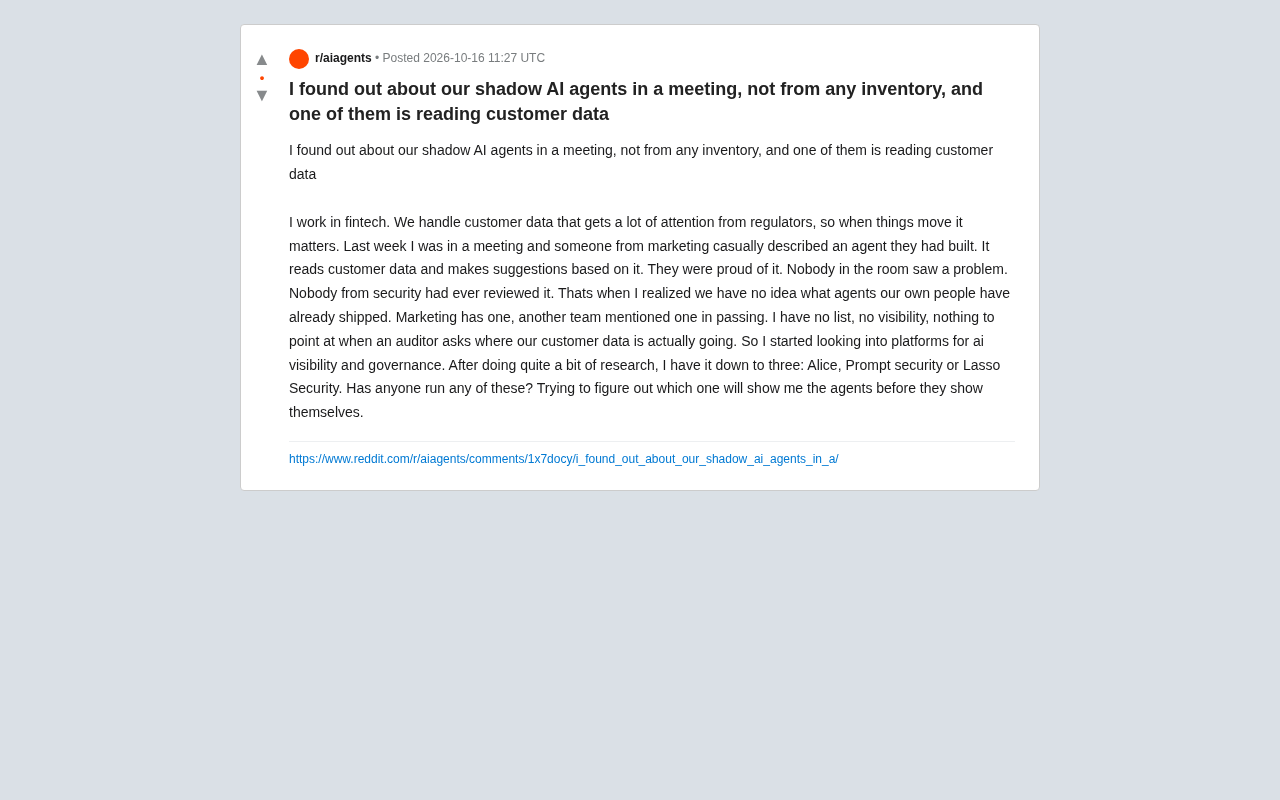
A practitioner working at a fintech company posted on Reddit about something that would send chills down the spine of any security and compliance team: he discovered that multiple unknown "shadow AI Agents" were already running inside the company, and one of them was reading customer data — and all of this came to light when the marketing team casually mentioned it during an ordinary meeting.
How the Shadow Agent Was Discovered
The poster's fintech company handles large volumes of regulated customer data, so any change involving data flows is particularly sensitive. Yet during a cross-departmental meeting, a member of the marketing team proactively described an Agent they had built: it could read customer data and generate recommendations based on that data. The tone was full of pride, and no one in the room thought anything was wrong with it.
What truly alarmed him was this: the security team had never reviewed this Agent. He didn't even know how many similar Agents were running inside the company. Marketing had one, and another team had casually mentioned one too. He had no inventory, no visualization dashboard, and when auditors asked "where exactly is customer data flowing," he had nothing to show them.
This scenario is not rare. When the barrier to entry for LLMs and Agent frameworks drops to the point where "a business person can build a working tool in a few days," IT and security approval processes are often bypassed. Agents don't show up in procurement lists the way traditional SaaS applications do — they're more like weeds planted by business teams themselves, growing outside the view of formal governance.
What is an AI Agent? Unlike traditional scripts or automation tools, an AI Agent typically uses a large language model (LLM) as its core reasoning engine, capable of autonomously planning steps toward a goal, calling external tools (such as database queries, API calls, file reads and writes), and dynamically adjusting its behavior across multiple rounds of interaction. This means an Agent can not only passively execute preset instructions but also actively decide "what to do next" and "which data to access." It is precisely this autonomy that, while bringing efficiency gains, also introduces risks that traditional security models struggle to cover: its data access paths are not hard-coded in advance but generated at runtime by model reasoning, making them difficult to audit or restrict with static rules. Moreover, Agents often define task boundaries through natural language prompts, and the prompts themselves can be modified, injected, or abused, further blurring the boundaries of behavior. For a fintech company, an Agent that can read customer data is effectively a "digital employee" with dynamic permissions — yet its permissions were never formally granted through any process.
Why Shadow Agents Are Especially Dangerous in Financial Scenarios
Fintech companies face very real regulatory pressure. Every flow of customer data, every accessor, every purpose should in theory have records, approvals, and boundaries. Traditional data governance systems are built on the "application-database-permission" model, while Agents are characterized by:
- Non-standardized access paths: Agents may connect directly to data sources via APIs, bypassing regular data access audit layers
- Distributed deployment locations: They may run on cloud functions, local scripts, third-party Agent platforms, or even under personal accounts
- Unpredictable behavior: LLM outputs are non-deterministic — the same input may trigger different data calls
- Short and hidden lifecycles: Business teams spin one up temporarily and abandon it when done, leaving security teams no time to discover it
What the poster worries about is not just "having no inventory" but that when regulators or auditors come asking, he cannot answer the most basic question: where is our customer data right now, and who is reading it in what way.
Why does the traditional data governance model fail? Traditional data governance is built on a three-layer "application-database-permission" model: applications are fixed software entities with clear owners; database access is controlled through unified accounts and permission systems; and all data operations leave traces in database audit logs. However, AI Agents break all three premises. First, an Agent may not be an "application" but a piece of code running on a personal laptop, a cloud function, or a third-party platform, with no formal application registration process. Second, an Agent may use personal API keys or service accounts to connect directly to data sources, bypassing the unified permission gateway. Finally, an Agent's query behavior is dynamically generated by an LLM and may not appear in standard SQL audit logs, or may mask bulk reads of sensitive data behind seemingly normal query patterns. As a result, traditional governance tools cannot answer the basic question of "who is reading customer data and through what means" — which is exactly what auditors care about most.
Candidate Governance Platforms: Alice, Prompt Security, and Lasso Security
After realizing the severity of the problem, the poster began researching AI visibility and governance platforms and has narrowed it down to three candidates: Alice, Prompt Security, and Lasso Security. His goal is clear — find the shadow Agents before they expose themselves.
These three platforms represent several typical approaches in the current AI governance landscape. One category focuses on AI asset discovery and inventory management (AI visibility), helping enterprises map out exactly which AI applications and Agents are running internally; another leans more toward runtime protection, focusing on real-time risks such as prompt injection, data leakage, and model abuse. The poster clearly cares more about the former: he wants a map, not an alarm.
However, he didn't reveal his final choice in the post, instead throwing the question to the community: "Has anyone used these platforms?" This shows that even security practitioners who proactively start solving the problem still lack sufficient first-hand experience when it comes to tool selection.
The difference between AI visibility and runtime protection. The core capability of AI visibility platforms is discovering and inventorying AI assets within an enterprise: including directly called LLM APIs, AI features embedded in business systems, and Agents and automation workflows built by employees on their own. These tools typically build a dynamically updated AI asset inventory by scanning network traffic, integrating with cloud service interfaces, and analyzing identity and access management logs. Runtime protection platforms, on the other hand, focus on real-time risks during Agent execution — such as detecting and blocking prompt injection attacks, preventing sensitive data leakage through model outputs, and limiting the scope of external tools that models can call. The key difference is: visibility solves the problem of "I don't know what exists," while protection solves the problem of "I see it but can't stop it in time." In the poster's scenario, since he doesn't even know the number or location of Agents, a visibility platform is the more urgent first step.
The Structural Governance Gap This Case Exposes
Several layers of meaning can be read from this Reddit post.
First, the "ownerlessness" of Agents is becoming the default state. When the cost of building an Agent is low enough for business staff to do it independently, and the security team's involvement process is slow and heavy, bypassing approval becomes the rational choice. The problem isn't that employees don't follow the rules — it's that governance mechanisms haven't kept pace with the speed of tool adoption.
Second, the lack of AI asset inventories is more widespread than imagined. The poster mentioned "no inventory, no visibility," which would be unacceptable in traditional IT asset management but is the norm in the AI Agent space. Traditional CMDBs and SaaS management platforms struggle to cover these new types of assets.
Third, compliance pressure will force tool adoption. In heavily regulated industries like fintech, once auditors start asking about AI Agents' data access records, enterprises will have no choice but to passively procure governance tools. The poster's research behavior itself is a manifestation of this pressure.
Why can't CMDBs and SaaS management platforms cover Agents? Traditional IT asset management relies on Configuration Management Databases (CMDBs) and SaaS management platforms (such as Zylo, Productiv) to track software assets within an enterprise. CMDBs are typically integrated with procurement systems, deployment pipelines, and endpoint management agents, and can discover installed software and registered services. However, AI Agents often lack these characteristics: they may exist as a Python script running in an employee's local environment or a temporary cloud instance, or they may call third-party Agent platforms through personal accounts without going through the enterprise's single sign-on and procurement processes. SaaS management platforms mainly identify cloud applications authorized through OAuth, whereas many Agents use API keys instead of OAuth and may call model provider interfaces directly. As a result, these two types of tools are almost blind to Agents, and enterprises need dedicated AI asset discovery tools to fill this gap.
Takeaways for Practitioners
If you're dealing with similar issues, this case offers some actionable directions.
Start by building a "known Agent inventory," even if it begins with a cross-departmental inquiry. The poster's experience shows that information about many Agents' existence is scattered in the daily conversations of business teams — proactively asking is faster than waiting for a security scan to find them.
Second, when selecting an AI governance platform, first clarify whether you're solving "discovery" or "protection." These two types of needs correspond to very different product capabilities, and evaluating them together easily leads to loss of focus. The poster narrowed his scope to visibility and governance, which is a clear direction.
Finally, don't treat governance as a solo performance by the security team. The marketing team didn't have malicious intent when building their Agent — they just didn't know it required approval. Clarifying boundaries is more useful than assigning blame after the fact.
The last line of the original post is very telling: "Want to figure out which platform can find the Agents before they expose themselves." This is probably the shared sentiment of many security practitioners today.
One-line Summary
A fintech security team discovered multiple shadow AI Agents reading customer data, exposing a structural gap in AI governance.
Paragraph Summary
A security practitioner at a fintech company shared on Reddit that he accidentally discovered during a meeting that an AI Agent built by the marketing team was reading customer data, while the security team knew nothing about it. Multiple similar shadow Agents existed inside the company, with no asset inventory and no visualization tools, leaving him unable to answer auditors' questions about data flows. The article analyzes why Agents' non-standardized access, distributed deployment, and hidden lifecycles render traditional data governance models ineffective, and points out that in heavily regulated industries, compliance pressure will force enterprises to procure AI visibility tools. The poster is evaluating three platforms — Alice, Prompt Security, and Lasso Security — but has not yet made a choice.
Related articles

Chain of Thought Isn't Just for AI: How Humans Can Use CoT to Improve Thinking Quality
Chain of Thought isn't just a prompt trick for large models. Starting from a Hacker News discussion, this article analyzes why CoT works for human thinking too, breaks down actionable ways to transfer it, and highlights the key differences between human CoT and machine CoT.
Cloudflare Teams Up with OpenAI: Closi…
Cloudflare Teams Up with OpenAI: Closing the Loop from Vulnerability Discovery to Defense with AI
Cloudflare uses OpenAI Daybreak to investigate security vulnerabilities and generate reviewable remediation plans, while developers use Codex to boost coding efficiency and quality.

Orca Multi-Agent Orchestration in Practice: A Guide to Parallel Collaboration with Claude and Codex
Orca is Stable AI's free open-source agent workbench supporting 34 agents like Claude Code and Codex in parallel. Learn its Git worktree isolation, multi-model orchestration, and mobile management.