shim-cli: A Privacy Guardrail for AI Coding Agents

shim-cli uses open-source hooks and a local proxy to make AI coding agents' data flows auditable and maskable.
shim-cli is an open-source privacy tool for AI coding agents that intercepts data before it leaves the machine via hooks and a local proxy. In Claude Code, it masks secrets and personal data before the model reads tool results, and shim watch provides session-level auditing of sent content and token costs. It covers Claude Code, Codex, Copilot CLI, and VS Code, emphasizes no account and no telemetry, and ranked 3rd on Product Hunt on launch day. The article also notes limitations: masking relies on pattern matching, with risks of false positives and misses, and integration depth on non-Claude Code platforms remains to be verified.
AI coding agents are becoming developers' everyday companions, but the data flowing between them and external services often resembles a black box. An open-source tool called shim-cli aims to open up that black box—letting developers see exactly what agents are sending, while blocking sensitive information before the model ever reads it.
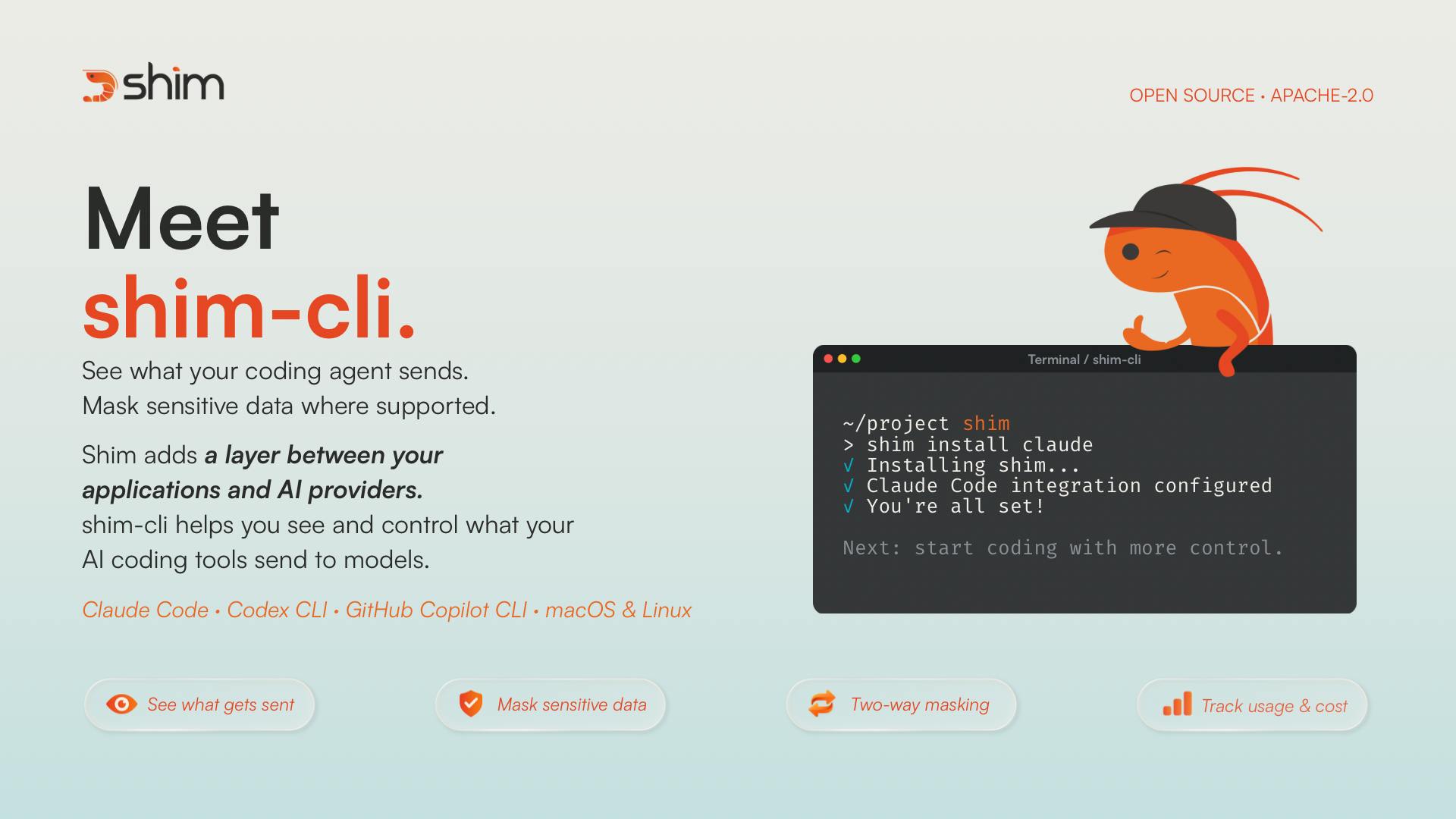
The Black Box Dilemma: How Much of Your Secrets Do Agents See
When developers ask Claude Code or GitHub Copilot CLI to help debug, the agent sends tool execution results (file contents, terminal output, environment variables) back to the model. The problem is that these results may contain API keys, database passwords, and personally identifiable information. Most tools don't do fine-grained filtering by default, and developers have no way of knowing what a given session actually sent out.
shim-cli targets exactly this blind spot. It provides open-source hooks and a local proxy that intercept data before it leaves the machine. The official tagline is blunt: see what agents send, mask what you can.
Two Core Actions: Masking and Auditing
Redacting Tool Results in Claude Code
shim-cli acts as a hook within Claude Code, masking matching secrets and personal data in tool execution results before the model reads them. This means the model can still reason from context, but the original sensitive values never enter the LLM's context window. For developers who frequently run commands and read logs in the terminal, this layer of protection reduces the risk of "accidentally pasting a key into the conversation."
The hook mechanism is an extension point offered by Claude Code: custom scripts are inserted at specific points in the tool-call lifecycle (such as before tool execution, after execution, and before the model reads results), thereby altering or intercepting the data flow. shim-cli leverages this mechanism to complete masking before tool results are returned to the model. Compared with modifying the agent's source code or building a standalone gateway, the hook approach is less invasive and easier to maintain as the host version upgrades. However, the scope of what a hook can do is limited by the granularity of the interfaces the host exposes. If the host doesn't provide an interception point before reading, external tools can often only perform after-the-fact auditing—which also explains why support depth differs across platforms.
Pattern-matching redaction typically relies on regular expressions or predefined rule sets to identify sensitive information, such as common API key prefixes, private key file headers, ID numbers, and email formats. Its advantages are that it requires no semantic understanding and is simple to deploy; its drawbacks are limited recognition of format variants, custom key naming, and high-entropy random strings, plus a tendency to misclassify sample code or test data as real secrets. More mature implementations combine entropy detection, contextual keywords, and configurable whitelists, and output hit logs for manual review—directly related to the need for adjustable rule sets mentioned in this article.
shim watch: See What a Session Sent and What It Cost
Another component, shim watch, provides a session-level audit view showing what content a session sent to the model and how much it cost. For scenarios billed by token or where teams need to justify AI usage costs, this transparency is the foundation for procurement decisions and cost control.
Telemetry refers to usage data that software automatically reports during operation, which may include call counts, error information, or even parts of request content. For developer tools, telemetry is an important means of improving products, but in scenarios involving code and keys, it can also become a leakage channel. shim-cli explicitly states that it collects no telemetry and requires no account registration, meaning its audit data is stored only locally and enterprises can review its network behavior themselves. When evaluating such tools, it's advisable to verify the "zero telemetry" claim with actual packet captures or firewall logs rather than relying solely on the product page description.
Covering Mainstream Agents, Emphasizing Zero Account and Zero Telemetry
shim-cli claims support for Claude Code, Codex, Copilot CLI, and VS Code, essentially covering the current mainstream AI coding entry points. On privacy posture, it explicitly states that no account registration is required and no telemetry data is collected—for enterprise developers concerned about code leaks, these two points are more convincing than the number of features.
The project is released as open source, hosted on GitHub, and launched on Product Hunt under the Open Source, Privacy, and Developer Tools categories, receiving 104 votes and 9 comments, ranking 3rd for the day. For a privacy tool aimed at developers, this level of attention shows the pain point is real.
Limitations Worth Noting
Masking rules rely on pattern matching, so both false positives and misses can occur: over-masking can cause the model to lose critical context, while under-configuration lets sensitive information leak as before. Whether the product can offer adjustable rule sets and clear hit logs determines its usability in real projects.
Moreover, the value of such tools depends heavily on the depth of integration with the host agent. Whether support for Codex and Copilot CLI beyond Claude Code also achieves "masking before reading," or merely stays at the observation level, requires developers to verify themselves.
The context window is the total number of tokens a model can read in a single inference, shared among tool execution results, conversation history, and system prompts. Although masking sensitive values protects privacy, the replacement placeholders also consume tokens, and over-masking may remove clues the model needs to complete the task, causing the agent to retry repeatedly and increasing costs. Therefore, when configuring rules, you need to balance privacy protection against task success rate, and observe changes in session cost before and after masking via shim watch to form a quantifiable basis for tuning.
Conclusion
shim-cli turns the data flow of AI coding agents from invisible into something auditable and intervenable. It isn't meant to stop agents from working, but to let developers hand over data with informed consent. For teams in regulated industries or handling sensitive codebases, this kind of local-first, open-source, verifiable tool is worth adding to the toolbox for an evaluation.
Related articles

DeepCell: One-Click AI Generation of Documents, Spreadsheets, and Slides
DeepCell tops Product Hunt with one-click generation of documents, spreadsheets, and slides, using the .deepcell format for linked updates, designed for System 2 tasks like modeling and sales reviews.

Doneas: 15-Minute Daily Accountability Calls That Keep Indie Developers From Procrastinating
Doneas is a daily accountability tool for indie developers: plan tasks on Monday, join a 15-minute call with five builders each day, and log deliveries on a public progress page. This article analyzes its core mechanics, effectiveness, and potential issues around retention and matching.

Fastlane 2.0: Fully Automated AI Ad Campaigns, From Creative to Optimization
Fastlane 2.0 is an AI ad automation tool: enter your website and it learns your brand, generates video and image ads, and runs and optimizes them on Meta, TikTok, Instagram, and YouTube.