ShipHappens: A Native Mac Tool Reimagining App Store ASO Optimization

ShipHappens is a native Mac ASO workbench combining keyword optimization, AI screenshots, localization, and review management.
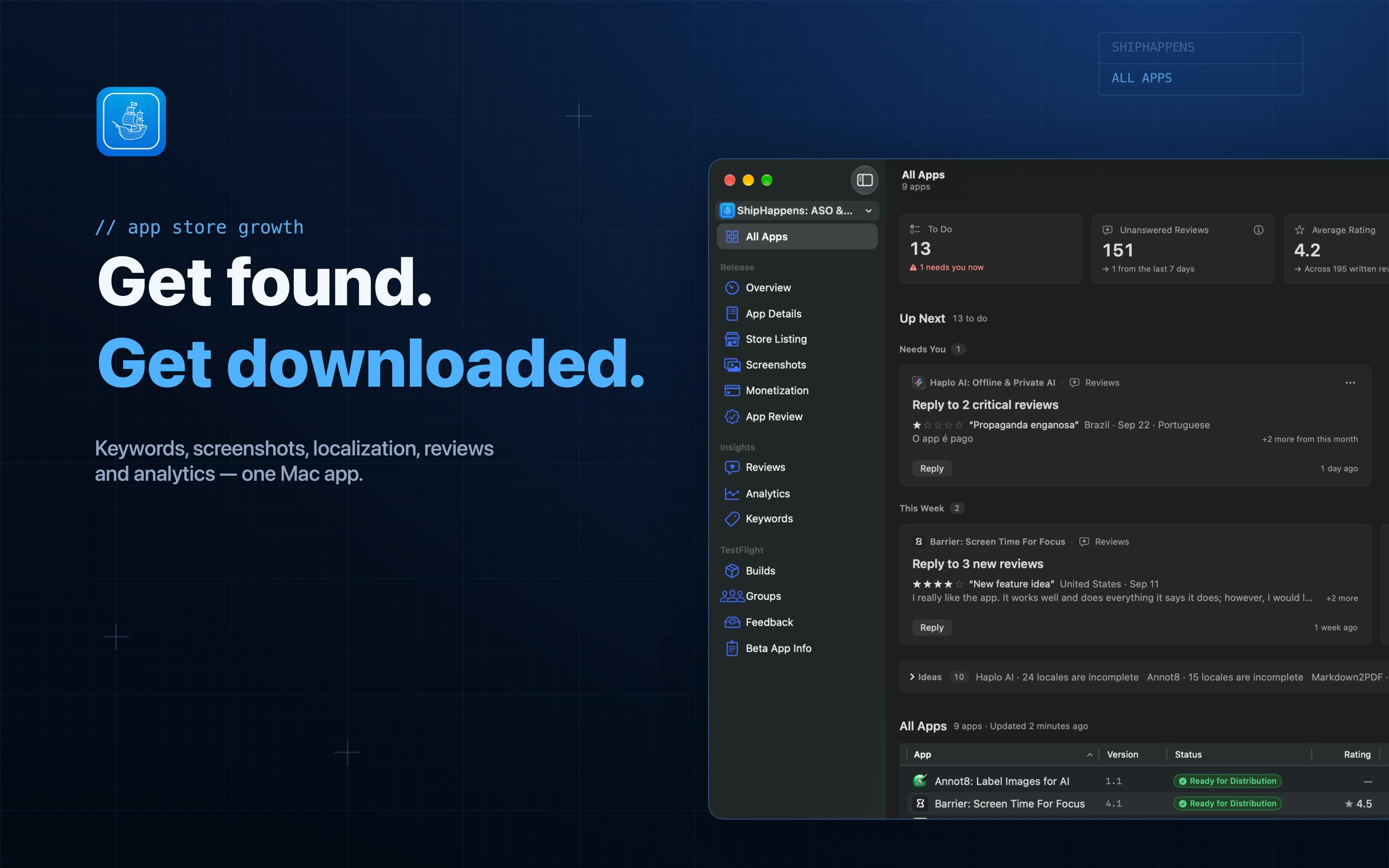
ShipHappens is a native Mac app built by indie developer JC to address the frustrating experience of App Store Connect. It consolidates ASO keyword optimization, AI screenshot generation, one-click localization into 39 languages, product page A/B testing, and multilingual review replies into a single interface. Its core advantage is pulling directly from Apple's official search popularity data rather than third-party estimates. Credentials are stored locally in Keychain, and AI providers are fully user-selectable — even supporting local models. The app debuted at #16 on Product Hunt and targets iOS indie developers and small teams pursuing international growth.
Apple's App Store Connect is slow, cluttered, and buries the features that actually drive downloads deep within layers of menus. Developer JC built ShipHappens to tackle this problem head-on — it's a native Mac app that consolidates keyword optimization (ASO), screenshot creation, multilingual localization, and review management into a single, efficient workspace.
Why App Store Connect Frustrates Developers
For indie developers and small teams, the real challenge begins after an app ships. App Store search rankings depend heavily on keyword optimization, yet Apple's official backend has long drawn criticism: slow load times, fragmented workflows, and the settings that actually drive organic downloads scattered across disconnected pages.
ShipHappens is designed to fill that gap. Rather than replacing App Store Connect, it provides a faster, more focused interface on top of it — reorganizing high-frequency ASO tasks into a coherent workflow. According to its Product Hunt listing, the tool reached #16 on launch day with 72 upvotes, signaling genuine demand among developers for this kind of productivity tool.
Core Features Breakdown
Keyword Selection Powered by Apple's Official Data
One of ShipHappens' most valuable capabilities is using Apple's own search popularity data to inform keyword decisions. Many ASO tools on the market rely on third-party search volume estimates, which carry significant margin of error. Connecting directly to Apple's native data means keyword strategy can align more closely with real search behavior, reducing the guesswork.
App Store Optimization (ASO) is essentially mobile SEO. The core logic: fill your app name, subtitle, and 100-character keyword field with high-volume, moderate-competition terms to rank higher in relevant search results. Apple provides developers with Search Ads, where the "Search Popularity" metric scores keywords on a scale of 5–100, reflecting their relative search frequency within the App Store — the closest thing to first-party data available. Third-party ASO tools like AppFollow and Sensor Tower typically reverse-engineer search volume by tracking ranking changes, which is inherently an estimate with some degree of inaccuracy. ShipHappens pulls directly from Apple's official data, meaning the popularity scores developers see align with the actual signals inside Apple's system — enabling more accurate judgments about which keywords are worth targeting.
AI Screenshot Creation and 39-Language Localization
App Store screenshots are a major conversion factor, but designing and adapting multiple screenshot sets is time-consuming. ShipHappens includes built-in AI screenshot generation to help developers quickly produce compliant, polished visuals.
Even more practical is the one-click translation of app listings into 39 languages. For developers aiming to reach global markets, manually localizing App Store copy language by language is an enormous undertaking. Bulk translation significantly lowers the barrier to going international.
A/B Testing and Multilingual Review Replies
The tool also supports A/B testing of product pages, letting developers use data — not gut instinct — to determine which screenshots or copy perform better. On the review management side, ShipHappens allows replies to user feedback in any language, which is essential for maintaining relationships with users across multiple countries.
Additionally, it offers a unified feed spanning all your apps, aggregating status across products and surfacing what to optimize next — eliminating the need to context-switch between multiple apps to track down issues.
Apple officially introduced Product Page Optimization in App Store Connect in 2021, allowing developers to create up to three treatment variants for icons, screenshots, and promotional text, then measure which version drives higher conversion rates (the ratio of page views to actual downloads) through traffic allocation. This native A/B testing mechanism draws on Apple's internal data, making results relatively trustworthy — but the workflow inside App Store Connect is cumbersome. ShipHappens essentially wraps this process so developers can launch and track tests without digging through the backend, lowering the operational barrier to using this official feature.
Privacy-First Design and AI Flexibility
ShipHappens' approach to data security is worth noting: user credentials are stored in the system Keychain rather than uploaded to third-party servers. This is a meaningful advantage for privacy-conscious developers.
On the AI side, it avoids locking you into a single vendor — developers can bring your own AI provider, or even run local models. This open architecture eliminates vendor lock-in and gives cost-sensitive or compliance-driven teams significantly more flexibility.
macOS Keychain is Apple's built-in encrypted credential storage service, using AES-256 encryption with access permissions tied to the user's system login credentials. Apps cannot read credentials stored by other apps without the user's knowledge. For an ASO tool, the sensitive credentials typically involved include App Store Connect API keys (for fetching search popularity data and submitting metadata) and AI service access tokens. Keeping this information in the local Keychain rather than syncing it to the tool vendor's cloud means that even if ShipHappens' servers were ever compromised, developer credentials would remain unexposed. The "bring your own AI provider" design further ensures that sensitive content like app copy doesn't pass through ShipHappens' own intermediate layer, creating cleaner privacy boundaries.
Who It's Built For
ShipHappens has a clear target audience: iOS indie developers, small studios that frequently do ASO work, and teams looking to bring their apps to international markets. As a native Mac app, it generally outperforms web-based tools in responsiveness and system integration.
From a product logic standpoint, it consolidates ASO work — which is typically fragmented across multiple tools — into a single desktop application. This "unified workbench" approach is very much in line with the prevailing trend in developer tooling. That said, as a newly launched product, its data accuracy, AI generation quality, and long-term stability still need to be validated through real-world use. There are currently no user reviews on Product Hunt, so hands-on feedback remains limited.
Summary
ShipHappens addresses a real, high-frequency pain point: the inefficiency of App Store optimization workflows. By integrating Apple's official data, AI-generated screenshots, multilingual localization, and a privacy-first architecture, it gives indie developers a smoother ASO workflow. For anyone frustrated with the App Store Connect experience, this is a tool worth watching.
Related articles

Chain of Thought Isn't Just for AI: How Humans Can Use CoT to Improve Thinking Quality
Chain of Thought isn't just a prompt trick for large models. Starting from a Hacker News discussion, this article analyzes why CoT works for human thinking too, breaks down actionable ways to transfer it, and highlights the key differences between human CoT and machine CoT.
Cloudflare Teams Up with OpenAI: Closi…
Cloudflare Teams Up with OpenAI: Closing the Loop from Vulnerability Discovery to Defense with AI
Cloudflare uses OpenAI Daybreak to investigate security vulnerabilities and generate reviewable remediation plans, while developers use Codex to boost coding efficiency and quality.

Orca Multi-Agent Orchestration in Practice: A Guide to Parallel Collaboration with Claude and Codex
Orca is Stable AI's free open-source agent workbench supporting 34 agents like Claude Code and Codex in parallel. Learn its Git worktree isolation, multi-model orchestration, and mobile management.