ShipWithMuse: A Curated Directory of 1,000+ Real Muse Builds

ShipWithMuse is a curated directory of 1,000+ real Muse builds to help developers discover ecosystem practices.
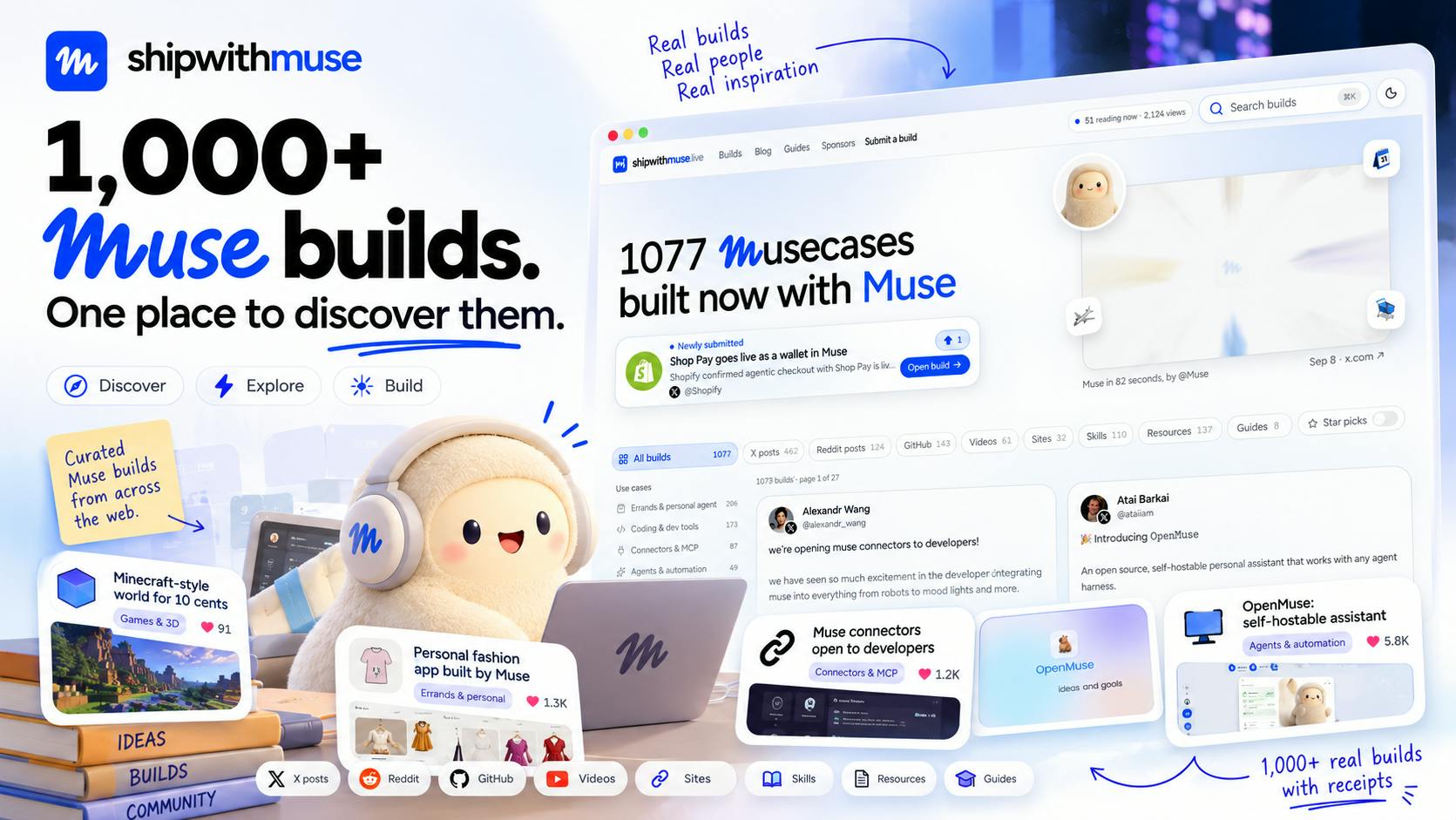
ShipWithMuse, built by Mohith Kumar, is a curated catalog aggregating real builds from the Muse platform — covering tools, connectors, skills, and use cases across 1,000+ entries. It tackles the fragmented discovery problem common in AI tool ecosystems by offering a unified interface filterable by category, source, and build type, with every entry linking back to its original source. Currently live on Product Hunt in its early stage, it primarily serves developers, productivity explorers, and ecosystem observers. Its long-term value depends on coverage breadth, update frequency, and ongoing community participation.
What Is ShipWithMuse
ShipWithMuse is a curated catalog focused on the Muse ecosystem, featuring over 1,000 real-world Muse builds — including experiments, tools, connectors, skills, and a wide range of use cases. Its core value isn't in creating content itself, but in systematically aggregating Muse projects scattered across the internet, so users can quickly discover what others are building with Muse.
The product was built by Mohith Kumar and has launched on Product Hunt, where it's listed under three categories: Productivity, Developer Tools, and Artificial Intelligence. At the time of writing, it had received 9 upvotes and 4 comments, ranking 18th.
Muse is an AI-native creation and collaboration tool from Anthropic, designed to embed large language model capabilities into real-world workflows. It lets users invoke external services via natural language (called "connectors") and encapsulate reusable action flows (called "skills"), making it accessible even to non-technical users who want to build personalized AI-assisted workspaces. This low barrier to entry has led to a large and diverse collection of community builds — which is exactly why a curated directory like ShipWithMuse makes sense. When a platform's ecosystem is active but fragmented, aggregation and discovery tools become genuinely valuable.
Core Features: A Multi-Dimensional Build Directory
ShipWithMuse's most practical strength lies in how it lets you search and browse. Instead of hunting through social media, code repositories, and video platforms, users can filter across multiple dimensions from a single, unified entry point:
- By category: Builds are organized into functional categories, making it easy to find what fits your use case.
- By source: Filter by where content originated — original posts, repositories, videos, or standalone websites.
- By build type: Whether you're looking for ready-to-use tools, connectors, or reusable skill modules, you can pinpoint exactly what you need.
Every directory entry links back to its original source — the original post, repo, video, or site. This "don't break the information chain" design means ShipWithMuse functions more like a navigation layer: it respects original creators while giving interested users a direct path to primary sources.
A curated catalog is fundamentally different from a typical user-submitted aggregation platform. Standard aggregators rely on users to submit content themselves, leading to highly variable quality. A curated catalog implies some level of manual or semi-automated vetting — ensuring that entries are real, complete, and accurately categorized. The upside is a better signal-to-noise ratio; users don't need to sift through low-quality content on their own. The tradeoff is higher maintenance costs and slower expansion. With 1,000+ entries as a starting point, whether ShipWithMuse can maintain its curation quality over time is the key variable determining whether its model is sustainable.
Why Directories Like This Matter
Ecosystems that form around AI tools often grow quickly, but the practical examples tend to be highly scattered. When developers want to learn from what others have done, it's hard to know whether someone has already tackled a given idea, how well it works, and where to get started.
ShipWithMuse addresses exactly this discovery cost problem. By curating 1,000+ real-world examples, it transforms fragmented community knowledge into a searchable, categorized knowledge base. For teams assessing the boundaries of what Muse can do, independent developers looking for inspiration, or users hoping to reuse existing connectors and skills, this kind of aggregation can significantly shorten the path from idea to implementation.
The success of this type of product depends heavily on breadth of coverage and update frequency. A starting scale of 1,000+ entries is a solid foundation, but the long-term value of an ecosystem directory needs to be sustained through ongoing maintenance and community contribution.
Who Is It For
Based on its positioning, ShipWithMuse is primarily aimed at three audiences:
- Developers: Looking for ready-to-use tools, connectors, and skills, or researching how others have approached technical implementations.
- Productivity and workflow explorers: Wanting to understand how Muse is being used in real workflows and find transferable use cases.
- Ecosystem observers: Hoping to get a quick read on what's happening in an AI tool community and which build directions are most active.
Summary
ShipWithMuse has a clear thesis — rather than becoming yet another build tool, it aims to be a map of what's being built. In a landscape where AI tools multiply rapidly and practical examples accumulate just as fast, products that structure community knowledge into something searchable and navigable have real-world value. It's still in its early stages, with modest upvote and comment numbers, and whether it can become the authoritative index for the Muse ecosystem will depend on directory quality, update cadence, and sustained community participation.
Related articles

Understanding DeepSeek in 3 Minutes: The Rise from a Quant Hedge Fund to an Open-Source AI Leader
DeepSeek's history in 3 minutes: from High-Flyer Quant's compute build-up to V2's MLA inference cost cuts, V3's $5.576M training bill, R1's open-source global shock, and V4 with a $7B Series A.

Local Creative Writing Model Showdown: Fine-tuned Qwen3.8 27B Wins, DeepSeek v4.1 Underwhelms
Bilibili creator tests seven local creative writing models: Hemingway and HumanLike Chat based on Qwen3.8 27B perform best, DeepSeek v4.1 is plain, Dongfang Shuo ranks last with confused characters. Includes three test prompts, scores, and usage advice.

Liang Wenfeng's Three Big Bets: Why Did DeepSeek Open-Source Its 82% Gross Margin?
Why did DeepSeek open-source DeepInfer, its 82% gross margin inference framework, and then launch a hundred-billion funding round? An analysis of Liang Wenfeng's three big bets and the open-source strategy.