Shopify: AI Search Is Driving Incremental Traffic, Not Replacing Google
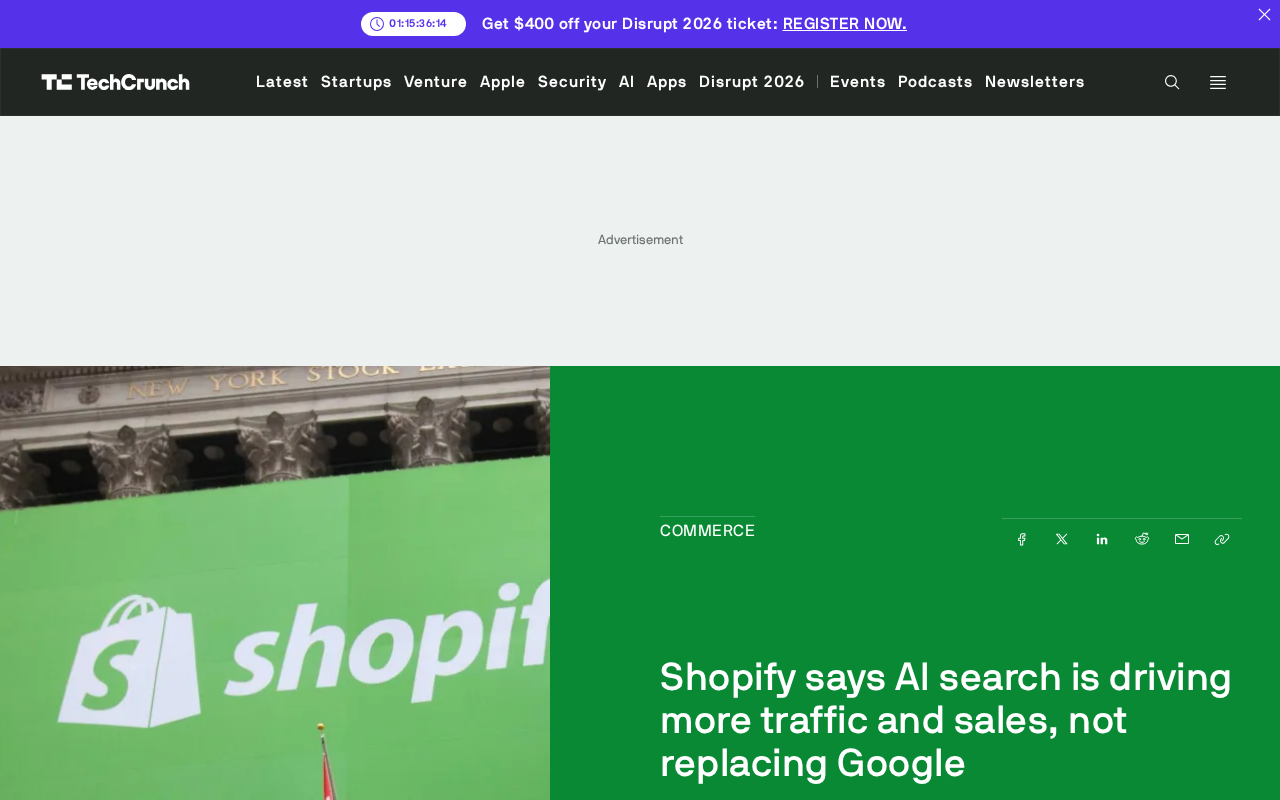
Shopify finds AI search adds new e-commerce traffic rather than cannibalizing Google search.
Shopify reports that AI search tools like ChatGPT and Perplexity are generating incremental traffic for e-commerce merchants rather than replacing Google. AI search fills the top of the marketing funnel with discovery shopping, while traditional search remains strong for high-intent purchases. Merchants should embrace GEO (Generative Engine Optimization) and structured content, though attribution challenges and platform disintermediation risks warrant caution.
AI Search Is Becoming a New Traffic Channel for E-Commerce
As generative AI search tools like ChatGPT, Perplexity, and Google AI Overviews become mainstream, one of the biggest questions in e-commerce is: Will AI search upend the traditional search engine traffic landscape and cut off the valuable customer flow that Google delivers to merchants?
These three tools represent three distinct approaches to AI-powered search. ChatGPT, built on a large language model (LLM), enables real-time information retrieval through plugins and web browsing capabilities. Perplexity was designed from the start as an "answer engine," deeply integrating traditional search indexing with LLM reasoning to crawl the web in real time and generate structured, citation-backed responses for every query. Google AI Overviews (formerly SGE, Search Generative Experience) is Google's attempt to embed generative AI directly at the top of search results pages, using the Gemini model to synthesize and summarize search results. What they all share in common is a fundamental shift in how users access information — from "browsing ten blue links" to "getting a comprehensive answer directly." This paradigm shift is precisely why the e-commerce industry is watching so closely.
E-commerce giant Shopify has offered a relatively optimistic take. According to Shopify's observations, AI search is currently playing the role of incremental traffic — bringing merchants additional visits and sales conversions rather than simply displacing Google search. For the millions of independent store owners who rely on search traffic, this assessment is a signal worth paying attention to.
As one of the world's largest e-commerce SaaS platforms, Shopify serves millions of merchants globally as of 2024, providing all-in-one services including store building, payments, logistics, and marketing. Its merchants' total gross merchandise volume (GMV) has surpassed $200 billion. Unlike Amazon and other marketplace models, Shopify merchants operate independent brand stores (DTC, Direct-to-Consumer), meaning they don't rely on an internal platform traffic pool. Instead, they must acquire traffic from external channels — especially Google search, social media, and paid advertising. Any shift in the search ecosystem therefore directly impacts these merchants' customer acquisition costs and sales performance, making Shopify's assessment of AI search trends a bellwether for the industry.
Why AI Search Is "Incremental" Rather Than "Replacement"
Layered User Search Intent
AI search and traditional search serve inherently different use cases. Traditional keyword search typically reflects users who already know exactly what they're looking for, while generative AI search excels at handling exploratory, comparative, and consultative complex queries.
For example, a user might ask an AI, "What are some affordable moisturizers recommended for sensitive skin?" The AI will synthesize information from multiple sources into a structured answer, complete with product links. This kind of "discovery shopping" — which might never have happened otherwise — is precisely the new traffic source that AI search creates.
To understand this, it helps to revisit the classic "funnel model" in search marketing. This model divides the user's purchase journey into several stages: at the very top is the "awareness/discovery" stage, where users have unclear needs and are in exploration mode; the middle is the "consideration/comparison" stage, where users begin narrowing their options; and the bottom is the "decision/purchase" stage, where users have clear buying intent. Traditional search engines perform strongly in the middle and lower funnel, since users typically search with specific keywords. "Discovery Shopping" refers to the process where users discover new products through browsing, recommendations, or conversational interactions without a specific purchase goal — social commerce (such as TikTok Shop and Instagram Shopping) has long validated the commercial value of this model, and AI search's conversational interface further lowers the barrier for discovery shopping. AI search is filling the gap at the top of the traditional search funnel, rather than cannibalizing existing conversion traffic at the bottom.
Two Channels Coexisting in Parallel
Shopify's perspective implies a key trend: AI search and Google search are, at the current stage, more of a parallel coexistence. After users complete initial information gathering and brand awareness through AI tools, they often still return to Google or visit merchant websites directly to make their final decisions and purchases.
This means merchants aren't facing a "zero-sum game" but rather a multi-channel ecosystem where traffic entry points keep expanding. For merchants who position themselves strategically, this is a window of opportunity to capture the early-mover advantage of a new channel.
What This Means for E-Commerce Merchants
Content and Structured Data Become More Important
When generating shopping recommendations, generative AI heavily relies on a webpage's structured data, clear product descriptions, and authoritative content signals. This means merchants need to rethink their SEO strategy — moving beyond simply optimizing keyword rankings to ensuring AI can accurately "understand" and "cite" their product information.
In other words, future search optimization must cater not only to Google's crawlers but also to the comprehension logic of AI models — a practice the industry has begun calling "GEO" (Generative Engine Optimization).
GEO was formally introduced as a concept in 2024 by researchers from Princeton University, Georgia Institute of Technology, and other institutions in an academic paper. Unlike traditional SEO, which primarily focuses on search engine results page (SERP) rankings, GEO's core objective is to increase the probability that content gets cited and recommended in AI-generated responses. Research shows several key strategies are particularly effective for GEO: adding authoritative citations and statistical data can boost citation probability by approximately 30-40%; using clear structured markup (such as Schema.org's Product, Review, and other tags) helps AI models accurately extract product attributes; and content expertise, experience, and trustworthiness (the elements emphasized by Google's E-E-A-T framework) are also important signals AI models use to assess information quality. For e-commerce merchants, GEO means product pages can no longer be mere keyword-stuffed content — they need to become structured information sources that AI can "understand" and "trust."
Platform-Level Infrastructure Support
As an e-commerce infrastructure provider, the stance of platforms like Shopify is also crucial. When platforms proactively optimize product data discoverability and establish data integrations with AI search tools, merchants can more seamlessly tap into this emerging channel. This is also the business logic behind Shopify's eagerness to highlight the positive value of AI search — helping merchants capture new traffic is, in itself, the platform's core value proposition.
Maintaining a Cautious Perspective
Interestingly, as a stakeholder, Shopify's messaging naturally carries an optimistic bias. The long-term impact of AI search on e-commerce traffic is still in its early observation phase, with several uncertainties:
-
Attribution challenges: Traffic from AI search is often difficult to track precisely, making it hard for merchants to quantify its true contribution. Specifically, merchants have traditionally used UTM parameters, Google Analytics source/medium tags, and cookie tracking to determine which channel drove each order. But AI search has created new attribution blind spots — many AI tools don't attach standard referrer information when recommending product links, causing this traffic to be categorized as "Direct Traffic" in analytics tools. Users may also develop brand awareness through AI conversations but complete purchases through other channels (such as typing in the URL directly or searching for the brand name), and this kind of cross-channel indirect influence is nearly impossible for existing attribution models to capture. These technical hurdles make it difficult for merchants to accurately assess the true ROI of AI search.
-
Platform control: If AI search tools choose to close the transaction loop directly within their conversational interfaces, merchants could actually face the risk of being "disintermediated." A "closed transaction loop" means the entire process — from search and discovery to decision-making and payment — is completed within a single platform, with no need to redirect to an external website. This model is already well-established in China's internet ecosystem, with WeChat Mini Programs and Douyin (TikTok) Shops being prime examples. In the AI search space, similar trends are already emerging: ChatGPT launched shopping features in 2024 that display product cards and purchase buttons directly in the chat interface, and Perplexity has been testing a "Buy with Pro" feature. If this trend continues, AI search tools could evolve from "traffic distributors" into "transaction platforms." Merchants would still get sales, but lose their direct relationship with consumers, user data, and brand-building opportunities — the exact predicament that many third-party sellers on Amazon's marketplace have long faced.
-
Traffic concentration: AI recommendations may skew toward established brands, and smaller merchants may not get the equal exposure they might expect.
Therefore, "incremental rather than replacement" is best understood as an observation about the current stage, not a definitive conclusion about the future landscape.
Conclusion
Shopify's assessment offers a dose of reassurance for an anxious e-commerce industry: at least for now, AI search is more of a new traffic entry point than a gravedigger for Google. The rational response for merchants isn't panic — it's to start building structured content early, embrace GEO optimization, and find their positioning within an increasingly multi-channel ecosystem.
After all, no matter how the form of search evolves, products that can be efficiently discovered by users and deliver real value will always be the foundation of e-commerce competition.
Related articles

Chain of Thought Isn't Just for AI: How Humans Can Use CoT to Improve Thinking Quality
Chain of Thought isn't just a prompt trick for large models. Starting from a Hacker News discussion, this article analyzes why CoT works for human thinking too, breaks down actionable ways to transfer it, and highlights the key differences between human CoT and machine CoT.
Cloudflare Teams Up with OpenAI: Closi…
Cloudflare Teams Up with OpenAI: Closing the Loop from Vulnerability Discovery to Defense with AI
Cloudflare uses OpenAI Daybreak to investigate security vulnerabilities and generate reviewable remediation plans, while developers use Codex to boost coding efficiency and quality.

Orca Multi-Agent Orchestration in Practice: A Guide to Parallel Collaboration with Claude and Codex
Orca is Stable AI's free open-source agent workbench supporting 34 agents like Claude Code and Codex in parallel. Learn its Git worktree isolation, multi-model orchestration, and mobile management.