Shopify Launches Canvas: Build Your Online Store Through Conversation with AI

Shopify launches Canvas, letting merchants build online stores through AI conversation with real-time previews.
Shopify has launched Canvas, a conversational store-building tool that lets merchants describe what they want in plain language — like "change the homepage banner to a dark background" — and watch the changes appear instantly in a live preview, without navigating complex backend menus. By offloading the cognitive burden of learning tool logic onto AI agent Sidekick, Canvas significantly lowers the barrier for non-technical merchants. It also marks Sidekick's evolution from a Q&A assistant to an action-taking AI agent, reflecting the industry-wide shift toward intent-driven AI execution. How well it handles ambiguous instructions, complex customization, and real-world design quality remains to be seen.
Shopify Canvas: Turning Store Building into a Conversation
Shopify has unveiled a new store-building tool called Canvas, and its core idea is refreshingly straightforward — instead of navigating through complex backend menus, merchants can now build and customize their online stores simply by chatting with Shopify's AI agent, Sidekick. What makes this especially compelling is that every change is rendered as a real-time preview, so merchants can see results instantly as they describe what they want, and confirm whether the outcome matches their vision.
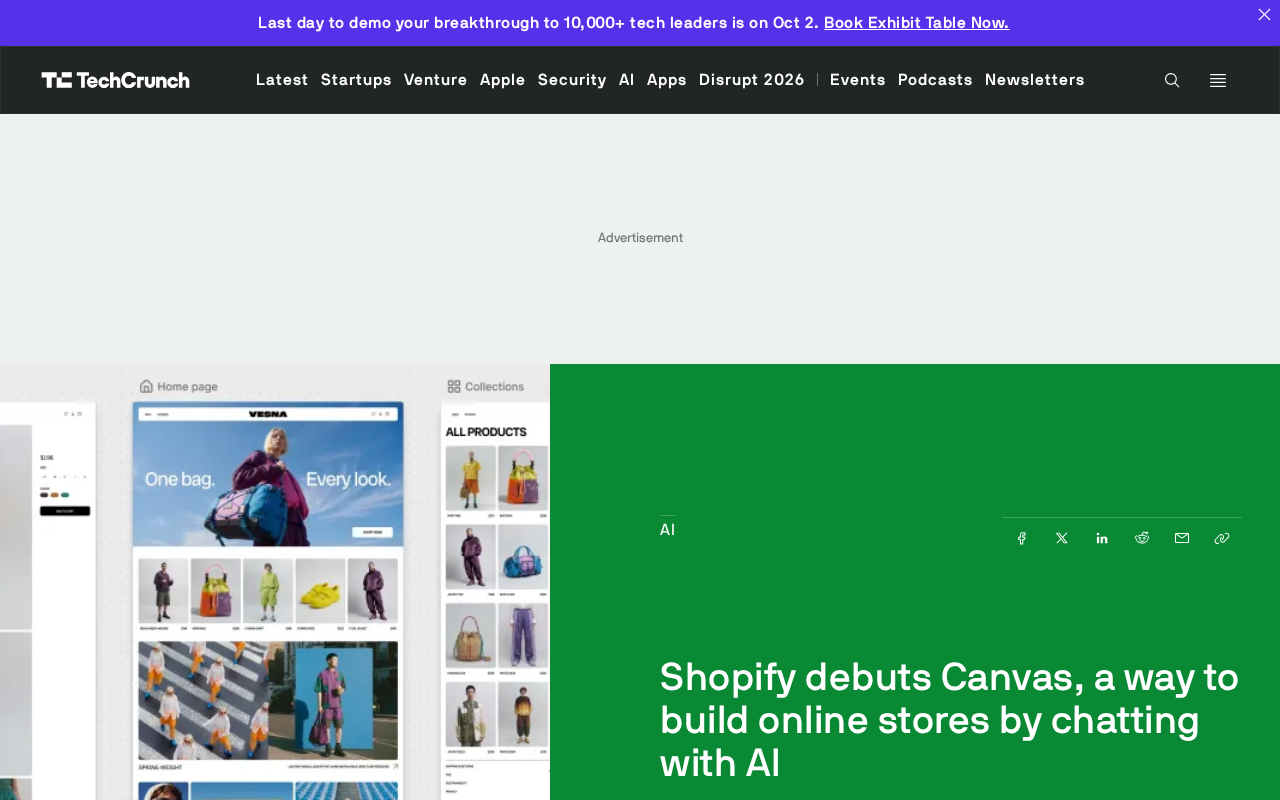
This design hands off one of the most time-consuming parts of traditional store building — hunting down settings, decoding configuration options, and going through endless trial and error — to natural language interaction. For small and mid-sized merchants without a technical background, the barrier to entry drops significantly.
Why Conversational Store Building Matters
From "Navigating the Interface" to "Expressing Intent"
Traditional store builders, no matter how much they emphasized "visual editing" and "drag-and-drop," still required users to first learn the tool's own logic: where to change colors, how to adjust layouts, which toggle controls which feature. Canvas shifts that cognitive burden onto the AI. Merchants simply describe the outcome they want — say, "change the homepage banner to a dark background" or "add a promotional countdown timer to the product page" — and Sidekick handles the actual execution.
This shift in interaction paradigm mirrors what generative AI has been doing across coding and design: users express intent, AI handles the details. Shopify has now brought this pattern to e-commerce store building — a high-frequency use case with clear, outcome-driven goals.
Real-Time Visibility as a Trust Mechanism
One of the biggest pain points of conversational AI in productivity tools is unpredictability — you say something, and you have no idea what the AI actually changed. Canvas directly addresses this with its emphasis on seeing changes happen in real time. The immediate feedback loop lets merchants instantly judge whether the AI understood their request correctly, which builds trust in the tool and reduces anxiety about unintended changes.
The concept of WYSIWYG (What You See Is What You Get) dates back to Xerox PARC in the 1970s, and later became a foundational design principle in desktop publishing and web editors — what you see while editing matches exactly what gets published, no switching between "source view" and "preview mode." Shopify Canvas extends this principle into conversational interaction: every natural language command is immediately mapped to a visible change on the page, rather than returning a set of written instructions. This is especially critical for AI productivity tools — since users can't predict what a large language model will produce, real-time rendering acts as a "checkpoint" for every action, making changes immediately reviewable, confirmable, and reversible, minimizing the potential cost of any mistake.
What This Means for the E-Commerce Ecosystem
Shopify's core audience is small and mid-sized merchants — businesses that typically don't have dedicated designers or developers on staff. Canvas effectively compresses the distance between "idea" and "live storefront." When building a store can be done through conversation, merchants can redirect their energy toward product selection, marketing, and operations, rather than wrestling with page layouts.
From an industry perspective, this is also a snapshot of the AI race among e-commerce platforms. Major store-building and e-commerce platforms are embedding AI agents into their core workflows, and Shopify's move to layer Canvas capabilities onto the existing Sidekick assistant represents a clear upgrade path — from "conversational assistant" to "action-taking agent." AI is no longer just answering questions; it's rolling up its sleeves and helping you open your store.
Questions That Still Need Answering
Despite the appeal of conversational store building, the real-world experience remains to be seen. The AI's ability to interpret ambiguous instructions, handle complex customization needs, and deliver quality design output will ultimately determine whether Canvas is a genuine productivity boost or just a compelling gimmick. It's also an open question whether, for fine-grained adjustments, a purely conversational interface might actually be more cumbersome than direct manipulation.
Publicly available details are still limited. Key specifics — such as the scope of supported customizations, compatibility with existing theme systems, and the quality of generated results — will require merchants to get hands-on before a fuller picture emerges.
Closing Thoughts
Canvas represents a significant attempt to reimagine how e-commerce stores are built: replacing complex backend operations with a conversation with AI. It aligns with the broader generative AI trend of "intent-driven execution," and stays true to Shopify's long-standing mission of lowering the barriers to running a business. Whether it genuinely changes how merchants build their stores comes down to how smart Sidekick really is and how well the experience holds up in practice — both well worth watching.
Background
Sidekick is Shopify's built-in AI assistant, launched in 2023 and built on large language models. It was originally positioned as a conversational tool to help merchants answer operational questions, analyze data, and get recommendations. The launch of Canvas marks Sidekick's evolution from "advisor" to "executor" — rather than telling a merchant "you can change the color in a certain spot in the theme editor," it now just does it for them.
This leap from information-retrieval AI to task-execution AI relies technically on an AI Agent architecture: the model doesn't just generate text responses — it can call tools, trigger APIs, and modify system state. For merchants, the perceived change is that things got simpler. For the platform, what's happening under the hood is a sophisticated execution layer that maps natural language instructions to concrete operations.
Related articles

Python 3.15 New Feature: Is the sentinel Type Better Than None?
Python 3.15 adds the sentinel type, using named unique sentinel objects to replace None and bare object(), resolving confusion among missing values, explicit emptiness, and invalid input while avoiding type hint failures.

Deep Learning's Three Architectures and the Universal Approximation Theorem: A Complete Guide to MLPs, CNNs, and Transformers
Explaining the inductive bias differences among MLP, CNN, and Transformer, the existence meaning of the Universal Approximation Theorem (UAT), and the role of Taylor expansion in approximation analysis, while clearing up common misconceptions.

GitLab Emergency Patch Release: Analysis of Critical Security Fixes
GitLab releases critical patch 19.5.1, sparking 355 points of discussion on Hacker News. This article analyzes the background, upgrade steps for self-hosted instances, and verification points to help DevOps teams respond quickly to security updates.