Shopify Stores Show 80% MCP Endpoint Exposure Rate, Yet agents.md Is Missing

A scan of 40 Shopify stores shows 80% expose MCP endpoints while 0% deploy agents.md, revealing the contradiction of interfaces coming first and governance lagging behind in the AI agent era.
A scanning study of 40 Shopify store domains shows that 80% of stores exposed the `/API/ucp/MCP` endpoint, while none provided an `/agents.md` file. MCP is a protocol that allows AI models to interact in a standardized way with external tools, and its widespread exposure may become an attack surface. agents.md is similar to robots.txt and is used to declare acceptable usage rules to AI agents; its complete absence means agent behavior lacks standards. The study has a limited sample and did not deeply test permission controls, but it already reveals that merchants should audit endpoint access controls, consider deploying agent declaration files, and watch for platform updates.
A 40-Domain Study Reveals the Current State
Recently, a scanning study of 40 Shopify store domains appeared on Hacker News with surprising results: 80% of stores exposed the /API/ucp/MCP endpoint, while none (0%) provided an /agents.md file. This finding quickly sparked discussion about the security of AI agent interactions with e-commerce platforms.
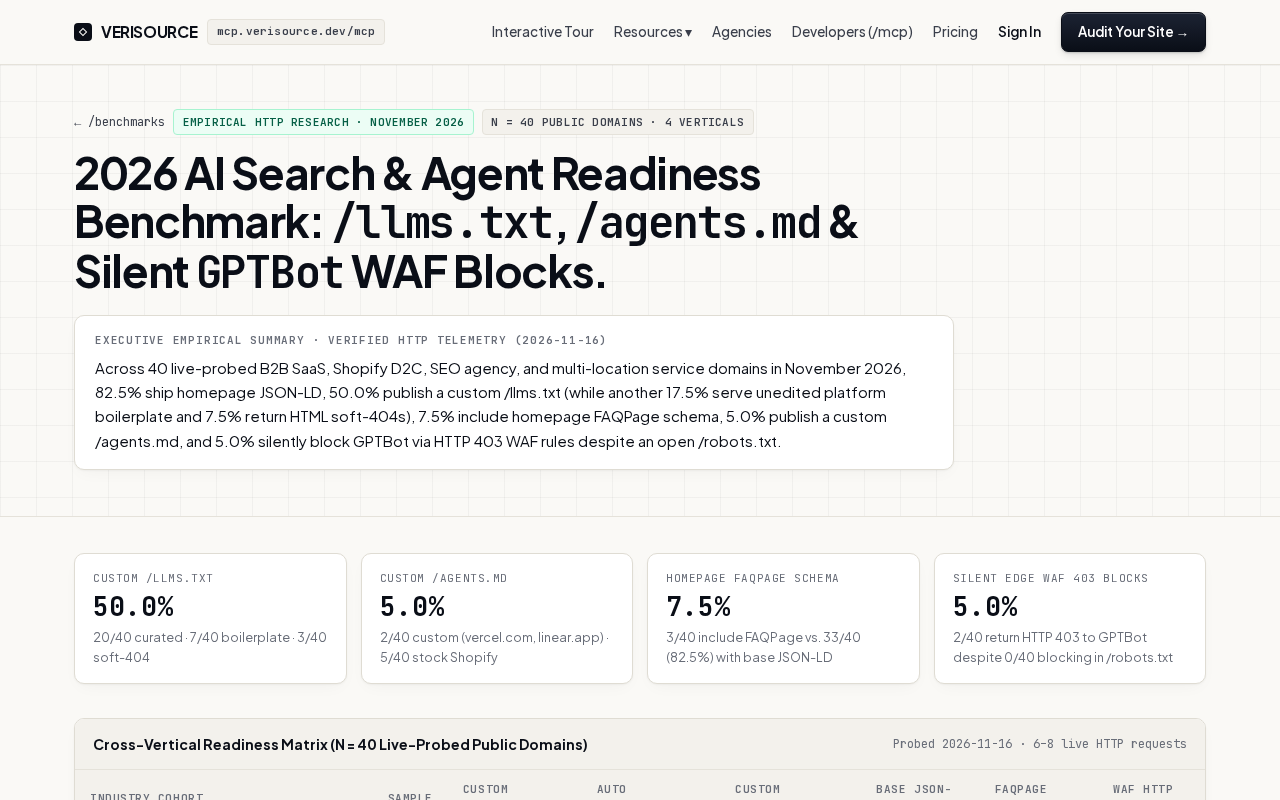
Although the sample size is only 40 domains, the problem it points to cannot be ignored: when merchants unknowingly expose MCP (Model Context Protocol) interfaces and lack clear agent behavior specification files, AI agent interactions with stores may be in a state of "no rules to follow."
What Is MCP? Why Does Its Exposure Matter?
MCP (Model Context Protocol) is a protocol that allows AI models to interact in a standardized way with external tools and data sources. In the Shopify context, the /API/ucp/MCP endpoint may be used to support AI agents in accessing store data or performing operations.
An 80% exposure rate means that most scanned stores may have this interface enabled by default, or at least have not actively disabled it. For merchants, this raises two levels of concern:
- Security risk: A public MCP endpoint may become an attack surface, allowing unauthorized agents to query sensitive information or trigger operations.
- Governance gap: Without an
/agents.mdfile, AI agents lack clear behavioral guidelines, such as which operations are permitted, what the rate limits are, and what the data usage policy is.
According to the original Hacker News post, the study only performed basic scanning and did not deeply test the endpoint's actual permission controls. But even from the exposure surface alone, it is enough to alert developers and merchants.
MCP (Model Context Protocol) was proposed by Anthropic in late 2024 to establish a unified communication standard between AI models and external tools and data sources. Its core idea is to decouple model capabilities from tool invocation: the model sends requests to an MCP server through standardized JSON-RPC messages, and the server translates the requests into operations on databases, APIs, or local files. MCP uses a client-server architecture and supports three transport methods: stdio (local inter-process communication), HTTP+SSE (Server-Sent Events), and streamable HTTP. Compared with earlier custom function-calling formats from various vendors, MCP's value lies in interoperability—the same tool only needs to implement an MCP server once and can then be reused by different AI clients. For this very reason, attackers or malicious agents can also use the same standard to quickly probe and connect to exposed endpoints.
What Does the Absence of agents.md Mean?
/agents.md is an emerging convention, similar to what robots.txt is for crawlers, used to declare acceptable usage rules to AI agents. The 0% finding indicates that although MCP endpoints are already widespread, corresponding agent governance practices are almost nonexistent.
This asymmetry may lead to the following consequences:
- Unpredictable agent behavior: AI agents may attempt operations that are not explicitly permitted, leading to data leaks or business logic errors.
- Ambiguous accountability: When agent behavior causes problems, the lack of a clear rules file makes it difficult to determine responsibility.
- Compliance risk: As regulations related to AI agents gradually improve, the absence of an agent declaration file may be considered non-compliant.
One detail: the study did not state whether these MCP endpoints are enabled by default by the Shopify platform or configured by merchants themselves. If this is default behavior, then Shopify may need to reassess its default security policy.
robots.txt is an informal standard in the search engine crawler space, widely adopted since 1994, using directives such as User-agent, Disallow, and Allow to tell crawlers which paths can be crawled. But it relies on voluntary compliance by crawlers and has no legal force. The idea behind agents.md is similar, but it targets more complex scenarios: AI agents not only read content but may also perform operations (such as placing orders, modifying inventory, or calling payment interfaces). Therefore, agents.md needs to declare not only accessible paths, but also allowed operation types, rate limits, authentication requirements, data retention policies, and contact channels in case of errors. At present, this convention is still in a community-driven stage, lacking a unified schema and platform endorsement, which makes it difficult to ensure that agents can correctly parse it even if merchants are willing to deploy it. The 0% finding reflects both a lack of awareness and the reality of missing standards.
Implications for Merchants and Developers
For Shopify merchants and developers, this study sounds an alarm:
- Audit MCP endpoints: Check whether your store exposes
/API/ucp/MCPand assess whether its access controls are sufficiently strict. - Consider deploying agents.md: Even if it is not currently mandatory, defining agent behavior specifications in advance helps mitigate future risks.
- Watch for platform updates: Shopify may release patches or guidelines on this issue, and merchants should stay informed.
For AI agent developers, this study also suggests that in the absence of clear rules, agent design should be more conservative and avoid aggressive probing of unknown endpoints.
It is important to distinguish between endpoint exposure and exploitability. A /API/ucp/MCP endpoint returning a 200 status code only indicates that the path responds; it does not mean it allows unauthenticated read or write operations. The actual risk depends on whether the endpoint requires OAuth tokens, whether it enforces scope restrictions, and whether it limits request frequency and source IPs. Merchants are advised to verify the following in sequence during an audit: whether anonymous requests are rejected, whether tokens are bound to specific stores and permission scopes, whether write operations have a secondary confirmation mechanism, and whether logs record agent identities. For developers, the principle of "least-privilege agents" can be adopted: read-only by default, write operations requiring explicit authorization, and unknown endpoints first probed with OPTIONS rather than called directly.
Limitations of the Study and Follow-up
One more point: this study covers only 40 domains, the sample size is limited, and the specific scanning method and domain list were not disclosed. Therefore, the 80% exposure rate may not represent all Shopify stores. But as a preliminary exploration, it reveals a real problem facing e-commerce platforms in the age of AI agents: interfaces come first, governance lags behind.
As protocols such as MCP become more widespread, how to balance openness and security will be a challenge shared by platforms, merchants, and agent developers. This study may only be the beginning.
One-line Summary
A scan of 40 Shopify stores shows 80% expose MCP endpoints while 0% deploy agents.md, revealing the contradiction of interfaces coming first and governance lagging behind in the AI agent era.
Paragraph Summary
A scanning study of 40 Shopify store domains shows that 80% of stores exposed the /API/ucp/MCP endpoint, while none provided an /agents.md file. MCP is a protocol that allows AI models to interact in a standardized way with external tools, and its widespread exposure may become an attack surface, allowing unauthorized agents to query sensitive information or trigger operations. agents.md is similar to robots.txt and is used to declare acceptable usage rules to AI agents; its complete absence means agent behavior lacks standards, which may lead to unpredictable behavior, ambiguous accountability, and compliance risks. The study has a limited sample and did not deeply test permission controls, but it already reveals that merchants should audit endpoint access controls, consider deploying agent declaration files, and watch for platform updates.
Related articles

AnthropicAI Accused of Posting Fraudulent Riemann Hypothesis Proof, Sparking Discussion
A Hacker News post accuses AnthropicAI of posting a fraudulent Riemann Hypothesis proof, sparking debate on the reliability of AI-generated mathematical proofs.

Tano: A Korean Vocabulary App That Skips Words You Already Know
Tano is an iPhone Korean vocabulary app that skips words you already know via a short placement test, delivers a few new words daily with spaced review, and offers scenario-based categories, three practice modes, and gamified avatar growth—free to start, no account needed.
overads.io: Let Marketing and GTM Run on Autopilot While You Sleep
overads.io tops Product Hunt with conversational workflows that automate multi-platform content publishing, Meta and Google ad monitoring, and GTMgenie email outreach for founders—$59/month.