Shorter Text, Harder to Detect? Length Calibration and Abstention for AI-Generated Text Detection

Research reveals threshold failure risks in short-text AI detection, proposes binned calibration to stabilize false-positive rates, and introduces abstention.
This paper systematically studies the reliability of AI-generated text detectors on short text (10–200 tokens). It provides a closed form describing false-positive rate drift when long-text thresholds are applied to short text, and proposes binned calibration using conformal p-values to stabilize the average false-positive rate at the 5.0% nominal value across lengths. Experiments show no detector reaches an 80% true-positive rate (best: Binoculars at 59% for 200 tokens), leading to an abstention rule. The study stresses measuring performance by length and abstaining honestly rather than assuming long-text tuning transfers.
AI-generated text detectors are typically trained and tested on passages of several hundred tokens, but in practice the text to be examined is often very short—a social media comment, a code comment, a one-line product review, perhaps only a few dozen or even a dozen tokens. What happens to detector reliability when text length shrinks dramatically? A paper titled "How Short Is Too Short? Length-Conditional Calibration and Abstention for Detecting AI-Generated Text" systematically answers this question and proposes a length-based calibration and abstention scheme.
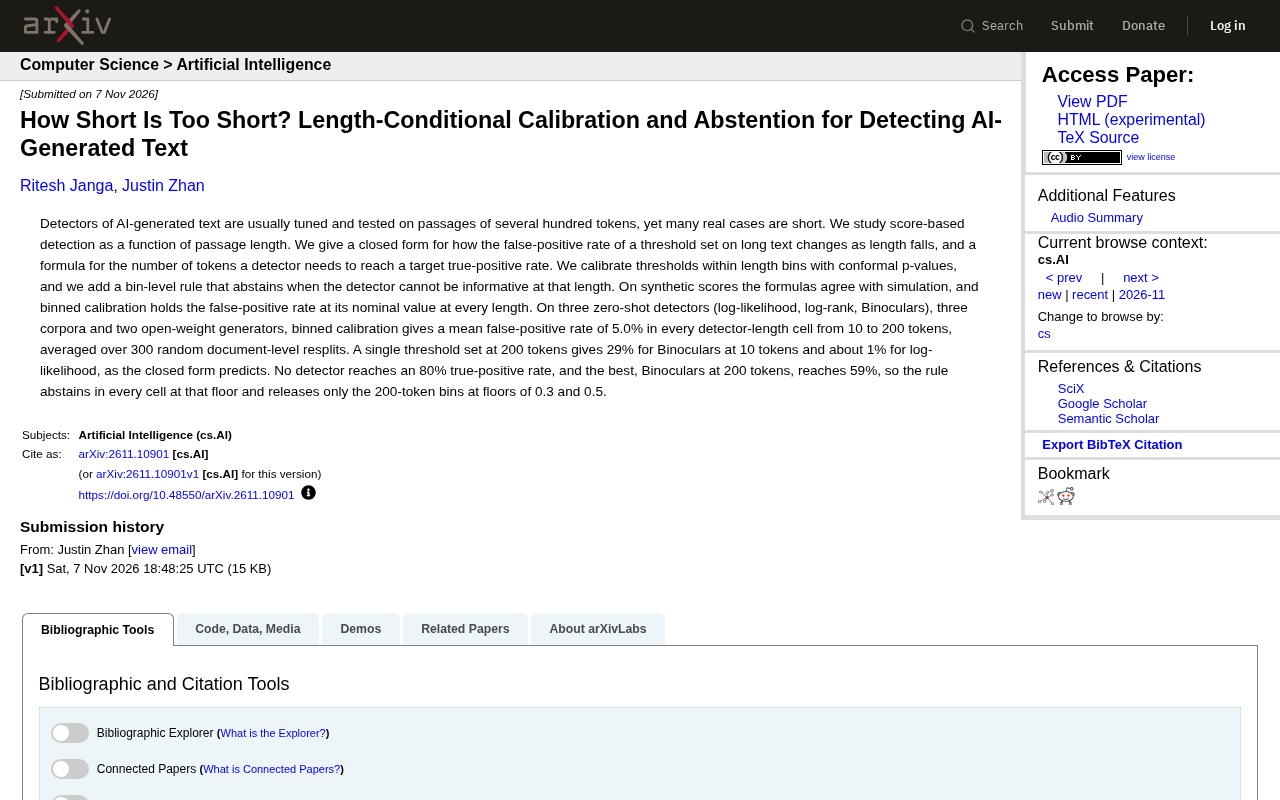
The Hidden Risk of Short-Text Detection: Threshold Failure
The starting point of this research is a widely overlooked engineering reality: detector decision thresholds are usually set on long text. When the same thresholds are applied directly to short text, how does the false-positive rate drift?
The authors provide a closed form that precisely describes this drift: a threshold set on long text will produce a predictable change in false-positive rate as text length decreases. The study also provides another formula—how many tokens a detector needs to reach a target true-positive rate. These two formulas form the theoretical backbone of the paper.
Experimental data confirm the formula's predictions. Taking the Binoculars detector as an example, a single threshold set at 200 tokens causes the false-positive rate to soar to 29% when text is shortened to 10 tokens; under the same conditions, the log-likelihood detector's false-positive rate is about 1%. This shows that different detectors vary enormously in sensitivity to length changes, and a one-size-fits-all threshold strategy is highly unreliable in short-text scenarios.
Binned Calibration: Keeping False-Positive Rates Stable at Every Length
To address the above problem, the research team proposes a binned calibration scheme: divide text into length intervals and calibrate thresholds separately within each interval using conformal p-values.
The effect is quite significant. Across three zero-shot detectors (log-likelihood, log-rank, Binoculars), three corpora, and two open-weight generators, averaged over 300 random document-level re-splits, binned calibration stabilizes the average false-positive rate at 5.0% for every detector–length combination from 10 to 200 tokens.
This 5.0% is exactly the nominal value—that is, no matter how short the text, the calibrated false-positive rate stays at the set level and no longer drifts with length. By contrast, the single-threshold scheme performs with clear divergence, as predicted by the closed form.
Conformal p-values are the core product of the conformal prediction framework. The basic idea is: using a held-out calibration set, compute a p-value for each new sample that measures the quantile level of "the current sample's detection score" within the reference distribution. If the p-value is less than a preset significance level α (e.g., 0.05), the null hypothesis that "the text was written by a human" is rejected, and the text is judged AI-generated. The advantage of conformal p-values is that they require no assumption about the specific form of the score distribution; relying only on exchangeability, they can guarantee with finite samples that the false-positive rate does not exceed α. In binned calibration, the authors construct a calibration set and compute conformal p-values separately for each length interval, thereby making false-positive rate control length-conditional—this is precisely the key to combining "binning" with "conformal."
Abstention Mechanism: Admitting the Detector "Doesn't Know"
Calibration solves false-positive rate drift, but another problem surfaces: on short text, the detector may simply lack enough information to make a judgment.
The study introduces a bin-level abstention rule: when the detector cannot provide valid information within a certain length interval, the system abstains directly instead of forcing an unreliable judgment.
The trigger condition for this design is intuitive. In the experiments, no detector reached an 80% true-positive rate; the best performer, Binoculars, reached only 59% at 200 tokens. Therefore, under the 80% true-positive rate requirement, the abstention rule triggered abstention in every length interval—including the longest 200-token interval. Only when the threshold was relaxed to 0.3 and 0.5 did the system release judgment results for the 200-token interval.
In other words, the real dilemma of short-text detection is not "an elevated false-positive rate" but "detectors generally lack sufficient discriminative power on short text." The value of the abstention mechanism lies in making this dilemma explicit rather than masking it with false confidence.
True-positive rate (TPR) is the counterpart of the false-positive rate: among all texts actually generated by AI, the proportion that the detector correctly judges as AI-generated, also called recall. The abstention rule in this paper uses TPR as the trigger condition: if within a certain length interval the detector cannot reach a preset TPR floor (e.g., 80%) at a given threshold, the system abstains on all samples in that interval. This design turns "insufficient detector capability" into an actionable engineering decision—abstention is not failure but an honest declaration of the discriminative-power ceiling. Notably, TPR and false-positive rate trade off against each other: lowering the threshold can raise TPR but pushes up the false-positive rate, so satisfying both simultaneously on short text is often infeasible, making abstention the only choice that does not produce false confidence.
Implications for Practical Deployment
The methodological significance of this research outweighs its specific numbers. It reminds us that deploying any AI text detection system requires answering questions at three levels:
First, does the threshold match the text length? Binned calibration is not costly, but it significantly stabilizes the false-positive rate. For detection systems that need to operate across multiple length scenarios, this is a necessary engineering step.
Second, does the detector have sufficient discriminative power at the current length? The analysis of the true-positive rate ceiling shows that in short-text scenarios the detector's capability ceiling may be far below expectations. Performance boundaries for each length interval should be clearly established before deployment.
Third, should the system learn to say "I don't know"? The abstention mechanism offers an honest engineering stance: rather than forcing a judgment when information is insufficient, hand the uncertainty to downstream processes. This is especially important in high-risk scenarios such as content moderation and academic integrity review.
The experimental setup covers three detectors, three corpora, and two generators, and the breadth of cross-validation provides some support for its conclusions. However, the 59% true-positive rate ceiling also reminds us that short-text AI detection remains a far-from-solved problem; calibration and abstention only let the system operate more reliably within its capability boundaries, not break through them.
For engineers building detection pipelines, the most practical advice from this research is perhaps: first measure your detector's performance curve across lengths, then decide on thresholds and abstention strategy—do not assume that tuning results from long text transfer directly to short text.
One-line Summary
Research reveals threshold failure risks in short-text AI detection, proposes binned calibration to stabilize false-positive rates, and introduces an abstention mechanism.
Paragraph Summary
This paper systematically studies the reliability of AI-generated text detectors on short text (10–200 tokens). The authors first provide a closed form that precisely describes how false-positive rates drift when long-text thresholds are transferred to short text, and verify it with the example of Binoculars soaring to a 29% false-positive rate at 10 tokens. They then propose binned calibration, using conformal p-values to calibrate thresholds separately in each length interval, stabilizing the average false-positive rate at the 5.0% nominal value for every combination from 10 to 200 tokens across three detectors, three corpora, and two generators. However, experiments find that no detector reaches an 80% true-positive rate—the best, Binoculars, reaches only 59% at 200 tokens—prompting the abstention rule to trigger in most intervals. The study concludes that deploying AI text detection systems requires measuring performance curves by length, matching thresholds, and abstaining honestly, rather than assuming long-text tuning transfers.
Related articles
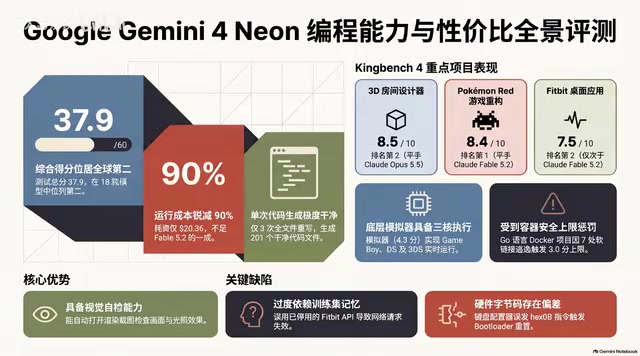
Gemini 4 Neon Hands-On: Value King or Confident Catastrophe?
Gemini 4 Neon review: 1M-token context, four thinking levels, 201 files in one KingBench4 pass at one-tenth Fable 5.2's cost—but it hallucinates fake data, leaves 7 symlink escapes, and bricks keyboards.

Google Gemini 4 Neon Hands-On: 6 3D Works That Impress and Fail
Hands-on with Google Gemini 4 Neon on a 3060 laptop: 6 3D works tested. Sunshower Fishing Harbor and mechanical keyboard impress; soft-body physics and faces fall short.

Gemini 4 Neo Web Novel Writing Test: Faint AI Flavor, Textured Dialogue
Bilibili creator's first-look review of Gemini 4 Neo for Chinese web novel writing: testing a Three Kingdoms transmigration opening with faint AI flavor, emotionally textured dialogue, and strong crisis building, plus comparison of 4A/4H/4C models and full workflow demos.