Should AI Study Assistants Just Give You the Answer? Reflections Sparked by Microsoft's Study Agent

Microsoft's Study Agent uses Socratic questioning to counter the cognitive dependency of spoon-fed AI answers.
As AI study tools proliferate, the risk of cognitive outsourcing through direct answers is drawing growing concern. Microsoft's updated Study and Learn Agent responds with a differentiated guided approach: instead of providing answers, it uses Socratic questioning to push students toward their own conclusions, while generating quizzes and flashcards and adding support for 50 languages. The article examines two competing learning philosophies and draws on the retrieval practice effect from cognitive science to support guided learning — concluding that the user's own mindset, not just tool design, is the ultimate determinant of AI-assisted learning outcomes.
A Learning Dilemma Worth Watching
More and more students are turning to AI as an everyday study companion — but a nagging concern is starting to surface: when AI constantly spoonfeeds you ready-made answers, are you becoming more dependent and less capable of thinking for yourself?
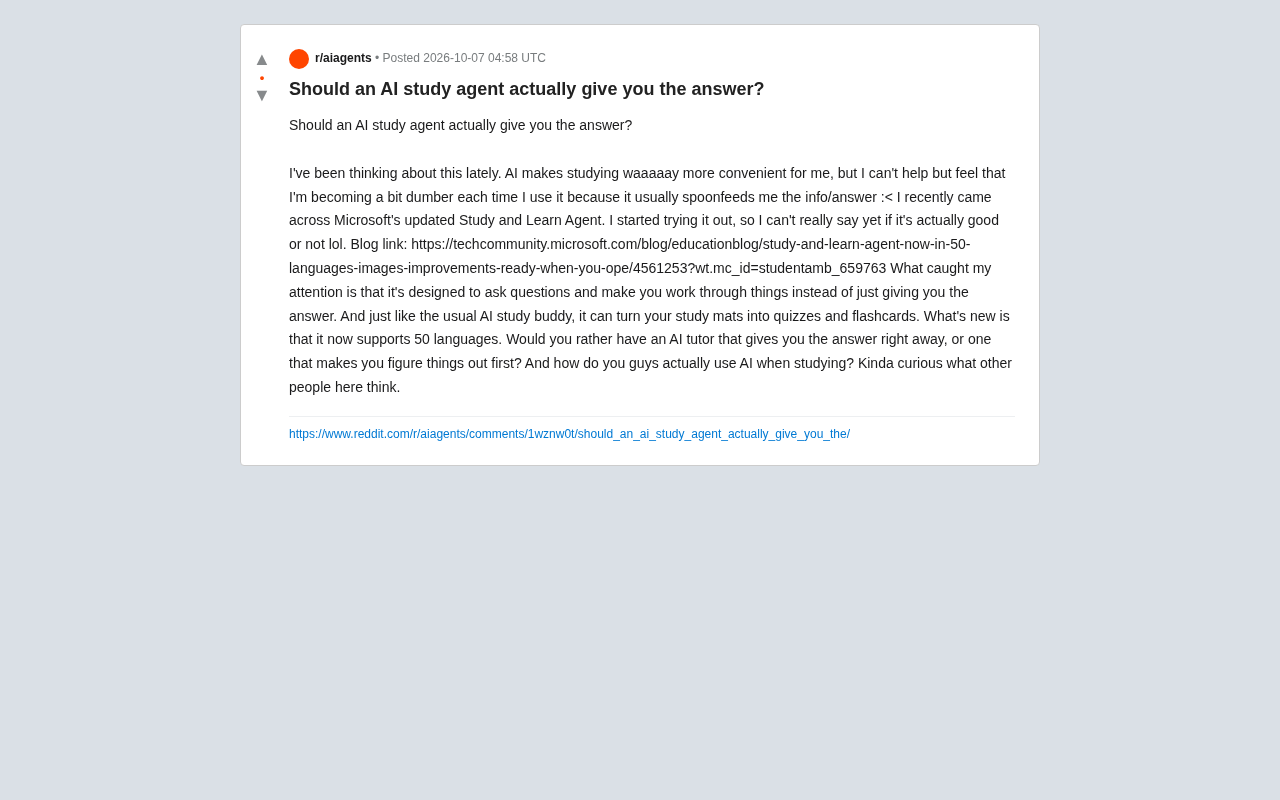
A Reddit user's post captured what many are quietly feeling. He admitted that AI has made studying more convenient than ever, but after each session he'd feel a vague sense of having "gotten a little dumber" — because AI tends to serve up information and answers on a silver platter. This tension between convenience and cognitive decline is the central issue that AI education tools can no longer avoid.
Microsoft's Study and Learn Agent: A Different Approach
The same user mentioned that he'd recently started trying out Microsoft's updated Study and Learn Agent. While he said it was too early to draw firm conclusions, the tool's design philosophy caught his attention.
Unlike most AI tools that answer every question on demand, Microsoft's learning agent is designed to guide you through a problem step by step via questions — rather than handing you the answer directly. In other words, it functions more like a Socratic tutor: it prompts you to reason toward a conclusion yourself, rather than doing the thinking for you.
Beyond this core philosophy, it also retains practical features common to AI study tools: converting your learning materials into quizzes and flashcards for review and self-testing. One of the biggest highlights of this update is the addition of support for 50 languages, dramatically expanding its accessibility for students around the world.
The Socratic method originates from the dialogue practices of ancient Greek philosopher Socrates. Its core principle is to guide students toward discovering contradictions and blind spots in their own understanding through continuous questioning — rather than direct instruction — so they can actively construct knowledge themselves. Its modern educational significance lies in requiring learners to continuously activate metacognition (monitoring and reflecting on one's own thinking process), rather than passively receiving pre-digested conclusions. Transplanting this philosophy into AI tool design poses a unique challenge: the AI must accurately assess a student's current cognitive state and ask questions that are neither too simple (losing their challenge) nor too abstruse (causing frustration). This technically requires the model to dynamically model learning progress, not just perform question-and-answer matching.
"Give Answers" vs. "Teach Methods": Two Philosophies Collide
Behind this question lie two fundamentally different learning philosophies.
The direct-answer model is highly efficient — great for quickly filling knowledge gaps, meeting deadlines, or confirming what you already know. But the long-term risk is that the brain may skip over the retrieval and reasoning steps that are actually critical for consolidating memory and understanding. The well-established retrieval practice effect in cognitive science shows that the act of actively recalling and effortfully thinking — the struggle itself — is the core mechanism by which knowledge becomes internalized.
The guided-questioning model deliberately introduces "desirable difficulties," helping learners build stronger neural connections through productive struggle. It sacrifices short-term efficiency in exchange for long-term comprehension and independent thinking.
Microsoft's choice of the latter as its product positioning is clearly a direct response to the criticism that AI education tools risk enabling "cognitive outsourcing."
The retrieval practice effect is one of the most extensively validated findings in cognitive psychology, systematically studied by psychologist Henry Roediger and colleagues. The core principle: compared to repeatedly re-reading material, actively attempting to retrieve information from memory — even when retrieval fails — significantly improves long-term retention. The mechanism is that every effortful retrieval attempt strengthens that memory's neural pathway while helping the brain build richer associative indexes. Related research gave rise to the desirable difficulties theory, proposed by cognitive scientist Robert Bjork: moderate difficulty, delayed feedback, and spaced repetition during learning — while lowering short-term performance — dramatically improve long-term mastery. This theory directly explains why Socratic questioning leads to better knowledge internalization than simply providing answers: the struggle itself is proof that learning is happening.
How Should You Actually Use AI Study Tools?
No tool is inherently right or wrong — it all comes down to how you use it. Drawing on this discussion, here are a few healthier AI study practices:
- Think first, then ask: When you encounter a problem, try to form your own answer or approach before asking AI to verify or supplement it — don't reach for the answer first.
- Treat AI as a sparring partner, not an answer machine: Use its quiz and flashcard generation capabilities for active self-testing to reinforce memory retrieval.
- Always ask "why": Even when AI gives you an answer, push further — ask for the reasoning process and underlying logic, turning passive reception into active understanding.
- Watch out for the comfort trap: Effective learning usually comes with some cognitive load. If using AI feels "too easy," that may be a signal that real learning isn't happening.
Closing Thoughts: Convenience Shouldn't Come at the Cost of Thinking
The Reddit discussion that sparked this piece is ultimately asking a fundamental question about the relationship between AI and human cognition: do we want AI to complete our thinking for us, or to help us think better?
Microsoft Study and Learn Agent's guided design offers one possible answer — AI can be a tutor who pushes you forward, rather than a crutch that lets you stop thinking. But what ultimately determines learning outcomes is still the attitude and approach of the learner themselves. As that user's moment of self-reflection reminds us: when learning starts feeling "too convenient," that may be exactly the moment to pause and reflect.
Related articles

JobRunner MCP Server: AI Agents Can Now Fix Failed Java Jobs
JobRunner launches an open-source MCP server enabling AI agents to view cluster status, diagnose failures, and recover Java jobs—incident response from any cloud coding environment or existing agent.

MLAI Digital Launches 9 Security Agents: MCP Server Safeguards the Full Lifecycle of Agentic AI
MLAI Digital launches Security MCP Server with nine built-in specialized security agents covering vulnerability discovery, attack simulation, prompt injection detection, API and infrastructure assessment, and accelerated remediation—embedding security validation across the full Agentic AI lifecycle from development to production.

Running Isaac Lab on H100 GPUs: Exploring Better Approaches
Exploring optimization methods for running Isaac Lab on NVIDIA H100 GPUs, including MIG configuration, mixed precision, TensorRT acceleration, and community experience to improve robotics simulation and reinforcement learning efficiency.