ShouldBuild: Validate Product Ideas with Real User Complaints Before Wasting Months of Development

ShouldBuild validates product ideas by analyzing real user complaints across multiple platforms before you build.
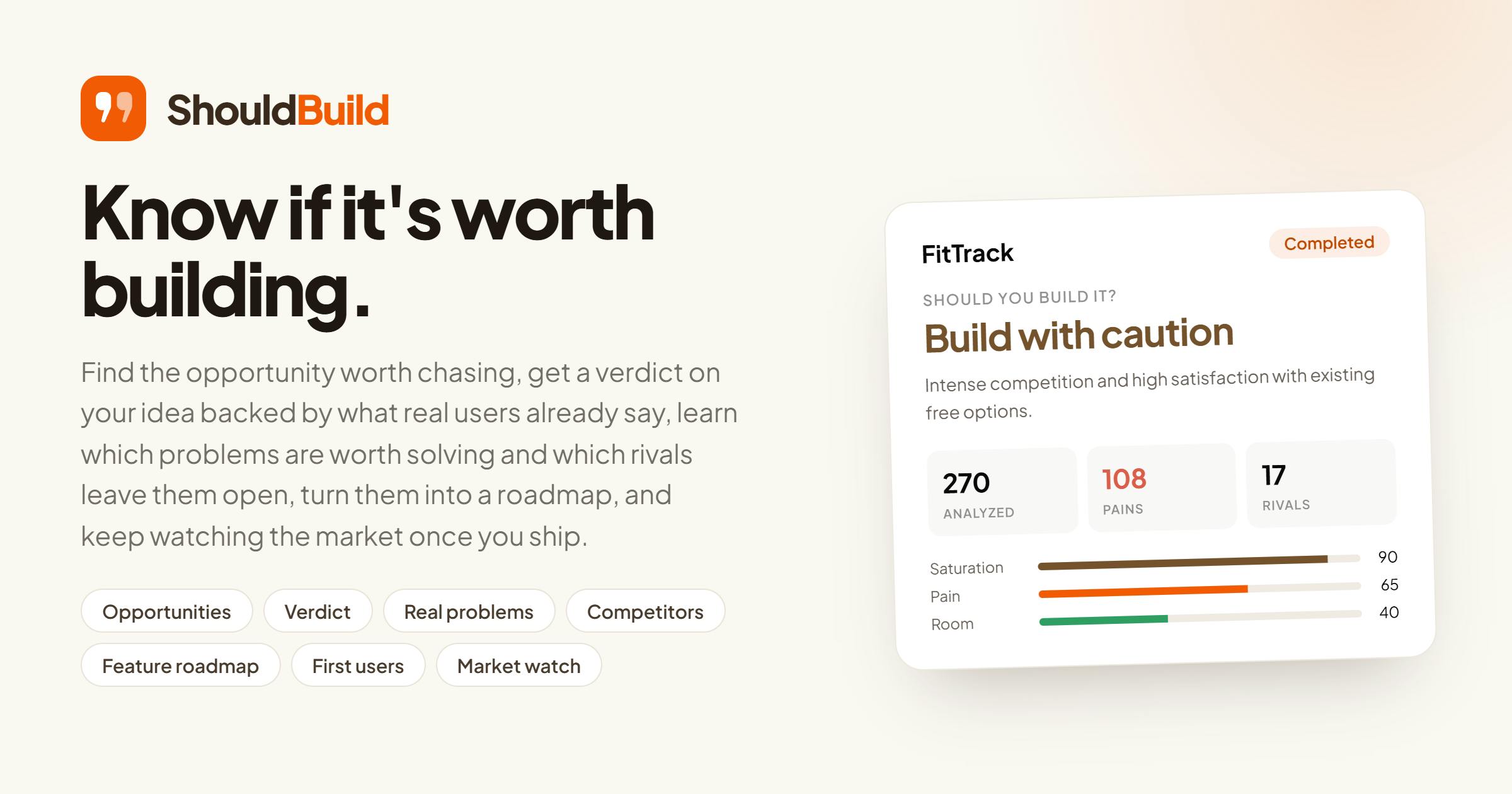
ShouldBuild is a product validation tool that scrapes real user complaints from app stores, Reddit, Hacker News, and the open web to deliver a data-backed build/don't-build verdict. It converts market insights into actionable product backlogs and offers weekly monitoring to track new competitors, emerging complaints, and whether shipped features actually reduce user pain points.
The Most Painful Lesson for Founders: Nobody Needs Your Product
For any indie developer or product manager, the most painful experience is this: spending months polishing a product, only to discover after launch that nobody actually needs it. It's not just a waste of time—it's a massive drain on resources, energy, and even confidence.
In the Lean Startup methodology, Eric Ries long ago proposed the core concept of the "Build-Measure-Learn" loop: validate your core assumptions before investing significant resources in development. In practice, however, traditional validation methods—user depth interviews, surveys, smoke tests (using landing pages to collect purchase intent)—all require weeks of time and considerable research skills, leading many eager developers to skip this step entirely.
ShouldBuild, which recently launched on Product Hunt, targets precisely this pain point. Product Hunt is the world's most influential new product launch platform, founded by Ryan Hoover in 2013, attracting a large community of early adopters and entrepreneurs—many well-known products like Notion and Loom gained early growth momentum through the platform. ShouldBuild's tagline is blunt and sharp: "Find out what your market wants before you waste months." This product validation tool attempts to deliver a data-driven "build / don't build" verdict before you write a single line of code.
How ShouldBuild Works: Mining Demand from Real Complaints
Multi-Channel User Pain Point Scraping
ShouldBuild's core logic isn't complicated, but it captures the essence of product validation: problems that real users are already complaining about represent the most authentic demand signals.
It automatically scrapes and analyzes user voices across multiple channels, including:
- App store reviews (App Store / Google Play) — negative reviews of existing products often reveal unmet needs. From a technical perspective, this falls within the natural language processing (NLP) domains of sentiment analysis and topic modeling. Modern large language models based on the Transformer architecture can understand contextual semantics, distinguish sarcasm, rhetorical questions, and other complex expressions, and automatically identify high-frequency pain points and feature requests from massive amounts of unstructured reviews—with accuracy far exceeding traditional keyword-matching methods;
- Reddit — with over 100,000 subreddits covering virtually every vertical, high user anonymity, authentic expression, and deep discussions, the information density far exceeds typical social media. Many successful products were inspired by recurring complaints in Reddit communities;
- Hacker News — operated by Y Combinator, it gathers the world's most active tech entrepreneurs and engineers, with discussions skewing toward technical tools, developer experience, and product design, making it a "gold mine" for developer-focused product research;
- The open web — broader public information sources.
Based on this data, ShouldBuild delivers a build / don't-build verdict, with every conclusion accompanied by clickable original quotes. This is particularly crucial: it doesn't ask you to blindly trust AI's judgment—instead, it puts the "evidence chain" directly in front of you, letting you verify the credibility of conclusions yourself.
From Market Insights to an Actionable Product Backlog
Validation is only the first step. ShouldBuild goes further by helping users crystallize valuable findings: you can save noteworthy insights and convert them into product concepts and a development backlog.
Here, Backlog is a core concept in Agile Development, specifically referring to a prioritized list of product requirements. In the Scrum framework, the Product Backlog is maintained by the product owner and contains items such as User Stories, technical debt, and feature improvements. The team selects high-priority items from the top of the Backlog at the beginning of each Sprint (iteration cycle) for development. Transforming market insights directly into Backlog items means the conversion path from discovering needs to entering the development workflow is dramatically shortened.
This means the tool's value extends beyond a binary "should I or shouldn't I" judgment—it reaches into the early stages of product planning, helping founders transform fuzzy market signals into concrete execution plans.
Continuous Monitoring: Weekly Market Change Tracking
One particularly clever design in ShouldBuild is its continuous monitoring mechanism.
Every Monday, users can see what has changed in the market:
- Have new rivals appeared? Competitive Intelligence is a crucial element in strategic management. Traditional approaches rely on consulting firms or manual tracking—expensive and infrequently updated. AI-driven automated competitive monitoring can scan product launch platforms, funding news, and other information sources in real time, issuing alerts the moment competitive landscapes shift. In fast-iterating SaaS markets, this real-time awareness can determine the speed of strategic adjustments.
- Have new complaints surfaced?
- Most importantly—have the features you've already shipped actually reduced the corresponding complaints?
This last point reflects the product designer's depth of thinking. It quantifies the validation loop of "did the product actually solve a real problem" into a continuously trackable metric: if you built a feature targeting a specific complaint, has that complaint actually decreased in subsequent data? This is an extremely pragmatic "impact verification" approach that prevents teams from falling into the trap of feeling good about themselves.
Why This Direction Deserves Attention
AI-Driven Market Research Costs Are Plummeting
Traditional market validation methods—user interviews, surveys, MVP testing—all require significant time and labor costs. ShouldBuild represents an emerging category of AI applications: using large language models and data scraping capabilities to automate and scale what was previously expensive market research.
For resource-constrained indie developers and early-stage startup teams, the appeal of such tools is obvious: it compresses "validating demand" from weeks to minutes, at minimal cost. ShouldBuild offers a 7-day free trial with no credit card required, further lowering the barrier to trying it out.
Potential Limitations and Usage Recommendations
Of course, there are aspects of such tools that warrant careful consideration. Complaint-based demand mining is fundamentally optimizing for "known pain points"—it excels at discovering incremental improvement opportunities but may struggle to capture truly disruptive, latent needs that users "can't articulate." As the famous Ford quote goes: if you asked users what they wanted, they'd say a faster horse.
Behind this frequently cited quote lies the "disruptive innovation" theory systematically articulated by Harvard Business School professor Clayton Christensen in The Innovator's Dilemma. The theory argues that innovations that truly reshape industries often don't come from incrementally satisfying existing user needs, but from redefining "non-consumers" or "over-served markets." Steve Jobs didn't rely on traditional market research when designing the iPhone—he based decisions on his judgment of technology convergence trends. This reminds us that data-driven demand validation may have blind spots when it comes to discovering "10x improvement" opportunities.
Additionally, complaint data from public channels contains noise and bias. Research shows that only about 1-5% of users actively leave reviews, and the willingness to share negative experiences is 2-3 times that of positive ones—a classic case of Survivorship Bias and the Silent Majority problem. User demographics also vary significantly across platforms: Reddit users skew younger and more tech-savvy, while App Store one-star reviewers may have simply made operational errors rather than having genuine unmet needs. The loudest complainers don't necessarily represent the mainstream market, and users willing to pay are often not the same as those who love to vent. Therefore, ShouldBuild's verdicts are best used as reference inputs for decision-making rather than the sole basis—ideally combined with willingness-to-pay validation (such as pre-sale tests or pricing experiments) to form a complete decision-making loop.
Summary: A New Option for Low-Cost Product Idea Validation
Based on its Product Hunt ranking and initial reception, ShouldBuild is still in its early stages, but the pain point it addresses is real and widespread. Its value proposition is clear:
Rather than burying your head in development for months, first listen to the voices the market has already been sending.
For developers wrestling with "should I actually build this idea," ShouldBuild offers a low-cost, evidence-based starting point for product idea validation. It can't make the decision for you, but it can ensure your decision is built on real evidence—and that is often the key to saving months of detours.
Key Takeaways
Related articles

Felix Rieseberg Personal Homepage
Felix Rieseberg's personal homepage sparks attention on Hacker News. This article covers the Slack engineer's technical background, the rise and fall of nativefier, and the value of a developer homepage as a tech calling card.

@ai-sdk/vue 3.0.306 Patch Release Syncs with [email protected] Update
@ai-sdk/vue 3.0.306 released, synced with [email protected]. A routine patch release for the Vercel AI SDK ecosystem with no public API changes; the Vue adapter layer stays version-aligned with the core package.

Gemini 4 Argon API Launches: The Era of Million-Token Output Begins
Google launches Gemini 4 Argon with sparse MoE architecture, up to 1M output tokens, and a 68.90% Vals Index score, available across API, AI Studio, and the Gemini app.