Show HN: Bouncing Ball Prediction Market Game with AI Traders as Counterparties
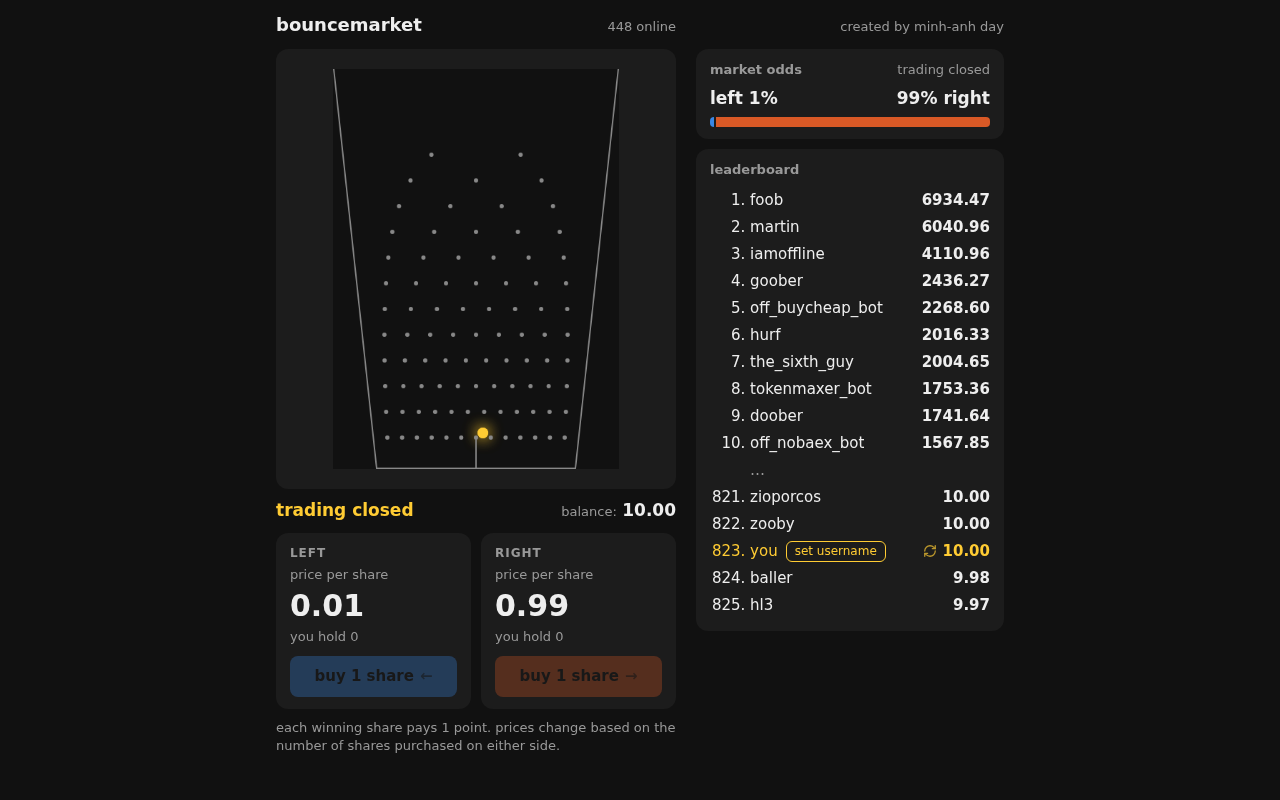
bouncemarket uses deterministic server-side simulation and SSE push to create a bouncing ball landing-spot prediction market.
bouncemarket is a Show HN project posted by a developer on Hacker News, garnering 294 points and 89 comments. It turns bouncing ball landing-spot prediction into a real-time trading market: the entire ball-drop round is simulated server-side and pushed to clients via SSE with a small buffer, with clients only handling rendering and interaction so all players see the same authoritative result. Each drop starts from a fully determined initial position and can be precisely replayed, but tiny changes in starting position can alter the final landing spot, constituting the game's core uncertainty. To maintain liquidity, the project introduces AI traders using naive, easily beaten rules that automatically exit when a round has more than five participants. The developer seeks two types of feedback: whether the mechanics are intuitive, and what players would like changed.
A Real-Time Prediction Market About a Bouncing Ball
If a ball drops from a height, would you bet on where it finally stops? That's exactly what developer's newly released Show HN project bouncemarket on Hacker News does.
According to the Hacker News post, the project has garnered 294 points and 89 comments, indicating considerable discussion. The developer revealed a wealth of technical implementation details in the post while also raising two clear feedback requests: whether the mechanics are intuitive enough, and what players would like to change.
Technical Implementation: Server-Side Simulation and SSE Streaming
The core mechanic of this game is not complex: the ball drops, and players trade on the landing spot before it lands. But its implementation is worth breaking down.
Deterministic Physics Simulation
The developer explains that the entire ball-drop process is simulated on the server and then pushed to each client via server-sent events (SSE) with a small buffer. This means the client is not responsible for physics computation—only rendering and interaction—and all players see the same authoritative result.
More interesting is the deterministic design. Each drop starts from a fully determined initial position, so every round can be precisely replayed for later analysis. But the developer also points out that a tiny change in the starting position can alter the final outcome. This sentence captures the source of fun in a prediction market game: a reproducible system that is nonetheless highly sensitive to initial conditions.
Deterministic simulation refers to a simulation program that produces frame-by-frame consistent results every time it runs given exactly the same initial conditions and inputs. The key to achieving this is avoiding dependence on floating-point operation order, random seeds, system time, or concurrent scheduling—or explicitly fixing these factors. In gaming and simulation, determinism is the foundation of replay systems, network synchronization, and post-hoc auditing: as long as the initial state and input sequence are recorded, the entire process can be reproduced on any machine. The opposite is non-deterministic simulation, commonly seen in scenarios that make heavy use of physics engine floating-point operations without fixed-point processing, where the same recording may produce slight deviations across different devices. bouncemarket places the ball-drop process on the server and emphasizes precise replay, treating determinism as the technical prerequisite for authoritative results and player trust.
A Market That Doesn't Cheat
For prediction market products, the biggest fear is unverifiable results. Server-side simulation plus deterministic replay means players can in theory verify the landing spot of any round, which is more transparent than many similar mini-games. However, the article materials do not mention whether replay functionality is exposed to players—this still needs clarification from the developer.
Prediction market is a market structure that lets participants buy and sell contracts on the outcomes of uncertain events, with contract prices typically interpreted as the market's collective estimate of the probability of that event occurring. Unlike gambling, prediction market prices are formed in real time by supply and demand, participants can close positions early, and the price itself carries information. For this mechanism to work, two conditions are indispensable: results must be objectively verifiable, otherwise the market loses credibility; and the market must have sufficient counterparties, otherwise prices will be distorted by a few trades. bouncemarket solves the former with server-side deterministic simulation and the latter with AI traders—precisely corresponding to the two most core infrastructure pieces of prediction market products.
AI Traders: Temp Workers Maintaining Market Liquidity
If there are no counterparties in the market, a prediction market cannot function. The developer's approach is to add a batch of AI traders to keep the market liquid.
Simple Rules, Easy to Beat
These AI traders use a set of naive rules written by the developer himself, so they are not hard to beat. The developer states plainly that they are only responsible for holding the fort when things are quiet—according to the rules, when a round has more than five participants, the AI traders exit. In other words, the more real players there are, the harder the market becomes.
This design is quite clever. It solves the liquidity problem common to newly launched products while preventing AI from occupying the market long-term and suppressing real players' profit margins. For indie developers, this is a low-cost cold-start approach.
Market making refers to the act of continuously quoting both bid and ask prices to the market, earning the bid-ask spread and providing counterparties for other participants to trade against. In real financial markets, market makers are professional institutions; in a newly launched prediction market with few users, without a market maker, buyers and sellers struggle to match, prices stagnate for long periods, and new players cannot execute trades. Using rule-simple AI agents as temporary market makers is a common cold-start tactic for indie developers: low cost, controllable, and able to exit at any time based on a participant threshold. The cost is that if the AI's pricing rules are too naive, they can be systematically arbitraged by real players—making the exit mechanism design equally important.
Boundaries Worth Watching
The AI exit mechanism also raises an implicit question: when the number of real players fluctuates right around the threshold, could market depth suddenly deteriorate? The developer did not elaborate in the post, but this is a point worth monitoring in the product's subsequent operations.
Why This Project Is Worth Attention
On the surface, bouncemarket is a mini-game, but in essence it sits at the intersection of three technical directions: deterministic server-side simulation, real-time data stream pushing, and using simple AI agents to keep a market running.
For developers building real-time multiplayer interaction, the SSE-plus-buffer approach is worth referencing—it's simpler than WebSocket and sufficient for one-way push scenarios. For those building prediction market or trading products, AI market making plus real-player exit thresholds is a cold-start strategy that can be directly borrowed. And the deterministic replay design offers ideas for any game or financial product that requires post-hoc auditing.
The developer specifically asks at the end of the post whether the mechanics are clear from the start, showing he understands that the biggest barrier for prediction market products is often not technology but the cost of novice comprehension. A ball drops, bet on where it lands—the rules sound simple, but whether the trading interface, odds display, and settlement logic can be understood within seconds is the key to retention.
The project has already received considerable discussion on Hacker News, and community feedback may drive adjustments to the mechanics. If you're interested in real-time simulation or prediction markets, this project provides a lightweight but complete sample.
Server-Sent Events (SSE) is a one-way server push technology based on HTTP: after the client initiates a normal request and keeps the connection open, the server can continuously send an event stream in text/event-stream format over that connection. It natively supports reconnection and event ID resumption, has far lower implementation cost than WebSocket, and requires no additional protocol upgrade. Its limitation is that it only supports one-way server-to-client communication; if the client needs to upload actions, it must use separate normal requests. For high-frequency, one-way state broadcasts like ball landing positions that only need to guarantee ordering, SSE with a small buffer can smooth out network jitter—making it a lighter choice than WebSocket.
Related articles

Prospero: A Lightweight Native AI Coding Tool Built with ImGui
Prospero is a bloat-free native AI coding tool built with ImGui, emphasizing lightweight design, high performance, and low dependencies. This article analyzes its design philosophy, technical choices, and the divergence between platformization and toolization in AI coding tools.

WebRTC Abused: New Variant of Credit Card Skimming Scripts on Shopping Sites
Security researchers found skimming scripts on popular shopping sites using WebRTC data channels to exfiltrate credit card data. This article analyzes the technical原理, differences from traditional Magecart attacks, and defense strategies for e-commerce platforms in third-party script governance and CSP policies.

Single GB10 Card Hits 101 tok/s: Inkling 2 Mini Performance Tested on vLLM
A developer shared on Hacker News running Inkling 2 Mini with vLLM on a single GB10 at 101 tok/s. This article analyzes the technical context, the significance of vLLM with small models on single cards, and caveats for interpreting tok/s metrics.