SignWith: Pay-Per-Document E-Signatures, Say Goodbye to Subscriptions

SignWith enters the e-signature market with pay-per-document pricing and MCP integration, challenging the subscription convention.
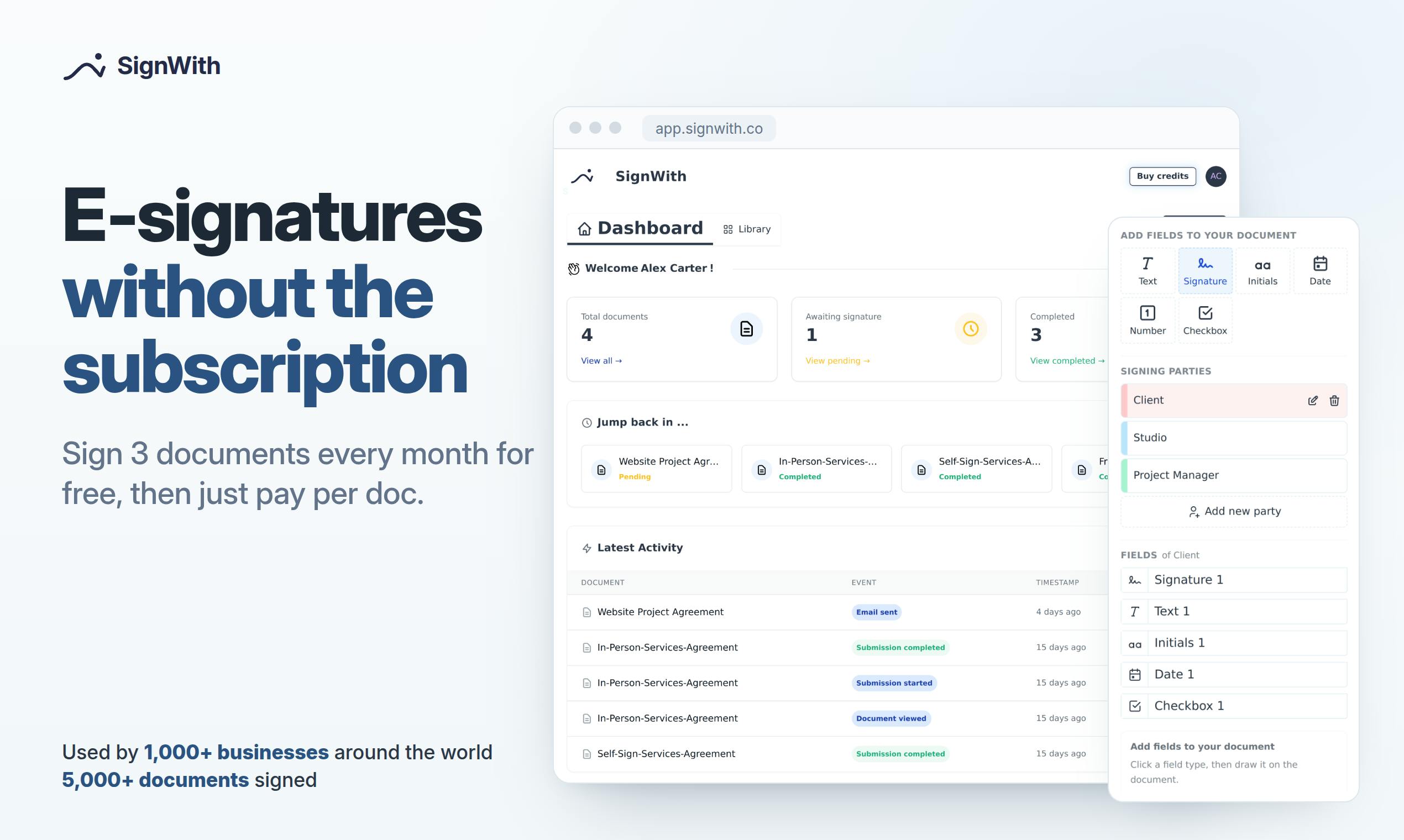
SignWith is an e-signature tool that ranked 3rd on Product Hunt with 137 upvotes. It breaks the subscription model dominated by Adobe Sign and DocuSign, offering 3 free documents per month and one-time credit packs starting at $9. It provides enterprise-grade features like signing order, email OTP verification, audit trails, and completion certificates, plus MCP integration for initiating signing directly in Claude and ChatGPT.
A New Option in the E-Signature Market
E-signature tools have long been dominated by subscription models. Platforms like Adobe Sign and DocuSign charge monthly fees, and the charges keep coming whether or not users actually need to sign documents that month. For small teams, freelancers, or indie developers who only occasionally need to sign contracts, this model doesn't make financial sense. SignWith launched on Product Hunt with a "no subscription, pay-per-document" positioning, earning 137 upvotes and ranking 3rd — a reflection of genuine market demand for flexible pricing.
An e-signature (electronic signature) refers to completing the signing and confirmation of an electronic document through electronic means, with its legal validity resting on different foundations across various jurisdictions. In the United States, the Electronic Signatures in Global and National Commerce Act (ESIGN Act), which took effect in 2000, along with the Uniform Electronic Transactions Act (UETA) adopted by the vast majority of states, together establish that electronic signatures hold the same legal standing as handwritten signatures. In the European Union, the eIDAS regulation classifies electronic signatures into three tiers — simple, advanced, and qualified — with the Qualified Electronic Signature (QES) carrying the highest legal weight. The reason mainstream platforms like DocuSign and Adobe Sign are widely accepted by enterprises is precisely that their audit trails, identity verification, and completion certificates can satisfy the evidentiary requirements of the above regulations regarding "signing intent," "signer identity," and "record integrity." It should be noted that e-signatures are not applicable to all documents — wills, certain real estate transactions, and specific judicial proceeding documents typically still require paper signing or notarization.
Pricing Model: Use for Free First, Then Pay as Needed
SignWith's pricing logic directly addresses the pain points of subscription models. Each account can sign 3 documents for free per month, with additional documents purchased through one-time credit packs starting at $9. This means low-frequency users can complete their daily signing tasks at virtually no cost, while high-frequency users only pay for what they actually use.
This model is similar to the pay-as-you-go approach of early cloud computing — pay for what you use, rather than prepaying a fixed fee for "potential usage." For scenarios with fluctuating signing needs (such as quarterly contract signing bursts), pay-per-document is clearly more sensible than a monthly package.
Core Features Cover Enterprise-Level Needs
Despite its flexible pricing, SignWith doesn't cut corners on features. Every account includes the following capabilities:
- Signing order: Supports multiple signers signing in sequence, suitable for contract workflows requiring tiered approvals
- Email OTP verification: Verifies signer identity through one-time passwords, enhancing signing security
- Audit trail: Fully records document views, signing times, and operation history
- Completion certificate: Generates a legally effective certificate file upon signing completion
This combination of features covers the basic requirements of e-signatures at the legal compliance level, which is sufficient for small and medium-sized businesses and independent professionals.
MCP Integration: Initiate Signing Directly in Claude and ChatGPT
SignWith's most differentiated capability lies in its MCP (Model Context Protocol) integration. Users can not only send documents through the app interface or API, but also initiate signing workflows directly within AI assistants like Claude and ChatGPT.
This design follows the trend of AI assistants gradually becoming work entry points. When users are discussing contract terms with an AI, they can directly complete the action of sending for signature through conversation, without switching to another tool. For teams that have already embedded AI assistants into their daily workflows, this seamless connection can reduce the efficiency loss caused by context switching.
From a product strategy perspective, MCP integration is also the key to SignWith establishing differentiation in an e-signature market dominated by giants — it doesn't attempt to compete head-on with DocuSign on feature depth, but instead chooses to stake a position in the emerging scenario of AI workflows.
MCP (Model Context Protocol) was released by Anthropic in late 2024. It is an open standard designed to let AI assistants connect to external tools and data sources in a unified way. Its basic architecture consists of MCP hosts (such as Claude Desktop, ChatGPT, and other clients), MCP servers (server-side services that encapsulate specific capabilities), and a standardized communication layer between them. Before MCP emerged, integrating each external service often required writing dedicated plugins or function call definitions separately for different AI platforms; MCP, through unified tool descriptions, resource reading, and prompt template interfaces, allows the same server to be reused by multiple AI clients. For SaaS products like SignWith, implementing a single MCP server enables serving Claude, ChatGPT, and other compatible clients simultaneously, significantly reducing distribution costs — which is also the technical prerequisite for its ability to quickly stake a position in AI workflows.
The Evaluation Criteria for E-Signature Tools Are Changing
SignWith's emergence illustrates a trend: the competitive dimension for tool-type SaaS is shifting from "who has more features" to "who has lower barriers to use and more flexible billing." When basic features have become highly commoditized, pricing models and integration capabilities become key factors in user choice.
For developers and small teams, the API and MCP access methods provided by SignWith lower the cost of embedding e-signature capabilities into their own systems. If it can maintain transparency in credit pack pricing and API call limits going forward, it has the opportunity to gain a stable user base in the long-tail market.
One-line Summary
SignWith enters the e-signature market with pay-per-document pricing and MCP integration, challenging the industry's subscription convention.
Paragraph Summary
SignWith is an e-signature tool that earned 137 upvotes and ranked 3rd on Product Hunt. Its core selling point is breaking the subscription model long dominated by platforms like Adobe Sign and DocuSign, replacing it with a pay-per-document plan offering 3 free documents per month and one-time credit packs starting at $9 for additional documents. On the feature side, it doesn't skimp due to flexible pricing, still providing enterprise-grade capabilities such as signing order, email OTP verification, audit trails, and completion certificates. Its most differentiated aspect is MCP integration, allowing users to initiate signing workflows directly within AI assistants like Claude and ChatGPT without switching tools. The article argues this reflects how the competitive dimension for tool-type SaaS is shifting from feature quantity to usage barriers and billing flexibility.
Related articles

Chain of Thought Isn't Just for AI: How Humans Can Use CoT to Improve Thinking Quality
Chain of Thought isn't just a prompt trick for large models. Starting from a Hacker News discussion, this article analyzes why CoT works for human thinking too, breaks down actionable ways to transfer it, and highlights the key differences between human CoT and machine CoT.
Cloudflare Teams Up with OpenAI: Closi…
Cloudflare Teams Up with OpenAI: Closing the Loop from Vulnerability Discovery to Defense with AI
Cloudflare uses OpenAI Daybreak to investigate security vulnerabilities and generate reviewable remediation plans, while developers use Codex to boost coding efficiency and quality.

Orca Multi-Agent Orchestration in Practice: A Guide to Parallel Collaboration with Claude and Codex
Orca is Stable AI's free open-source agent workbench supporting 34 agents like Claude Code and Codex in parallel. Learn its Git worktree isolation, multi-model orchestration, and mobile management.