siift: Turning AI Startup Noise into Actionable Business Decisions
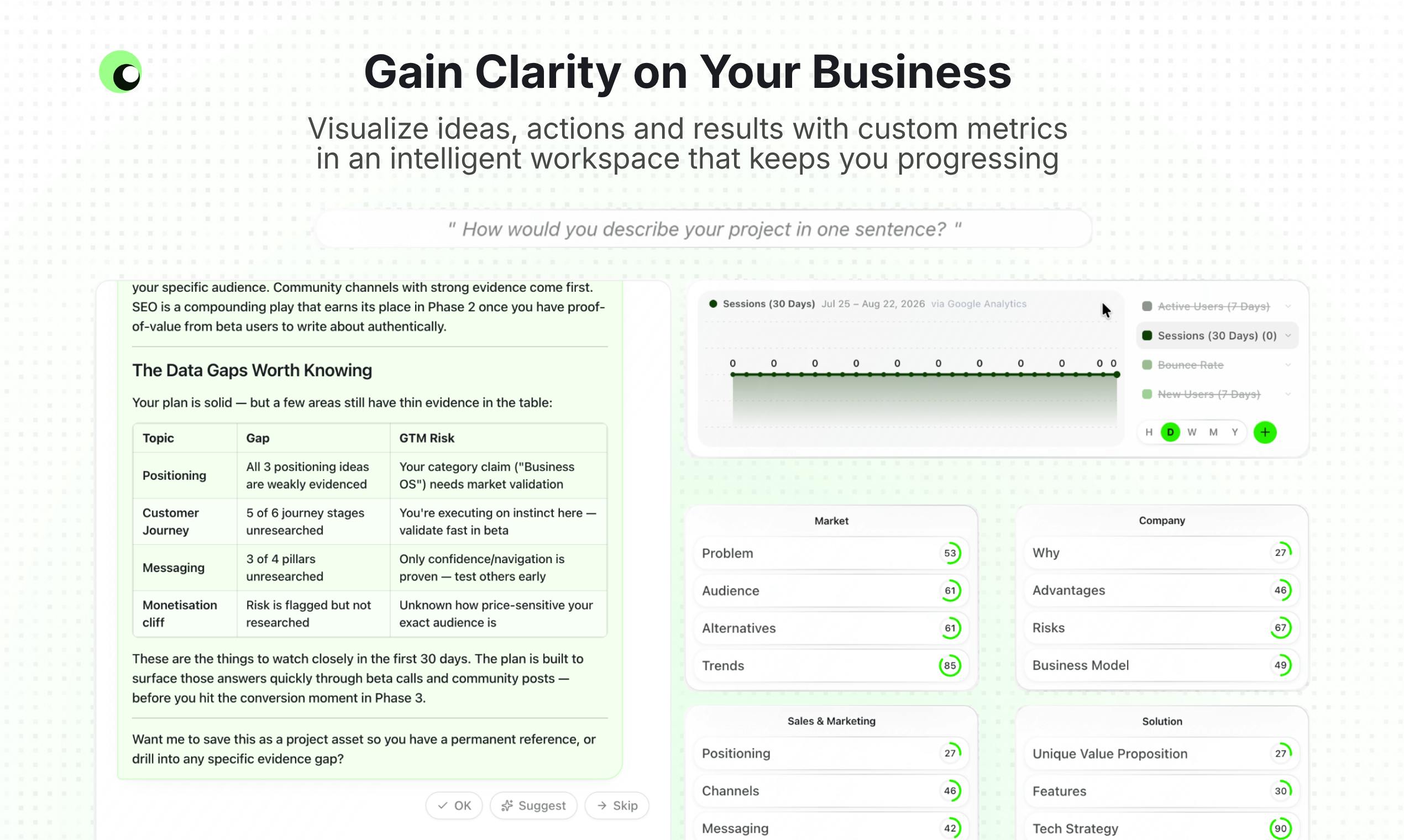
siift consolidates fragmented AI conversations into a living business map to help founders make better decisions.
siift is an AI startup tool that just debuted at #4 on Product Hunt, aiming to consolidate scattered AI chats, tool recommendations, and business information into a single "living business map." It covers the full journey from idea validation and build strategy to GTM and growth. Its key differentiators are persistent business context accumulation and built-in structured methodology frameworks — plus a focus on challenging user assumptions and identifying risks as an AI advisor rather than a mere assistant.
In an era overflowing with AI tools, building a business with AI can paradoxically create a new kind of chaos — scattered conversation logs, an ever-growing stack of tools, and contradictory advice that makes it harder than ever to know what to do next. siift, a new product that just launched on Product Hunt and climbed to #4 on the daily leaderboard (152 upvotes, 8 comments), is trying to solve exactly this problem: turning "AI noise" into better business decisions.
What Problem Does siift Actually Solve?
siift's core proposition is a single line: Turn AI noise into better business decisions.
The premise is concrete. When you're using ChatGPT, various SaaS tools, and documents to push a business forward, information ends up fragmented — today you're discussing pricing strategy in one chat, tomorrow you're running user research in another tool, and the day after you're drowning in conflicting recommendations. Each piece has value on its own, but none of it adds up to a complete picture. Founders end up making decisions on gut feel.
What siift wants to do is connect those scattered strategies, pieces of evidence, decisions, and outcomes into a single place — forming a living map of your business. In other words, it's not just another AI chat box; it's trying to serve as the central hub for your business context.
Full-Funnel Coverage from Validation to Growth
According to its official description, siift covers a fairly complete set of business stages: from early-stage validation and build strategy, all the way through GTM (go-to-market) and growth.
Its operating logic rests on two pillars:
- Evolving business context: siift accumulates the history of your business rather than starting from scratch every conversation. This is the key differentiator from general-purpose chat tools — which have no ability to retain a holistic picture of your business.
- Proven processes: The product claims to have built-in, validated business process frameworks to guide decision-making, rather than simply generating text.
Building on these two foundations, siift claims to do three things: challenge your assumptions, identify risks, and help you focus on what matters next.
"Challenging Assumptions" Is the Real Differentiator
Most AI tools tend to follow the user's lead, which makes them easy to turn into echo chambers. siift emphasizes proactively questioning founders' assumptions and surfacing potential risks — positioning itself closer to an "AI advisor" than an "AI assistant." For early-stage founders, a tool that's willing to push back and point out blind spots is theoretically far more valuable than one that simply agrees.
On the Echo Chamber Effect: The echo chamber problem is especially pronounced with AI tools. Because one of the training objectives of large language models is to generate outputs that users expect, they naturally tend to reinforce rather than challenge existing beliefs. In a startup context, this can be dangerously misleading — the more convinced a founder is about a direction, the more the AI will help find reasons to support it, until resources run dry and the core assumption turns out to be wrong. This is precisely why "Assumption Testing" is a central step in Lean Startup methodology: before committing significant resources, you validate the most critical unknowns at the lowest possible cost. A truly valuable AI advisor tool should have this "reverse questioning" capability built in — proactively asking "what makes you think users actually have this need?" or "what happens if this assumption is wrong?" — rather than helping users dress up unvalidated ideas in more polished language.
On GTM: Go-To-Market (GTM) refers to the complete commercialization roadmap for getting a product from development to its target users — covering key decisions like customer definition, pricing model, sales channels, and marketing messaging. For early-stage founders, GTM is often the hardest leap from "building a product" to "running a business." Technical or feature-level problems usually have clear answers, but GTM decisions are heavily dependent on market judgment, competitive dynamics, and resource constraints — with high error costs and limited ability to course-correct quickly. siift's inclusion of GTM in its coverage means it's positioning itself not just for the pre-product idea validation phase, but also for structured support during commercial launch. This end-to-end ambition is both the product's standout feature and a promise that requires a sufficiently robust methodology to deliver on.
Positioning Analysis: AI Co-Pilot for Startups, or Just Another Wrapper?
On Product Hunt, siift is categorized under Productivity, Artificial Intelligence, and Business, with a maker team that includes Caleb Tristan and others.
From a product logic standpoint, siift has landed on a genuine need: AI has lowered the barrier to execution, but raised the bar for decision quality. When anyone can use AI to rapidly produce plans and strategies, the real bottleneck becomes how to filter, validate, and prioritize. siift positions itself as the solution to that bottleneck.
That said, a few risks deserve sober consideration:
- The "living map" depends on data accumulation. The richer the context, the more precise the guidance — but that also means the cold-start experience may be limited.
- The actual content of "proven processes" remains opaque. Whether the methodology is genuinely validated and which industries it covers can't be determined from the product page alone.
- The moat question against general-purpose LLMs. As tools like ChatGPT continue to strengthen their memory and context capabilities, siift will need to prove that its structured business processes are irreplaceable.
On the "Wrapper" Problem: In the AI product context, a "wrapper" specifically refers to applications that add little more than a prompt layer or UI on top of a general-purpose LLM API, with no independent technical defensibility. The core risk for these products: once the underlying model natively supports the same functionality (like OpenAI rolling out memory features or Projects), the differentiation disappears. For siift to escape the wrapper label, it needs to demonstrate that its value comes from something beyond the model itself — such as a structured business process framework, cross-session context management mechanisms, or domain-specific knowledge graphs. This is the essence of the "moat question" raised above: a real moat isn't about "using AI" — it's about the layer of business logic and accumulated data sitting on top of AI that model providers can't easily replicate.
Closing Thoughts
siift represents one direction AI applications are evolving: from "generating content" toward "supporting decisions." It's trying to answer an increasingly common question — when AI makes doing things cheap, how do you ensure you're doing the right things?
For anyone currently stitching together a startup workflow across a pile of tools, the idea of "consolidating noise into a single business map" is worth paying attention to. But whether siift is a true AI co-pilot for founders, or just another polished workflow wrapper, remains to be proven in actual use. Its Product Hunt performance (#4 for the day) does suggest this direction has struck a nerve with a meaningful number of people.
Related articles

DeepSeek Speaks Japanese: Observations on Natural Multilingual Interaction
A Bilibili demo shows DeepSeek conversing naturally in Japanese — with proper honorifics, emotional roleplay, and Chinese–Japanese switching. Here's what it means.
From Solo to Team Player: The Journey of an AI/LLM Self-Learner
A CSE student with LLM, RAG, AI Agent, MCP, and LangChain skills seeks mentorship and team experience. Exploring how AI self-learners can transition from solo to collaborative engineering.
Jev: A New Frontier Model Claiming 40–400x Lower Cost and 20–200x Faster Inference
New frontier model Jev claims 40–400x lower cost and 20–200x faster inference. We break down the efficiency claims, likely technical approaches, and how to evaluate them.