Simulation-Driven Agentic VLM Framework: Solving the Data Scarcity Problem in Wildfire Monitoring

Low-cost 2D wildfire simulations auto-generate physically labeled videos for training-free multi-agent VLM wildfire monitoring.
This arXiv study addresses the critical challenge of scarce real-world physical annotations in wildfire monitoring by proposing a simulation-driven VLM framework. It converts 2D wildfire simulations into low-detail 3D proxies via Blender mapping, then enriches them with controllable video generation — automatically preserving simulator physics labels throughout. The resulting videos and labels form a multimodal memory store for a training-free multi-agent VLM system. Video memory achieves 51.5% four-label accuracy versus 22.6% for direct VLM querying, with the full system reaching 77.3% across six report fields, validated through ablation studies, cross-generator tests, and three real UAV evaluations.
The Core Contradiction in Wildfire Monitoring: Visual Evidence vs. Physical Dynamics
Effective wildfire monitoring is fundamentally a cross-modal task — it requires correlating visual evidence captured by cameras or drones with the physical dynamics driving fire spread (terrain, fuel distribution, wind direction, fire intensity). The harsh reality is that real-world videos with synchronized physical annotations are extremely scarce, while high-fidelity 3D fire simulation rendering is prohibitively expensive.
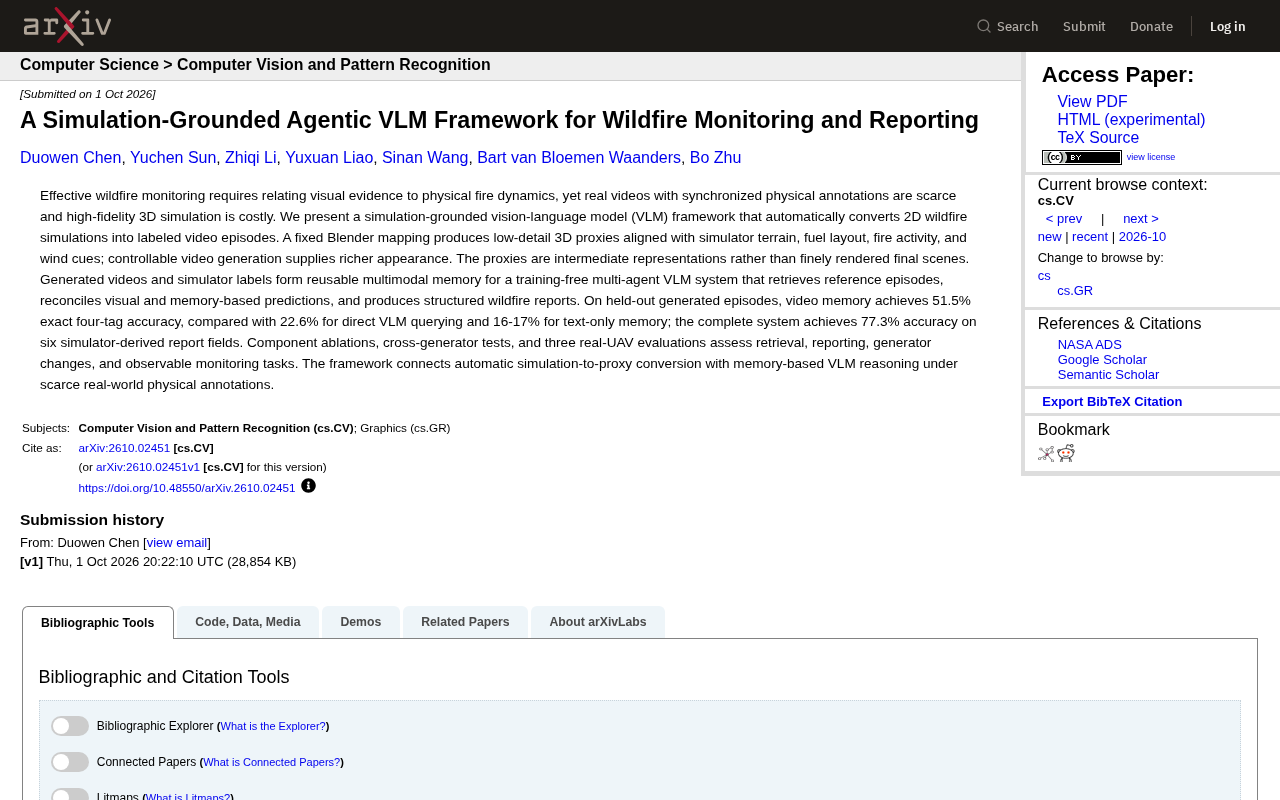
This data gap makes traditional supervised learning approaches unsustainable. A new study recently published on arXiv (arXiv:2610.02451) proposes a novel solution: a simulation-driven Vision-Language Model (VLM) framework that sidesteps the dependency on real annotated data by automatically converting low-cost 2D wildfire simulations into labeled video clips, then using a multi-agent reasoning system to generate structured fire reports.
From 2D Simulation to 3D Proxy: A Low-Cost Data Pipeline
The first key component of this framework is converting inexpensive 2D wildfire simulations into video material that models can learn from. The researchers employ a fixed Blender mapping pipeline to align terrain, fuel layout, fire activity, and wind cues from the simulator, producing low-detail 3D proxies.
There's an interesting design philosophy worth noting here: these 3D proxies are not meticulously rendered final scenes — they exist as intermediate representations. In other words, the framework doesn't pursue photorealistic visuals; instead, it seeks a balance between the physical accuracy of simulation and the cost of generation. Controllable video generation techniques then enrich these rough proxies with additional visual detail.
This two-stage pipeline — "simulation as the foundation, generation for polish" — preserves the precise physical labels that simulation data naturally carries while avoiding the computational burden of high-fidelity 3D rendering. It offers a scalable data production pathway for data-scarce scenarios.
The Blender mapping pipeline uses the open-source 3D creation software Blender to project flat data from 2D simulator outputs (terrain elevation, fuel density distribution, fireline position, wind direction vectors, etc.) into three-dimensional space, generating renderable scene proxies. The core value of this step lies in "information inheritance": 2D simulators (such as FARSITE and Phoenix) already embed validated physical equations, so their outputs naturally carry precise combustion dynamics labels. By preserving these labels through fixed mapping rules into the 3D proxy, the subsequently generated video clips automatically receive free physical annotations — no frame-by-frame manual verification required. The deliberate trade-off of "low-detail proxies" stems from an engineering reality: high-fidelity fire rendering requires simulating particle systems, volumetric smoke, dynamic lighting, and other computationally intensive effects, with single-frame render times reaching hours. Rough proxies only need to retain geometric outlines and motion trends, compressing rendering costs by orders of magnitude and making large-scale data production feasible under limited compute.
Multimodal Memory + Training-Free Multi-Agent System: An Elegant Reasoning Design
The generated videos and simulator labels together form a reusable multimodal memory store, supporting a training-free multi-agent VLM system.
This system operates in three steps: retrieve reference clips, reconcile visual predictions with memory-based predictions, and produce a structured wildfire report. The training-free nature means it doesn't need task-specific fine-tuning — instead, it relies on memory retrieval and multi-agent collaboration for inference. This is particularly practical under the real-world constraint of scarce annotated data.
Key Results: Significant Gains from Memory Retrieval
The experimental results are compelling. On held-out generated clip tests:
- The video memory approach achieved 51.5% four-label exact-match accuracy;
- By comparison, direct VLM querying achieved only 22.6%;
- Text-only memory performed even lower, at just 16%–17%.
Video memory more than doubled the accuracy of direct querying, clearly demonstrating that incorporating visual memory into the reasoning loop is critical for cross-modal physical inference. The complete system further achieved 77.3% accuracy across six simulator-derived report fields.
The underlying logic of the training-free multi-agent VLM system closely resembles Retrieval-Augmented Generation (RAG) extended to the visual domain. Traditional fine-tuning requires large numbers of labeled samples to "burn" task knowledge into model weights; the memory retrieval approach instead externalizes knowledge to a database, dynamically retrieving the most relevant reference cases at inference time. Multiple specialized agents then handle sub-tasks such as "visual perception," "physical inference," and "report writing," with the final output integrated through negotiation or voting mechanisms. This design offers dual advantages: the memory store can be expanded with new simulation clips at any time without retraining the model, and the prediction reconciliation process between agents naturally provides an uncertainty estimation mechanism — when visual predictions and memory predictions are highly consistent, output confidence is higher; otherwise, human review can be triggered. This is especially important for safety-critical emergency response scenarios.
Beyond Simulation: Three Real-World UAV Evaluations
The most common criticism of simulation-based frameworks is whether they transfer to the real world. This study conducts relatively thorough validation, including component ablation experiments, cross-generator testing, and three real-world UAV evaluations.
These evaluations examine retrieval capability, report generation quality, robustness after generator replacement, and observable performance on monitoring tasks. Cross-generator testing is particularly important — it answers the question of whether the framework is overly dependent on a specific video generation model — while the real UAV evaluations directly probe the sim-to-real generalization gap.
Although the paper's abstract does not disclose specific numerical results for real-world scenarios, this multi-dimensional validation design reflects the researchers' clear-eyed awareness of the classic "train in simulation, deploy in reality" challenge.
Sim-to-Real transfer is the core challenge for frameworks of this type. Simulation-generated videos, even after visual detail enrichment by generative models, still exhibit distribution gaps from real drone footage — including lens distortion, motion blur, smoke occlusion, lighting variation, and unstructured real-world terrain textures. Cross-generator testing estimates overfitting to a specific generation style by swapping video generation models (e.g., from one diffusion model to another); stable performance across different generators suggests the memory retrieval captures physical structural features rather than visual style artifacts. Real UAV evaluations directly confront this distribution gap and represent the most compelling evidence of the framework's practical value. It's worth noting that the UAV platform's own flight attitude, gimbal vibration, and sensor noise can further reduce the discriminability of visual features — which is precisely why validation difficulty in this setting far exceeds that of purely simulated tests.
Value and Limitations: A Pragmatic Path Through Annotation Scarcity
The core contribution of this work lies in connecting automated simulation-to-proxy conversion with memory-based VLM reasoning, constructing a functional monitoring and reporting system under conditions of extreme real-world physical annotation scarcity.
Its significance extends beyond wildfire scenarios. Any domain facing the tension between "complex physical processes, expensive real-world annotation, and relatively cheap simulation" — flood monitoring, storm tracking, industrial accident surveillance, and more — could draw inspiration from this paradigm of "simulation-generated data + training-free multi-agent memory reasoning."
Of course, the limitations are equally apparent. The visual appearance gap between low-detail 3D proxies and real fire scenes, the artifacts that generated videos may introduce, and the fact that 77.3% accuracy still falls short of the reliability required for real emergency decision-making all represent challenges that need to be overcome. But as a methodological exploration, it offers a valuable reference for building multimodal AI systems in data-scarce environments.
Related articles

Chain of Thought Isn't Just for AI: How Humans Can Use CoT to Improve Thinking Quality
Chain of Thought isn't just a prompt trick for large models. Starting from a Hacker News discussion, this article analyzes why CoT works for human thinking too, breaks down actionable ways to transfer it, and highlights the key differences between human CoT and machine CoT.
Cloudflare Teams Up with OpenAI: Closi…
Cloudflare Teams Up with OpenAI: Closing the Loop from Vulnerability Discovery to Defense with AI
Cloudflare uses OpenAI Daybreak to investigate security vulnerabilities and generate reviewable remediation plans, while developers use Codex to boost coding efficiency and quality.

Orca Multi-Agent Orchestration in Practice: A Guide to Parallel Collaboration with Claude and Codex
Orca is Stable AI's free open-source agent workbench supporting 34 agents like Claude Code and Codex in parallel. Learn its Git worktree isolation, multi-model orchestration, and mobile management.